
Entry
Reader's guide
Entries A-Z
Subject index
Veterans
Most societies consider veterans of military service a special subgroup by virtue of the sacrifices they have made and the often extraordinary risks they have incurred in defense of their nation. As a result, governments make particular benefits and services available to them and the public takes responsibility for assuring the well-being of this special group of citizens. It is thus a matter of concern that veterans are represented in great numbers among homeless Americans.
Risk Factors for Veteran Homelessness
The first national study of homelessness among U.S. veterans was based on survey data gathered in 1987. Forty percent of homeless men reported past military service, compared with only 34 percent of men in the general population. Further analyses confirmed that veterans were 1.4 times as likely to be homeless as other men, and that approximately 200,000 were homeless on any given night.
By far the greatest risk of homelessness was among those who served in the post-Vietnam all-volunteer army from 1972 to 1980. These men were about four times as likely to be homeless as their non-veteran peers. In contrast, veterans in the age group that served during the Vietnam period were only 1.4 times as likely, matching the overall average. World War II–era veterans had a slightly lower rate: They were only nine-tenths as likely to be homeless as non-veterans. These data indicate that combat exposure is not the strongest determinant of homelessness among veterans of various war eras; indeed, post-Vietnam veterans had the least combat exposure but the greatest risk of homelessness. Rather, the key factors seem to be related to their premilitary experience and status. World War II veterans are a highly representative cross-section of their age group in the society at large. So are Vietnam veterans, partly because of deliberate policies to make the draft as fair as possible. In contrast, veterans of the all-volunteer force have been shown to have more psychiatric and substance abuse disorders than non-veterans in their age group. Many seem to have entered the military because they lacked desirable options in the civilian labor market. Moreover, negative public opinion on the Vietnam conflict made military service unpopular and recruiters could not be selective in the post-Vietnam era.
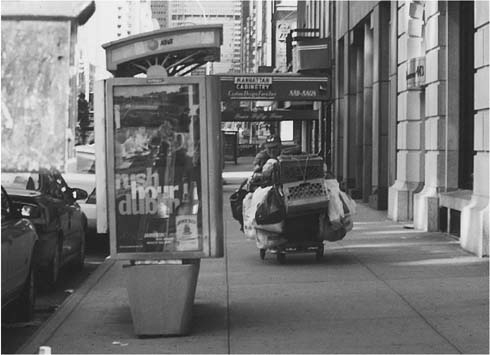
A homeless veteran makes his away along a street in midtown Manhattan in October 2003 with his possessions piled in a grocery cart
This finding was replicated in two subsequent studies, one based on data from the Shelter-night survey in the 1990 census, the other on a 1996 national survey. While the gap has diminished, veterans are still twice as likely as non-veterans to be homeless, by these measures of the 1990s. This risk is far higher than was observed among veterans of the Vietnam era and before.
Vietnam Service and Posttraumatic Stress Disorder
These findings seem counterintuitive to many homeless service providers who assist Vietnam veterans suffering from posttraumatic stress disorder (PTSD). A number of studies have found that while there are high rates of Vietnam service and PTSD among those who are homeless, these rates are no higher than those found in non-homeless, low-income veterans. Available data indicate that among veterans, just as among other men, the antecedents of homelessness include poverty, social isolation, and substance abuse. Thus Vietnam military service does not seem to be an especially strong predictor of homelessness, although it is quite common among homeless men.
...
- Causes
- Cities
- Demography and Characteristics
- Health Issues
- History
- Housing
- Legal Issues, Advocacy, and Policy
- Lifestyle Issues
- Appendix 3: Directory of Street Newspapers
- Child Care
- Child Support
- Criminal Activity and Policing
- Encampments, Urban
- Libraries: Issues in Serving the Homeless
- Mobility
- Panhandling
- Parenting
- Prostitution
- Shelters
- Single-Room Occupancy Hotels
- Social Support
- Soup Kitchens
- Street Newspapers
- Survival Strategies
- Work on the Streets
- Organizations
- American Bar Association Commission on Homelessness and Poverty
- Association of Gospel Rescue Missions
- Corporation for Supportive Housing
- European Network for Housing Research
- FEANTSA
- Goodwill Industries International
- Homeless International
- International Network of Street Newspapers
- International Union of Tenants
- National Alliance to End Homelessness
- National Center on Family Homelessness
- National Coalition for the Homeless
- National Resource Center on Homelessness and Mental Illness
- Salvation Army
- UN-HABITAT
- Urban Institute
- Wilder Research Center
- Perceptions of Homelessness
- Appendix 1: Bibliography of Autobiographical and Fictional Accounts of Homelessness
- Appendix 2: Filmography of American Narrative and Documentary Films on Homelessness
- Autobiography and Memoir, Contemporary Homelessness
- Images of Homelessness in Contemporary Documentary Film
- Images of Homelessness in Narrative Film, History of
- Images of Homelessness in Nineteenth- and Twentieth-Century America
- Images of Homelessness in the Media
- Literature, Hobo and Tramp
- Photography
- Public Opinion
- Populations
- Research
- Service Systems and Settings
- “Housing First” Approach
- Assertive Community Treatment (ACT)
- Case Management
- Children, Education of
- Continuum of Care
- Family Separations and Reunifications
- Food Programs
- Foster Care
- Harm Reduction
- Health Care
- Homeless Assistance Services and Networks
- Housing, Transitional
- Interventions, Clinical
- Interventions, Housing
- Mental Health System
- Outreach
- Poorhouses
- Safe Havens
- Self-Help Housing
- Service Integration
- Shelters
- Single-Room Occupancy Hotels
- Soup Kitchens
- Work on the Streets
- Workhouses
- World Perspectives and Issues
- Australia
- Bangladesh
- Brazil
- Calcutta
- Canada
- Copenhagen
- Cuba
- Denmark
- Egypt
- France
- Germany
- Homelessness, International Perspectives on
- Housing and Homelessness in Developing Nations
- Indonesia
- Italy
- Japan
- London
- Montreal
- Mumbai (Bombay)
- Nairobi
- Netherlands
- Nigeria
- Paris
- Russia
- South Africa
- Spain
- Sweden
- Sydney
- Tokyo
- Toronto
- United Kingdom
- United Kingdom, Rural
- Zimbabwe
- Loading...
Get a 30 day FREE TRIAL
-
 Watch videos from a variety of sources bringing classroom topics to life
 -
Read modern, diverse business cases
-
Explore hundreds of books and reference titles

Read next

More like this
Sage Recommends
We found other relevant content for you on other Sage platforms.
Have you created a personal profile? Login or create a profile so that you can save clips, playlists and searches