
Entry
Reader's guide
Entries A-Z
Subject index
United Kingdom
The United Kingdom (U.K.) has established legislation and relatively well-developed service provision in relation to homelessness, and there is an abundance of literature on homelessness dating back as far as the origins of social inquiry into inequality and poverty. Also, the political processes associated with the causes of homelessness in the U.K. are traditionally analyzed according to welfare ideologies and changing political regimes (e.g., Conservative governments of 1979–1997 and the New Labour government post–1997). Given the history of the U.K. welfare state, changes in policies and interventions are an important consideration because they directly and indirectly impact the causes of homelessness.
Defining Homelessness
Homelessness is defined by statute in the U.K. Yet, because of the wide range of issues that may result in the occurrence of homelessness, no single definition has been applied in the literature. Rather, the bulk of the research takes a commonsense approach to defining homelessness. Under such an approach, the circumstances go beyond legal definitions and include (a) rooflessness (i.e., street homelessness or “rough sleeping”); (b) living in emergency/temporary accommodation (hostels or night shelters); (c) living long-term in institutions (other accommodation not available); (d) bed and breakfast or similar accommodation unsuitable for the long term; (e) informal, insecure, and/or impermanent accommodation with friends, or under notice to quit; (f) intolerable physical conditions, including overcrowding; and (g) involuntary sharing (e.g. abusive relationships) (Fitzpatrick et al. 2000). As such, recent emphasis in defining homelessness has focused on place-based definitions, and away from significance-based definitions.
Homelessness and Decentralized Government
Another factor influencing the causes of homelessness is the decentralization of government. Briefly, the United Kingdom of Great Britain and Northern Ireland consists of the four principalities of England, Scotland, Wales, and Northern Ireland, all historically governed centrally from London. Under devolution, or the implementation of autonomous self-governing systems, a Scottish Parliament was created in 1999, followed by National Assemblies for Wales and Northern Ireland (subject to suspension in the light of political change), and a Greater London Assembly. Scotland has always had the greatest degree of autonomy from London, and this is increasingly the case in post-devolution. The Welsh and Northern Ireland assemblies have some policy responsibility for housing and have undertaken reviews of homelessness in those principalities, causing the role of regional government to play an important part in determining access to housing and support services.
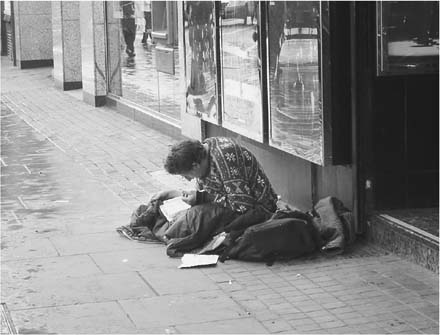
A homeless young man writing in his personal journal on a London street in July 2003
General and National Trends
In response to the increase in homelessness in the 1980s, a number of large-scale studies explored the nature and causes of homelessness in the U.K. For example, in national studies of homelessness, Anderson, Kemp and Quilgars (1993), Drake, O'Brien and Biebuyck (1981), Niner (1989), and O'Callaghan et al. (1996) have demonstrated that the single most common characteristic is poverty. Other smaller-scale studies have been conducted, and the patterns emerging have supported those reported in the large-scale investigations (Fitzpatrick et al. 2000).
Subpopulations
More recently, there has been a trend toward exploring subpopulations of homelessness. This results, in part, from research investigating changes in the composition of the population. Main subpopulations explored include family and youth homelessness, street homelessness (rooflessness) and rural homelessness. It should be noted that factors causing homelessness across these groups differ somewhat in scope and nature.
...
- Causes
- Cities
- Demography and Characteristics
- Health Issues
- History
- Housing
- Legal Issues, Advocacy, and Policy
- Lifestyle Issues
- Appendix 3: Directory of Street Newspapers
- Child Care
- Child Support
- Criminal Activity and Policing
- Encampments, Urban
- Libraries: Issues in Serving the Homeless
- Mobility
- Panhandling
- Parenting
- Prostitution
- Shelters
- Single-Room Occupancy Hotels
- Social Support
- Soup Kitchens
- Street Newspapers
- Survival Strategies
- Work on the Streets
- Organizations
- American Bar Association Commission on Homelessness and Poverty
- Association of Gospel Rescue Missions
- Corporation for Supportive Housing
- European Network for Housing Research
- FEANTSA
- Goodwill Industries International
- Homeless International
- International Network of Street Newspapers
- International Union of Tenants
- National Alliance to End Homelessness
- National Center on Family Homelessness
- National Coalition for the Homeless
- National Resource Center on Homelessness and Mental Illness
- Salvation Army
- UN-HABITAT
- Urban Institute
- Wilder Research Center
- Perceptions of Homelessness
- Appendix 1: Bibliography of Autobiographical and Fictional Accounts of Homelessness
- Appendix 2: Filmography of American Narrative and Documentary Films on Homelessness
- Autobiography and Memoir, Contemporary Homelessness
- Images of Homelessness in Contemporary Documentary Film
- Images of Homelessness in Narrative Film, History of
- Images of Homelessness in Nineteenth- and Twentieth-Century America
- Images of Homelessness in the Media
- Literature, Hobo and Tramp
- Photography
- Public Opinion
- Populations
- Research
- Service Systems and Settings
- “Housing First” Approach
- Assertive Community Treatment (ACT)
- Case Management
- Children, Education of
- Continuum of Care
- Family Separations and Reunifications
- Food Programs
- Foster Care
- Harm Reduction
- Health Care
- Homeless Assistance Services and Networks
- Housing, Transitional
- Interventions, Clinical
- Interventions, Housing
- Mental Health System
- Outreach
- Poorhouses
- Safe Havens
- Self-Help Housing
- Service Integration
- Shelters
- Single-Room Occupancy Hotels
- Soup Kitchens
- Work on the Streets
- Workhouses
- World Perspectives and Issues
- Australia
- Bangladesh
- Brazil
- Calcutta
- Canada
- Copenhagen
- Cuba
- Denmark
- Egypt
- France
- Germany
- Homelessness, International Perspectives on
- Housing and Homelessness in Developing Nations
- Indonesia
- Italy
- Japan
- London
- Montreal
- Mumbai (Bombay)
- Nairobi
- Netherlands
- Nigeria
- Paris
- Russia
- South Africa
- Spain
- Sweden
- Sydney
- Tokyo
- Toronto
- United Kingdom
- United Kingdom, Rural
- Zimbabwe
- Loading...
Get a 30 day FREE TRIAL
-
 Watch videos from a variety of sources bringing classroom topics to life
 -
Read modern, diverse business cases
-
Explore hundreds of books and reference titles

Read next

More like this
Sage Recommends
We found other relevant content for you on other Sage platforms.
Have you created a personal profile? Login or create a profile so that you can save clips, playlists and searches