
Entry
Reader's guide
Entries A-Z
Subject index
Panhandling
Like homelessness more generally, begging is an ancient phenomenon associated with massive economic and population shifts caused by crop failures and famines, plagues, the aftermath of war and the demobilization of armies, the liberation of slaves, the reorganization of industrial or agricultural production—that is, with upheavals that dislocate people from customary economic roles and leave them destitute and desperate.
In Western societies, beggars have long been perceived as threats to social order because they lived without settled livelihood, frequently wandered and thus turned up as unwanted strangers, and sometimes associated with bandits and thieves. Beginning in roughly the fifteenth century, there were frequent and often brutal attempts to suppress them in England and Europe by arrest, beating, or branding and other forms of mutilation. At the same time, however, in many places disabled or otherwise “helpless” beggars were protected by religious authorities and regarded as proper subjects of charity by those courting divine favor. This led to a variety of ruses invented to arouse public pity and, predictably, to a voluminous literature on the perfidy of beggars that stretches from Martin Luther's famous Liber Vagatorum (The Book of Vagrants), published in 1528, to dozens of articles in twentieth-century popular magazines.
The systematic crackdown on begging in the United States began during the depression of 1873–1878, when legions of freed slaves, excess factory hands, and redundant farm workers took to the roads. Such “tramps,” as they came to be called, worked at a variety of temporary jobs when they could get them, but they often resorted to begging and pilfering. The Charity Organization Societies that flourished in major U.S. cities beginning in the 1880s made suppression of begging a priority, as part of their attempts to prevent the demoralization of the poor. Often, they employed special officers, deputized by local authorities, to warn off beggars or arrest them as vagrants. From the 1870s through the years just before World War I, there were numerous proposals (rarely implemented) in the United States, England, and European countries for the “colonization” of beggars and other vagrants; that is, proposals for their longterm, forced commitment to labor camps.
Like homelessness, public begging in the United States was transformed by the war economy of the 1940s and the rudimentary welfare state established during the Great Depression. Although the sobriety of beggars had been impugned since early in the nineteenth century, by the 1950s begging, like homelessness, was largely segregated in the skid row districts of cities and associated in popular culture with men too dissipated to work. As they had for a century, county jails and to a lesser extent, state mental hospitals, served as temporary sites of confinement and physical rehabilitation for such men (and occasionally, women).
Panhandling takes various forms. Here a man in Covent Garden, London, in July 2003 chalks out an elaborate Buddhist drawing and receives coins from passersby
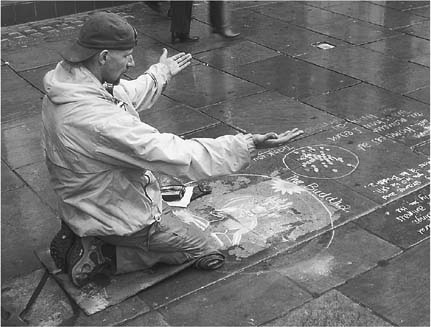
With the spread of mass homelessness in the 1980s, begging, too, reappeared across the American landscape, and familiar complaints about the practice resurfaced. Programs appeared in New York, Philadelphia, Los Angeles, and other cities that encouraged citizens to distribute coupons for charity meals and other services instead of money that could be used to purchase alcohol and other drugs. Ironically, these were nearly identical to programs launched by Victorian charity organizers. And like their predecessors, the anti-begging programs of the 1990s were short-lived. Instead, many cities, including the notoriously liberal enclaves of San Francisco and Berkeley, California, began to refurbish old antibegging ordinances to use as threats, at the least.
...
- Causes
- Cities
- Demography and Characteristics
- Health Issues
- History
- Housing
- Legal Issues, Advocacy, and Policy
- Lifestyle Issues
- Appendix 3: Directory of Street Newspapers
- Child Care
- Child Support
- Criminal Activity and Policing
- Encampments, Urban
- Libraries: Issues in Serving the Homeless
- Mobility
- Panhandling
- Parenting
- Prostitution
- Shelters
- Single-Room Occupancy Hotels
- Social Support
- Soup Kitchens
- Street Newspapers
- Survival Strategies
- Work on the Streets
- Organizations
- American Bar Association Commission on Homelessness and Poverty
- Association of Gospel Rescue Missions
- Corporation for Supportive Housing
- European Network for Housing Research
- FEANTSA
- Goodwill Industries International
- Homeless International
- International Network of Street Newspapers
- International Union of Tenants
- National Alliance to End Homelessness
- National Center on Family Homelessness
- National Coalition for the Homeless
- National Resource Center on Homelessness and Mental Illness
- Salvation Army
- UN-HABITAT
- Urban Institute
- Wilder Research Center
- Perceptions of Homelessness
- Appendix 1: Bibliography of Autobiographical and Fictional Accounts of Homelessness
- Appendix 2: Filmography of American Narrative and Documentary Films on Homelessness
- Autobiography and Memoir, Contemporary Homelessness
- Images of Homelessness in Contemporary Documentary Film
- Images of Homelessness in Narrative Film, History of
- Images of Homelessness in Nineteenth- and Twentieth-Century America
- Images of Homelessness in the Media
- Literature, Hobo and Tramp
- Photography
- Public Opinion
- Populations
- Research
- Service Systems and Settings
- “Housing First” Approach
- Assertive Community Treatment (ACT)
- Case Management
- Children, Education of
- Continuum of Care
- Family Separations and Reunifications
- Food Programs
- Foster Care
- Harm Reduction
- Health Care
- Homeless Assistance Services and Networks
- Housing, Transitional
- Interventions, Clinical
- Interventions, Housing
- Mental Health System
- Outreach
- Poorhouses
- Safe Havens
- Self-Help Housing
- Service Integration
- Shelters
- Single-Room Occupancy Hotels
- Soup Kitchens
- Work on the Streets
- Workhouses
- World Perspectives and Issues
- Australia
- Bangladesh
- Brazil
- Calcutta
- Canada
- Copenhagen
- Cuba
- Denmark
- Egypt
- France
- Germany
- Homelessness, International Perspectives on
- Housing and Homelessness in Developing Nations
- Indonesia
- Italy
- Japan
- London
- Montreal
- Mumbai (Bombay)
- Nairobi
- Netherlands
- Nigeria
- Paris
- Russia
- South Africa
- Spain
- Sweden
- Sydney
- Tokyo
- Toronto
- United Kingdom
- United Kingdom, Rural
- Zimbabwe
- Loading...
Get a 30 day FREE TRIAL
-
 Watch videos from a variety of sources bringing classroom topics to life
 -
Read modern, diverse business cases
-
Explore hundreds of books and reference titles

Read next

More like this
Sage Recommends
We found other relevant content for you on other Sage platforms.
Have you created a personal profile? Login or create a profile so that you can save clips, playlists and searches