
Entry
Reader's guide
Entries A-Z
Subject index
Older Homeless Persons
In the United States, older homeless persons—those age fifty and over—often seem invisible. Public policy generally focuses on younger homeless people or on social categories in which the aging are subsumed without special notice, such as disabled individuals and veterans.
For purposes of studying homeless populations, researchers have set the aging marker at anywhere from age forty to sixty-five. However, a growing consensus holds that the “older homeless” should be defined as age fifty and over. Indeed, at that age, many homeless persons look and act ten to twenty years older.
Although the proportion of older persons among the homeless has declined since the 1980s, their absolute number has grown. (As for the actual percentage of aging Americans who are homeless, estimates vary widely—from about 3 to 28 percent—due to heterodox methods and definitions of aged status.) In any case, the proportion of older homeless persons can be expected to increase dramatically as more baby boomers turn fifty. Thus, with an anticipated doubling of the fifty-and-over population by about 2030, a comparable increase in the number of older homeless persons is likely. The current low estimate of 60,000 would grow to 120,000, while the high estimate of 400,000 would mushroom to 800,000.
Factors Contributing to Homelessness in Older People
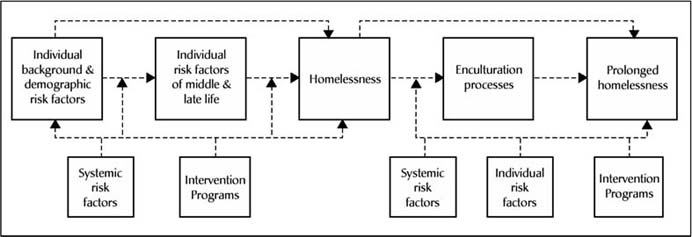
Homelessness generally results from a concurrence of conditions, events, and risk variables. The flow chart in Figure 1 depicts these factors in four categories, summarized below.
- Personal risk factors may accumulate over a lifetime. Except in the case of extremely vulnerable individuals, homelessness is likely to occur only when several of these personal risk factors coexist.
- Systemic factors play a critical role. In most instances, such variables as the availability of lowcost housing and the income to pay for it are the ultimate determinants of homelessness.
- Enculturation factors—that is, a person's adaptation to the street or shelter—may further sustain and prolong homelessness.
- Programmatic factors can prevent or terminate homelessness, depending on the timeliness, quality, and availability of the service intervention.
Individual Risk Factors
The principal risk factors found to increase vulnerability to homelessness among older individuals are described below, based on studies conducted in the period from 1983 to 1998.
Figure 1.Model of Homelessness and Aging
Gender: The ratio of older homeless men to women is approximately 4:1.
Race: African-Americans are overrepresented among older homeless populations—and they are even more so among their younger counterparts.
Fifty to sixty-four age range: Because of the entitlements available to persons at age sixty-five, the risk of homelessness drops at that age. Indeed, the proportion of elders over sixty-five among the homeless is roughly one-fourth of their representation in the general population. Conversely, persons between fifty and sixty-four are overrepresented among the homeless, close to double their representation in the general population.
Extremely low income: Older homeless persons are likely to come from poor or near impoverished backgrounds and to spend their lives in similar economic status. More than three-fifths worked in unskilled or semi-skilled occupations. Median current income is roughly one-half the poverty level.
Disruptive events in youth: About one-fifth of older persons have had disruptive early life events such as the death of parents, placement in foster care, and so forth. Similar rates hold for younger homeless persons as well.
...
- Causes
- Cities
- Demography and Characteristics
- Health Issues
- History
- Housing
- Legal Issues, Advocacy, and Policy
- Lifestyle Issues
- Appendix 3: Directory of Street Newspapers
- Child Care
- Child Support
- Criminal Activity and Policing
- Encampments, Urban
- Libraries: Issues in Serving the Homeless
- Mobility
- Panhandling
- Parenting
- Prostitution
- Shelters
- Single-Room Occupancy Hotels
- Social Support
- Soup Kitchens
- Street Newspapers
- Survival Strategies
- Work on the Streets
- Organizations
- American Bar Association Commission on Homelessness and Poverty
- Association of Gospel Rescue Missions
- Corporation for Supportive Housing
- European Network for Housing Research
- FEANTSA
- Goodwill Industries International
- Homeless International
- International Network of Street Newspapers
- International Union of Tenants
- National Alliance to End Homelessness
- National Center on Family Homelessness
- National Coalition for the Homeless
- National Resource Center on Homelessness and Mental Illness
- Salvation Army
- UN-HABITAT
- Urban Institute
- Wilder Research Center
- Perceptions of Homelessness
- Appendix 1: Bibliography of Autobiographical and Fictional Accounts of Homelessness
- Appendix 2: Filmography of American Narrative and Documentary Films on Homelessness
- Autobiography and Memoir, Contemporary Homelessness
- Images of Homelessness in Contemporary Documentary Film
- Images of Homelessness in Narrative Film, History of
- Images of Homelessness in Nineteenth- and Twentieth-Century America
- Images of Homelessness in the Media
- Literature, Hobo and Tramp
- Photography
- Public Opinion
- Populations
- Research
- Service Systems and Settings
- “Housing First” Approach
- Assertive Community Treatment (ACT)
- Case Management
- Children, Education of
- Continuum of Care
- Family Separations and Reunifications
- Food Programs
- Foster Care
- Harm Reduction
- Health Care
- Homeless Assistance Services and Networks
- Housing, Transitional
- Interventions, Clinical
- Interventions, Housing
- Mental Health System
- Outreach
- Poorhouses
- Safe Havens
- Self-Help Housing
- Service Integration
- Shelters
- Single-Room Occupancy Hotels
- Soup Kitchens
- Work on the Streets
- Workhouses
- World Perspectives and Issues
- Australia
- Bangladesh
- Brazil
- Calcutta
- Canada
- Copenhagen
- Cuba
- Denmark
- Egypt
- France
- Germany
- Homelessness, International Perspectives on
- Housing and Homelessness in Developing Nations
- Indonesia
- Italy
- Japan
- London
- Montreal
- Mumbai (Bombay)
- Nairobi
- Netherlands
- Nigeria
- Paris
- Russia
- South Africa
- Spain
- Sweden
- Sydney
- Tokyo
- Toronto
- United Kingdom
- United Kingdom, Rural
- Zimbabwe
- Loading...
Get a 30 day FREE TRIAL
-
 Watch videos from a variety of sources bringing classroom topics to life
 -
Read modern, diverse business cases
-
Explore hundreds of books and reference titles

Read next

More like this
Sage Recommends
We found other relevant content for you on other Sage platforms.
Have you created a personal profile? Login or create a profile so that you can save clips, playlists and searches