
Entry
Reader's guide
Entries A-Z
Subject index
New York City
From the end of World War II through the mid-1970s, the typical homeless individual in New York City was an older “derelict” man suffering from alcoholism and related problems. Such men typically lived in single-room occupancy (SRO) hotels, flophouses, and missions in the city's Bowery district. Beginning in the middle of the 1970s and greatly accelerating in the 1980s, however, New York's homeless population underwent a substantial transformation.
Following the recession of the early 1980s, thousands of residents found themselves relying on the city for basic shelter. In 1980, New York City sheltered 2,000 people on any given night; a decade later, that number had risen more than tenfold. While the number of people relying on public shelter declined during the economic boom of the 1990s, the period following the events of September 11, 2001, and the subsequent downturn in the economy has seen record increases in the city's homeless population. Still, the official figures can be misleading. Since many people are sheltered only briefly, the number of homeless New Yorkers in any given year far exceeds the number on any single night. Moreover, with hundreds of thousands of city residents marginally housed or living “doubled up” with family and friends, a definition of homelessness that is limited to those living on the streets, in public spaces, and in publicly supported shelters and transitional housing understates the nature of the problem.
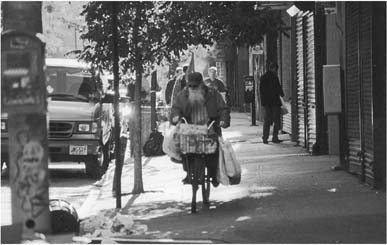
A homeless man on a Sunday morning in October 2003 in the Soho neighborhood of southern Manhattan
While New York City does not have the nation's highest rate of homelessness, it does have the greatest number of homeless people in a given metropolitan area. In 2003, nearly 40,000 were sheltered on any given night. Such figures, however, undercount the number of homeless. Seventy-five percent of shelter users are in families, while many singles do not use the shelter system at all.
Homeless New Yorkers are overwhelmingly African-American or Latino, and most have lived in New York for much, if not all, of their lives. Problems of substance abuse and mental illness are common among homeless singles, especially women and the long-term homeless; such problems are less prevalent among those in families.
Causes
Although several factors contributed to the rise in homelessness in the 1980s, the economic downturn was one primary cause. Another was the decline in purchasing power among the poor, due to wages and public benefits that did not keep pace with rising housing costs. Changes in federal legislation left many previously eligible New Yorkers ineligible for welfare, food stamps, and Social Security disability payments.
Furthermore, the availability of low-cost housing units declined. Changes in city policies resulted in the loss of SRO housing. Arson and abandonment further reduced availability and also resulted in the city becoming landlord to thousands of rental units. New construction of federally funded public housing projects ceased. Publicly supported housing, in the form of the New York City Housing Authority, had a ten-year waiting list. The federal Section 8 housing program was greatly scaled back in the 1980s. The vacancy rate for low-rent units was less than 2 percent throughout this period.
...
- Causes
- Cities
- Demography and Characteristics
- Health Issues
- History
- Housing
- Legal Issues, Advocacy, and Policy
- Lifestyle Issues
- Appendix 3: Directory of Street Newspapers
- Child Care
- Child Support
- Criminal Activity and Policing
- Encampments, Urban
- Libraries: Issues in Serving the Homeless
- Mobility
- Panhandling
- Parenting
- Prostitution
- Shelters
- Single-Room Occupancy Hotels
- Social Support
- Soup Kitchens
- Street Newspapers
- Survival Strategies
- Work on the Streets
- Organizations
- American Bar Association Commission on Homelessness and Poverty
- Association of Gospel Rescue Missions
- Corporation for Supportive Housing
- European Network for Housing Research
- FEANTSA
- Goodwill Industries International
- Homeless International
- International Network of Street Newspapers
- International Union of Tenants
- National Alliance to End Homelessness
- National Center on Family Homelessness
- National Coalition for the Homeless
- National Resource Center on Homelessness and Mental Illness
- Salvation Army
- UN-HABITAT
- Urban Institute
- Wilder Research Center
- Perceptions of Homelessness
- Appendix 1: Bibliography of Autobiographical and Fictional Accounts of Homelessness
- Appendix 2: Filmography of American Narrative and Documentary Films on Homelessness
- Autobiography and Memoir, Contemporary Homelessness
- Images of Homelessness in Contemporary Documentary Film
- Images of Homelessness in Narrative Film, History of
- Images of Homelessness in Nineteenth- and Twentieth-Century America
- Images of Homelessness in the Media
- Literature, Hobo and Tramp
- Photography
- Public Opinion
- Populations
- Research
- Service Systems and Settings
- “Housing First” Approach
- Assertive Community Treatment (ACT)
- Case Management
- Children, Education of
- Continuum of Care
- Family Separations and Reunifications
- Food Programs
- Foster Care
- Harm Reduction
- Health Care
- Homeless Assistance Services and Networks
- Housing, Transitional
- Interventions, Clinical
- Interventions, Housing
- Mental Health System
- Outreach
- Poorhouses
- Safe Havens
- Self-Help Housing
- Service Integration
- Shelters
- Single-Room Occupancy Hotels
- Soup Kitchens
- Work on the Streets
- Workhouses
- World Perspectives and Issues
- Australia
- Bangladesh
- Brazil
- Calcutta
- Canada
- Copenhagen
- Cuba
- Denmark
- Egypt
- France
- Germany
- Homelessness, International Perspectives on
- Housing and Homelessness in Developing Nations
- Indonesia
- Italy
- Japan
- London
- Montreal
- Mumbai (Bombay)
- Nairobi
- Netherlands
- Nigeria
- Paris
- Russia
- South Africa
- Spain
- Sweden
- Sydney
- Tokyo
- Toronto
- United Kingdom
- United Kingdom, Rural
- Zimbabwe
- Loading...
Get a 30 day FREE TRIAL
-
 Watch videos from a variety of sources bringing classroom topics to life
 -
Read modern, diverse business cases
-
Explore hundreds of books and reference titles

Read next

More like this
Sage Recommends
We found other relevant content for you on other Sage platforms.
Have you created a personal profile? Login or create a profile so that you can save clips, playlists and searches