
Entry
Reader's guide
Entries A-Z
Subject index
Japan
In contemporary Japan, the word homuresu, derived from English, is the most commonly used term to refer to people who inhabit public spaces such as parks, train and subway stations, riversides, and shopping districts. The term came into use as unhoused people became more visible with the deepening of the Great Heisei Recession—the stagnation following the burst of Japan's economic bubble in 1992. The use of homuresu in the media, academia, and common conversation has replaced the somewhat more derogatory furosha (“wanderer”) or runpen (“bum”) used previously. However, noting the stereotype of America's homeless as lazy substance abusers who deplete public resources, many social science researchers, activists, and journalists in Japan have come to use the more precise terms of nojukusha (“person who sleeps outside”) and nojuku roudousha (“laborer who sleeps outside”).
Homelessness in Post–World War II Japan
Homelessness proliferated in Japan at the end of World War II, as American conventional and nuclear bombs devastated major urban areas and the country struggled to rebuild its economy. At this time, many families and lone survivors of the war created makeshift housing in parks and other unused public and private spaces. By the time the country entered its period of rapid economic growth (1960–1973), the level of homelessness had waned substantially. However, despite popular myth, homelessness never wholly disappeared—even as Japan enacted its postwar “economic miracle.” Urban poverty and homelessness were largely confined geographically and socially to urban day-labor ghettos called yoseba, where unemployed men, many of them rural migrants, gathered in search of readily accessible employment, cheap housing, and camaraderie.
As the expanding manufacturing, shipping, and construction industries' demand for workers grew, a large pool of cheap and flexible labor was forming in yoseba, composed of men displaced from the declining agricultural and mining sectors, as well as the urban unemployed, persons disaffiliated from their families, the disabled, and former convicts. While many workers were reaping the benefits of Japanese style labor management characterized by lifetime employment and seniority-based advancement, those pushed and pulled into yoseba had to continuously search for short-term work and housing, rendering their livelihoods susceptible to fluctuations in the economy. Levels of homelessness within yoseba increased with rising unemployment during the oildriven recessions of the 1970s, though still not reaching the levels known later. Homelessness was largely short-term and generally confined to these districts. This limited form of homelessness, invisible to many, fueled a popular myth both at home and abroad that Japanese society was immune to the exploding problems of urban poverty and homelessness that the United States was facing.
A homeless person sits with his possessions in a park in Tokyo in June 1995
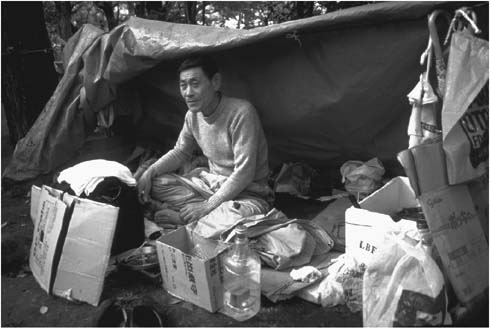
This myth disappeared as the Heisei Recession, beginning in 1991, continued to stall the economy and homelessness proliferated in most major cities and suburban areas. In 2001, the Japanese national government estimated the size of its “literal” homeless population to be around 25,000 people, some staying in the handful of short-term public shelters, but the vast majority living in encampments in major urban parks, stations, riversides, and scattered about the periphery of downtown shopping and business districts. Although activists note that the limitations of counting such a mobile and often hard-to-find population render this number a lower bound estimate of the nations' homeless population, they have yet to be able to provide an alternative estimate. Homelessness is concentrated in major urban areas, with the homeless populations in Osaka and Tokyo making up over one-half of the nation's total. While the growth of homeless persons in these major cities appears to be leveling off, the numbers in nearby suburban areas are on the rise.
...
- Causes
- Cities
- Demography and Characteristics
- Health Issues
- History
- Housing
- Legal Issues, Advocacy, and Policy
- Lifestyle Issues
- Appendix 3: Directory of Street Newspapers
- Child Care
- Child Support
- Criminal Activity and Policing
- Encampments, Urban
- Libraries: Issues in Serving the Homeless
- Mobility
- Panhandling
- Parenting
- Prostitution
- Shelters
- Single-Room Occupancy Hotels
- Social Support
- Soup Kitchens
- Street Newspapers
- Survival Strategies
- Work on the Streets
- Organizations
- American Bar Association Commission on Homelessness and Poverty
- Association of Gospel Rescue Missions
- Corporation for Supportive Housing
- European Network for Housing Research
- FEANTSA
- Goodwill Industries International
- Homeless International
- International Network of Street Newspapers
- International Union of Tenants
- National Alliance to End Homelessness
- National Center on Family Homelessness
- National Coalition for the Homeless
- National Resource Center on Homelessness and Mental Illness
- Salvation Army
- UN-HABITAT
- Urban Institute
- Wilder Research Center
- Perceptions of Homelessness
- Appendix 1: Bibliography of Autobiographical and Fictional Accounts of Homelessness
- Appendix 2: Filmography of American Narrative and Documentary Films on Homelessness
- Autobiography and Memoir, Contemporary Homelessness
- Images of Homelessness in Contemporary Documentary Film
- Images of Homelessness in Narrative Film, History of
- Images of Homelessness in Nineteenth- and Twentieth-Century America
- Images of Homelessness in the Media
- Literature, Hobo and Tramp
- Photography
- Public Opinion
- Populations
- Research
- Service Systems and Settings
- “Housing First” Approach
- Assertive Community Treatment (ACT)
- Case Management
- Children, Education of
- Continuum of Care
- Family Separations and Reunifications
- Food Programs
- Foster Care
- Harm Reduction
- Health Care
- Homeless Assistance Services and Networks
- Housing, Transitional
- Interventions, Clinical
- Interventions, Housing
- Mental Health System
- Outreach
- Poorhouses
- Safe Havens
- Self-Help Housing
- Service Integration
- Shelters
- Single-Room Occupancy Hotels
- Soup Kitchens
- Work on the Streets
- Workhouses
- World Perspectives and Issues
- Australia
- Bangladesh
- Brazil
- Calcutta
- Canada
- Copenhagen
- Cuba
- Denmark
- Egypt
- France
- Germany
- Homelessness, International Perspectives on
- Housing and Homelessness in Developing Nations
- Indonesia
- Italy
- Japan
- London
- Montreal
- Mumbai (Bombay)
- Nairobi
- Netherlands
- Nigeria
- Paris
- Russia
- South Africa
- Spain
- Sweden
- Sydney
- Tokyo
- Toronto
- United Kingdom
- United Kingdom, Rural
- Zimbabwe
- Loading...
Get a 30 day FREE TRIAL
-
 Watch videos from a variety of sources bringing classroom topics to life
 -
Read modern, diverse business cases
-
Explore hundreds of books and reference titles

Read next

More like this
Sage Recommends
We found other relevant content for you on other Sage platforms.
Have you created a personal profile? Login or create a profile so that you can save clips, playlists and searches