
Entry
Reader's guide
Entries A-Z
Subject index
Canada
With a population of 30 million, Canada has 11 million households, most of which now live in urban areas: With the growth in the country's urban population, driven in good part by both internal and external immigration, Canadians have increasingly needed to confront their perceptions of homelessness and the country's social policies toward it. It is now accepted in principle by all levels of government and the nonprofit sector that the definition of homelessness should include those individuals and families who are “sleeping rough” (outside) or frequenting emergency shelters, who are doubled up with friends and relatives, or who are precariously housed, subject to eviction, and thus at risk of becoming absolutely homeless. Nonetheless, public agencies, shelter providers, and nonprofit and volunteer organizations differ substantially on what constitutes an appropriate response to the homeless situation.
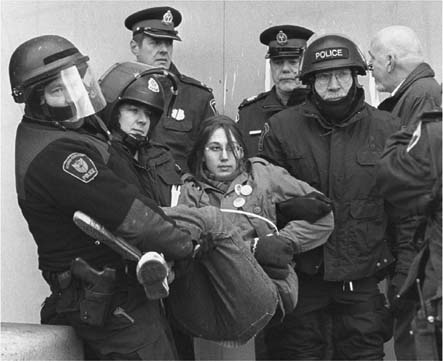
A protestor is carried off by police at a demonstration against homelessness in Ottawa on 12 November 1999
The Face of Homelessness
The face of homelessness has been changing across Canada, where people without shelter have gravitated to the cities. Many of the native-born homeless are Aboriginals, indigenous people who have moved from reserves into cities to secure shelter and social services; they are overrepresented by a factor of ten in Canada's homeless population. The largest municipalities, Montreal, Vancouver, and Toronto, receive well over half of all immigrants. As a result, half of the urban population in the largest cities is foreignborn (Statistics Canada, 2001). In Toronto, the Mayor's Homelessness Action Task Force found that about 15 percent of people in the hostel system are immigrants or refugees (Golden et al., 1999, 19).
Most new arrivals to Canada who experience housing difficulties find support within their own ethnic affinity groups, rather than with drop-ins, hostels, and social housing organizations. The latter have been slowly adapting to the need for more culturally sensitive services. For those in need of social housing, the waiting lists are so long—often seven years or more for individuals and families—that many applicants either move to another jurisdiction or opt for illegal basement apartments or “couchsurfing.” As the demand for housing has increased with the rising tide of immigrants and urban dwellers, there has been a commensurate increase in the cost of rentals. Between 1995 and 2000 in Toronto, average wages rose by 9 percent while rents increased by 29 percent.
The idea of a richly diverse multicultural society holds out the promise of inclusion and equity, but the reality for many new arrivals is lack of respect, low wages, poor working conditions, and exclusion. The housing situation for households living marginally is characterized by a growing trend of evictions, landlord discrimination, overcrowding, and increasing evidence of an invisible homeless population that suffers from ill health, lack of access to services, and social isolation.
In Toronto, whose trends are representative of large Canadian cities, 60,000 households are on the waiting list for social housing, shelter use doubled during the 1990s, and each year more than 32,000 people resort to shelters. Most are single adults over 24, but 20 percent are young people, ages 15 to 24. The number of children in the hostel system more than tripled in the past decade, to a total of 6,000. Some are handed over to child welfare agencies by parents who cannot manage to keep the family housed together (City of Toronto, 2001). These numbers do not include all those who are doubled up, living on the edge of homelessness, or living in substandard units, or who refuse to patronize shelters because of health or safety concerns, even during the coldest weather (Golden et al., 1999).
...
- Causes
- Cities
- Demography and Characteristics
- Health Issues
- History
- Housing
- Legal Issues, Advocacy, and Policy
- Lifestyle Issues
- Appendix 3: Directory of Street Newspapers
- Child Care
- Child Support
- Criminal Activity and Policing
- Encampments, Urban
- Libraries: Issues in Serving the Homeless
- Mobility
- Panhandling
- Parenting
- Prostitution
- Shelters
- Single-Room Occupancy Hotels
- Social Support
- Soup Kitchens
- Street Newspapers
- Survival Strategies
- Work on the Streets
- Organizations
- American Bar Association Commission on Homelessness and Poverty
- Association of Gospel Rescue Missions
- Corporation for Supportive Housing
- European Network for Housing Research
- FEANTSA
- Goodwill Industries International
- Homeless International
- International Network of Street Newspapers
- International Union of Tenants
- National Alliance to End Homelessness
- National Center on Family Homelessness
- National Coalition for the Homeless
- National Resource Center on Homelessness and Mental Illness
- Salvation Army
- UN-HABITAT
- Urban Institute
- Wilder Research Center
- Perceptions of Homelessness
- Appendix 1: Bibliography of Autobiographical and Fictional Accounts of Homelessness
- Appendix 2: Filmography of American Narrative and Documentary Films on Homelessness
- Autobiography and Memoir, Contemporary Homelessness
- Images of Homelessness in Contemporary Documentary Film
- Images of Homelessness in Narrative Film, History of
- Images of Homelessness in Nineteenth- and Twentieth-Century America
- Images of Homelessness in the Media
- Literature, Hobo and Tramp
- Photography
- Public Opinion
- Populations
- Research
- Service Systems and Settings
- “Housing First” Approach
- Assertive Community Treatment (ACT)
- Case Management
- Children, Education of
- Continuum of Care
- Family Separations and Reunifications
- Food Programs
- Foster Care
- Harm Reduction
- Health Care
- Homeless Assistance Services and Networks
- Housing, Transitional
- Interventions, Clinical
- Interventions, Housing
- Mental Health System
- Outreach
- Poorhouses
- Safe Havens
- Self-Help Housing
- Service Integration
- Shelters
- Single-Room Occupancy Hotels
- Soup Kitchens
- Work on the Streets
- Workhouses
- World Perspectives and Issues
- Australia
- Bangladesh
- Brazil
- Calcutta
- Canada
- Copenhagen
- Cuba
- Denmark
- Egypt
- France
- Germany
- Homelessness, International Perspectives on
- Housing and Homelessness in Developing Nations
- Indonesia
- Italy
- Japan
- London
- Montreal
- Mumbai (Bombay)
- Nairobi
- Netherlands
- Nigeria
- Paris
- Russia
- South Africa
- Spain
- Sweden
- Sydney
- Tokyo
- Toronto
- United Kingdom
- United Kingdom, Rural
- Zimbabwe
- Loading...
Get a 30 day FREE TRIAL
-
 Watch videos from a variety of sources bringing classroom topics to life
 -
Read modern, diverse business cases
-
Explore hundreds of books and reference titles

Read next

More like this
Sage Recommends
We found other relevant content for you on other Sage platforms.
Have you created a personal profile? Login or create a profile so that you can save clips, playlists and searches