
Entry
Reader's guide
Entries A-Z
Subject index
Calcutta
The “homeless” of Calcutta do not necessarily think of themselves as literally homeless; their habitat is a place of belonging on a particular city street or a colony of neighbors where being poor does not necessarily mean being without a home. Given the estimate that nearly half of the population would be considered “homeless”—because they sleep on the streets or in makeshift shelters—perhaps homelessness needs to be nuanced and redefined as virtual.
City of Contrasts
Calcutta, the capital city of West Bengal, India, is located on the east delta bank of the Hooghly River, a branch of the Ganges. The former capital of British India (1772–1912), Calcutta has the nation's largest metropolitan area, but retains its international reputation as the “problem city of the world” (Moorhouse 1974)—a microcosm of India and the Third World. Calcutta has a growing population of over 14 million. Approximately a million of these sleep on the streets. As many as 5 million residents live in makeshift cardboard or bamboo-thatched habitats. Another 5 million are considered “slum dwellers.” The remaining 3 million live relatively well in homes and apartments in Calcutta.
Paradoxically, Calcutta was once the richest and most important cities in India. A city of palaces, an intellectual, cultural, and commercial capital, Calcutta is a monument to the faded glory of the Raj, British India. From 1599, when the British established “a quiet trade” with India through the East India Company, Calcutta was considered an imperial city of the British empire. In 1912, Calcutta ceased to be the country's capital, though British fortunes could still be made for another two or three decades of political and economic domination. Even today, Calcutta has a prosperous side. Most people work to make a living. Universities educate the young. Businesses succeed. Culture inspires. Five-star hotels and restaurants exist for tourists. Calcutta has many foreign banks, several chambers of commerce, and a stock exchange. The city serves as the major educational and cultural center of India, catering to a growing cosmopolitan population.
City of Refuse
More than most urban centers, however, Calcutta has an acute housing shortage. In addition to densely populated public and private housing units, there are hundreds of bustees, or slums, where about one-third of the city's population lives. (Bustees are officially defined as “a collection of huts standing on a plot of land of at least one-sixth of an acre GAIA” [n.d.]). The majority of these huts are tiny, flimsy, unventilated, unfinished, single-story rooms with few sanitary facilities and little open space. In part, because of bustees, ecological congestion and air and water pollution remain a medical and environmental crisis in the city.
Homeless people asleep in the streets of Calcutta c. 1950
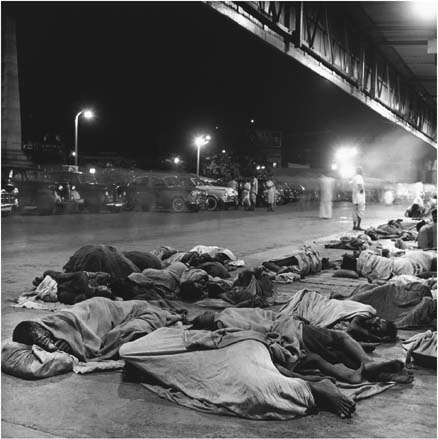
The weather in Calcutta exacerbates the poverty and disease. Though it is warm enough for the masses to sleep on the streets in winter without freezing to death, exposure to disease and unsanitary conditions continue to put millions at medical risk. The summer monsoon season lasts four months and creates a unique challenge: Huge shafts of water threaten to flood the homeless from the streets. As Geoffrey Moorhouse describes it: “Calcutta before the monsoon means being soaked with sweat after walking a slow fifty yards; it means not having an inch of dry skin except in air-conditioning.” When the monsoon breaks in June, there is a torrent of water and fierce thunder. “The streets are awash, the motor traffic is stalled, the trams can no longer move and only the rickshaw-pullers keep going through the floods, up to their knees and axles in water” (Moorhouse 1974, 25). As the storms rage and the river floods, the city becomes a breeding ground for malaria and other diseases that thrive on moisture.
...
- Causes
- Cities
- Demography and Characteristics
- Health Issues
- History
- Housing
- Legal Issues, Advocacy, and Policy
- Lifestyle Issues
- Appendix 3: Directory of Street Newspapers
- Child Care
- Child Support
- Criminal Activity and Policing
- Encampments, Urban
- Libraries: Issues in Serving the Homeless
- Mobility
- Panhandling
- Parenting
- Prostitution
- Shelters
- Single-Room Occupancy Hotels
- Social Support
- Soup Kitchens
- Street Newspapers
- Survival Strategies
- Work on the Streets
- Organizations
- American Bar Association Commission on Homelessness and Poverty
- Association of Gospel Rescue Missions
- Corporation for Supportive Housing
- European Network for Housing Research
- FEANTSA
- Goodwill Industries International
- Homeless International
- International Network of Street Newspapers
- International Union of Tenants
- National Alliance to End Homelessness
- National Center on Family Homelessness
- National Coalition for the Homeless
- National Resource Center on Homelessness and Mental Illness
- Salvation Army
- UN-HABITAT
- Urban Institute
- Wilder Research Center
- Perceptions of Homelessness
- Appendix 1: Bibliography of Autobiographical and Fictional Accounts of Homelessness
- Appendix 2: Filmography of American Narrative and Documentary Films on Homelessness
- Autobiography and Memoir, Contemporary Homelessness
- Images of Homelessness in Contemporary Documentary Film
- Images of Homelessness in Narrative Film, History of
- Images of Homelessness in Nineteenth- and Twentieth-Century America
- Images of Homelessness in the Media
- Literature, Hobo and Tramp
- Photography
- Public Opinion
- Populations
- Research
- Service Systems and Settings
- “Housing First” Approach
- Assertive Community Treatment (ACT)
- Case Management
- Children, Education of
- Continuum of Care
- Family Separations and Reunifications
- Food Programs
- Foster Care
- Harm Reduction
- Health Care
- Homeless Assistance Services and Networks
- Housing, Transitional
- Interventions, Clinical
- Interventions, Housing
- Mental Health System
- Outreach
- Poorhouses
- Safe Havens
- Self-Help Housing
- Service Integration
- Shelters
- Single-Room Occupancy Hotels
- Soup Kitchens
- Work on the Streets
- Workhouses
- World Perspectives and Issues
- Australia
- Bangladesh
- Brazil
- Calcutta
- Canada
- Copenhagen
- Cuba
- Denmark
- Egypt
- France
- Germany
- Homelessness, International Perspectives on
- Housing and Homelessness in Developing Nations
- Indonesia
- Italy
- Japan
- London
- Montreal
- Mumbai (Bombay)
- Nairobi
- Netherlands
- Nigeria
- Paris
- Russia
- South Africa
- Spain
- Sweden
- Sydney
- Tokyo
- Toronto
- United Kingdom
- United Kingdom, Rural
- Zimbabwe
- Loading...
Get a 30 day FREE TRIAL
-
 Watch videos from a variety of sources bringing classroom topics to life
 -
Read modern, diverse business cases
-
Explore hundreds of books and reference titles

Read next

More like this
Sage Recommends
We found other relevant content for you on other Sage platforms.
Have you created a personal profile? Login or create a profile so that you can save clips, playlists and searches