
Entry
Reader's guide
Entries A-Z
Subject index
Bowery, the
The Bowery is a major street that runs south to north for about a mile from Chatham Square to Copper Square in lower Manhattan. The major cross streets from south to north are Canal, Delancey, and Houston. One of the oldest in the nation, it is the street most associated in the public mind with homelessness, and from the late 1870s into the 1970s, it was “home” to many of the homeless in New York City. The Bowery as a skid row in the twentieth century included not just the street itself but also several side streets to the east and west, which at times housed institutions and organizations that served the homeless, such as the men's and women's municipal shelters. The Bowery's importance in the history of homelessness goes beyond its role as a major skid row. It has been a major venue for a considerable amount of research on the homelessness dating from the late 1800s and continuing into the 1990s.
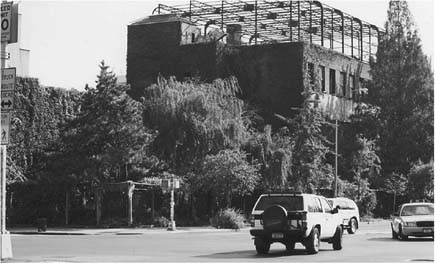
The garden on the corner of Bowery and East Houston Street in New York City, October 2003
History of the Bowery
The Bowery (the name is derived from the Dutch word bouwerij meaning “farm”) began as Bowery Lane, the major road out of New Amsterdam after the Dutch founded their New World colony and, beginning in 1626, granted large plots of land adjacent to the road to wealthy landowners to induce them to settle in New Amsterdam. The largest plot went to Petrus (Peter) Stuyvesant in 1651. His farm colony became known as Bowery or Stuyvesant Village. When the English displaced the Dutch and established New York in 1664, they maintained the farms and in 1673 renamed Bowery Lane the Boston Post Road, noting its role as part of the route from New York to Boston. But the name Bowery stuck, and it has been called that ever since. It remained a mainly country lane of houses, farms, and small shops for nearly 100 years. In the 1760s, the road began to attract a rougher crowd and was the site of foot racing and horse racing, dog fighting, and cock fighting.
The first major transformation began in the 1750s and continued into the next century as the large estates bordering the Bowery were subdivided and sold off, with houses and shops replacing farms. The Bowery became a major retail street, and by the early 1800s, the southern end became part of the immigrant slum centered in the Five Points. In 1826, the Bowery Theater (the largest in the nation at the time) opened, followed later by the Park and Chatham Theaters. The Bowery population shifted from the wealthy to the middle class to workers and poor European immigrants over the century and, by the 1850s, was associated in the public imagination with a working-class lifestyle and nativism, especially in regard to conflicts with recent arrivals from Ireland. The Bowery Boys and Gals, Mose (an urban Paul Bunyan), and gangs such as Bowery Boys and Atlantic Guards drew attention to the Bowery and beyond.
...
- Causes
- Cities
- Demography and Characteristics
- Health Issues
- History
- Housing
- Legal Issues, Advocacy, and Policy
- Lifestyle Issues
- Appendix 3: Directory of Street Newspapers
- Child Care
- Child Support
- Criminal Activity and Policing
- Encampments, Urban
- Libraries: Issues in Serving the Homeless
- Mobility
- Panhandling
- Parenting
- Prostitution
- Shelters
- Single-Room Occupancy Hotels
- Social Support
- Soup Kitchens
- Street Newspapers
- Survival Strategies
- Work on the Streets
- Organizations
- American Bar Association Commission on Homelessness and Poverty
- Association of Gospel Rescue Missions
- Corporation for Supportive Housing
- European Network for Housing Research
- FEANTSA
- Goodwill Industries International
- Homeless International
- International Network of Street Newspapers
- International Union of Tenants
- National Alliance to End Homelessness
- National Center on Family Homelessness
- National Coalition for the Homeless
- National Resource Center on Homelessness and Mental Illness
- Salvation Army
- UN-HABITAT
- Urban Institute
- Wilder Research Center
- Perceptions of Homelessness
- Appendix 1: Bibliography of Autobiographical and Fictional Accounts of Homelessness
- Appendix 2: Filmography of American Narrative and Documentary Films on Homelessness
- Autobiography and Memoir, Contemporary Homelessness
- Images of Homelessness in Contemporary Documentary Film
- Images of Homelessness in Narrative Film, History of
- Images of Homelessness in Nineteenth- and Twentieth-Century America
- Images of Homelessness in the Media
- Literature, Hobo and Tramp
- Photography
- Public Opinion
- Populations
- Research
- Service Systems and Settings
- “Housing First” Approach
- Assertive Community Treatment (ACT)
- Case Management
- Children, Education of
- Continuum of Care
- Family Separations and Reunifications
- Food Programs
- Foster Care
- Harm Reduction
- Health Care
- Homeless Assistance Services and Networks
- Housing, Transitional
- Interventions, Clinical
- Interventions, Housing
- Mental Health System
- Outreach
- Poorhouses
- Safe Havens
- Self-Help Housing
- Service Integration
- Shelters
- Single-Room Occupancy Hotels
- Soup Kitchens
- Work on the Streets
- Workhouses
- World Perspectives and Issues
- Australia
- Bangladesh
- Brazil
- Calcutta
- Canada
- Copenhagen
- Cuba
- Denmark
- Egypt
- France
- Germany
- Homelessness, International Perspectives on
- Housing and Homelessness in Developing Nations
- Indonesia
- Italy
- Japan
- London
- Montreal
- Mumbai (Bombay)
- Nairobi
- Netherlands
- Nigeria
- Paris
- Russia
- South Africa
- Spain
- Sweden
- Sydney
- Tokyo
- Toronto
- United Kingdom
- United Kingdom, Rural
- Zimbabwe
- Loading...
Get a 30 day FREE TRIAL
-
 Watch videos from a variety of sources bringing classroom topics to life
 -
Read modern, diverse business cases
-
Explore hundreds of books and reference titles

Read next

More like this
Sage Recommends
We found other relevant content for you on other Sage platforms.
Have you created a personal profile? Login or create a profile so that you can save clips, playlists and searches