
Entry
Reader's guide
Entries A-Z
Subject index
African-Americans
The old stereotype of a homeless person in America was a solitary middle-aged white male alcoholic. Although this may have described a majority of homeless people before the 1980s, the current homeless population in the United States is younger, includes a large number of families composed mostly of women and their children, is much poorer, and is much more ethnically diverse. African-Americans are overrepresented in all subgroups of homeless people, including adults, families, and adolescents.
Those who identify themselves as African-Americans represent 12 percent of the U.S. population and 50 percent of the U.S. homeless population. In some U.S. cities, African-Americans make up an even larger proportion of the homeless population. For example, in Buffalo, New York, African-Americans constitute 68 percent of homeless adults and in Detroit, Michigan, African-Americans make up 85 percent of the homeless population. African-Americans appear to be most heavily overrepresented among homeless adults and families.
Explaining the Overrepresentation
The surge of homelessness that began in the 1980s has been attributed to an increase in the number of poor people, a lack of affordable housing, and the loss of well-paying unskilled jobs. Additional historic and structural factors include racism, discrimination, and a lack of access to higher education. Research suggests that African-Americans are more likely to become homeless as a result of external factors like chronic and pervasive poverty than European-Americans, who are more likely to experience homelessness due to internal factors like mental illness, family dysfunction, and substance abuse.
Poverty
Homelessness can be seen as the by-product of a rise in the number of people experiencing poverty and an increase in the disparity between the rich and the poor. In fact, many scholars view homelessness simply as an extreme form of poverty. Research suggests that the current homeless population is suffering from more extreme poverty than the homeless population before the 1980s, whose income was three times higher than the income of the current homeless. Some studies have found that the problems of homeless people differ only slightly from the problems of the very poor. For example, some have found that rates of mental illness are much higher in both homeless and matched housed poor individuals (similar to the homeless in terms of age, gender, ethnicity, and/or neighborhood income). Because of the overrepresentation of African-Americans among poor persons in the United States, poverty can be viewed as an important cause of the overrepresentation of African-Americans among the homeless. Roughly 25 percent of African-Americans in the United States live in poverty. In addition, whereas 20 percent of U.S. children live below the poverty line, 50 percent of ethnic minority children live below the poverty line.
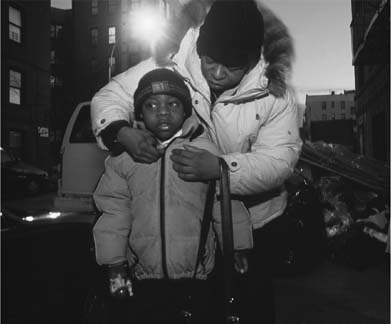
A mother and her child get ready to leave their temporary apartment in New York City at 6:30 a.m. for work and school
Factors that might be driving the increase in the number of poor persons, as well as the increase in the number of poor African-Americans, include welfare reform, gentrification, and a lack of well-paying unskilled jobs. In recent years, “welfare reform” has resulted in a reduction in the services provided to those who are poor. African-Americans appear to be faring worse than other ethnic groups on many factors directly related to poverty, including education, unemployment rates, and the availability of transferable job skills.
...
- Causes
- Cities
- Demography and Characteristics
- Health Issues
- History
- Housing
- Legal Issues, Advocacy, and Policy
- Lifestyle Issues
- Appendix 3: Directory of Street Newspapers
- Child Care
- Child Support
- Criminal Activity and Policing
- Encampments, Urban
- Libraries: Issues in Serving the Homeless
- Mobility
- Panhandling
- Parenting
- Prostitution
- Shelters
- Single-Room Occupancy Hotels
- Social Support
- Soup Kitchens
- Street Newspapers
- Survival Strategies
- Work on the Streets
- Organizations
- American Bar Association Commission on Homelessness and Poverty
- Association of Gospel Rescue Missions
- Corporation for Supportive Housing
- European Network for Housing Research
- FEANTSA
- Goodwill Industries International
- Homeless International
- International Network of Street Newspapers
- International Union of Tenants
- National Alliance to End Homelessness
- National Center on Family Homelessness
- National Coalition for the Homeless
- National Resource Center on Homelessness and Mental Illness
- Salvation Army
- UN-HABITAT
- Urban Institute
- Wilder Research Center
- Perceptions of Homelessness
- Appendix 1: Bibliography of Autobiographical and Fictional Accounts of Homelessness
- Appendix 2: Filmography of American Narrative and Documentary Films on Homelessness
- Autobiography and Memoir, Contemporary Homelessness
- Images of Homelessness in Contemporary Documentary Film
- Images of Homelessness in Narrative Film, History of
- Images of Homelessness in Nineteenth- and Twentieth-Century America
- Images of Homelessness in the Media
- Literature, Hobo and Tramp
- Photography
- Public Opinion
- Populations
- Research
- Service Systems and Settings
- “Housing First” Approach
- Assertive Community Treatment (ACT)
- Case Management
- Children, Education of
- Continuum of Care
- Family Separations and Reunifications
- Food Programs
- Foster Care
- Harm Reduction
- Health Care
- Homeless Assistance Services and Networks
- Housing, Transitional
- Interventions, Clinical
- Interventions, Housing
- Mental Health System
- Outreach
- Poorhouses
- Safe Havens
- Self-Help Housing
- Service Integration
- Shelters
- Single-Room Occupancy Hotels
- Soup Kitchens
- Work on the Streets
- Workhouses
- World Perspectives and Issues
- Australia
- Bangladesh
- Brazil
- Calcutta
- Canada
- Copenhagen
- Cuba
- Denmark
- Egypt
- France
- Germany
- Homelessness, International Perspectives on
- Housing and Homelessness in Developing Nations
- Indonesia
- Italy
- Japan
- London
- Montreal
- Mumbai (Bombay)
- Nairobi
- Netherlands
- Nigeria
- Paris
- Russia
- South Africa
- Spain
- Sweden
- Sydney
- Tokyo
- Toronto
- United Kingdom
- United Kingdom, Rural
- Zimbabwe
- Loading...
Get a 30 day FREE TRIAL
-
 Watch videos from a variety of sources bringing classroom topics to life
 -
Read modern, diverse business cases
-
Explore hundreds of books and reference titles

Read next

More like this
Sage Recommends
We found other relevant content for you on other Sage platforms.
Have you created a personal profile? Login or create a profile so that you can save clips, playlists and searches