
Entry
Reader's guide
Entries A-Z
Subject index
World Trade Organization
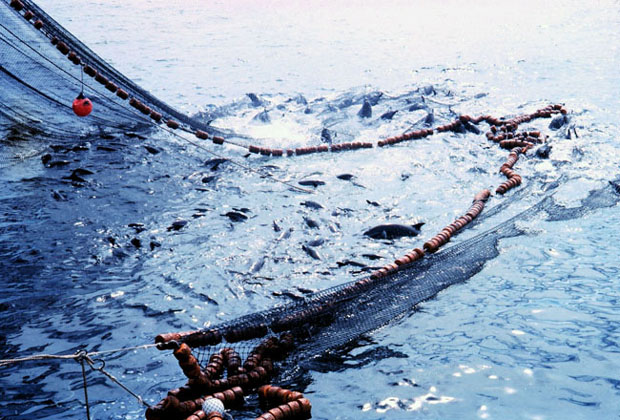
The photograph shows a dolphin caught in a controversial type of fish seine in the Pacific in 1966. The World Trade Organization's involvement in the dolphin-safe nets dispute led to changes within the organization in the early 1990s.
The World Trade Organization (WTO) is a central player in the process of contemporary globalization. Although its core function is to facilitate trade liberalization (the reduction or removal of tariffs and other trade practices that inhibit the free flow of goods and services) among its member states, the WTO also plays an important role in certain aspects of environmental governance. For example, the WTO is currently discussing how to liberalize trade in environmental goods and services and also plays an important role in adjudicating disputes relating to exemptions to trade rules for environmental protection purposes. This article introduces the organization's history, core principles, and institutional structure before summarizing environmental politics at the WTO.
The two primary functions of the WTO are to provide a forum for trading partners to negotiate legally binding rules to govern international trade liberalization, and to settle disputes among members related to the implementation and interpretation of those rules. The WTO was established in 1995 as the organization responsible for housing and servicing not only a revamped version of its predecessor, the 1947 General Agreement on Tariffs and Trade (GATT), but also a host of new international trade-related agreements. These new agreements, which emerged from the Uruguay Round of GATT negotiations, cover such areas as trade in goods, services, textiles, and agriculture, as well as rules for dispute settlement and intellectual property protection, among many trade-related topics.
The core principle of the WTO is nondiscrimination. This means that all WTO member governments must treat each other equally with respect to international trade. In this context, most-favored-nation treatment means WTO members cannot offer special terms of trade, such as lower tariffs, to one trading partner over another. Similarly, national treatment means that WTO members cannot discriminate between their own products and those imported from other member states. Although there are some exceptions to the principles of nondiscrimination—for example, to facilitate developing-country market access—the WTO agreements only permit these exceptions under strict conditions.
Institutional Structure
The core of the organization is its membership. The WTO currently has 153 members who negotiate and implement the policies that govern the bulk of international trade. The WTO's chief policymaking body is the Ministerial Conference, which consists of one representative from each member state and meets approximately every two years to make decisions on any matter related to any of the WTO agreements. Just below the Ministerial Conference hierarchically is the General Council, which is also made up of one representative from each member state; it is responsible for the operation of the WTO between Ministerial Conferences and makes all decisions by consensus. The General Council operates as the Dispute Settlement Body, administers the Trade Policy Review Mechanism, and oversees operation of all councils and committees.
The General Council delegates responsibility for the day-to-day operation of the organization to the Councils on Goods, Services, and Trade-Related Aspects of Intellectual Property Rights. The councils in turn establish various committees to discuss the various aspects of their work. In 2001, the General Council established the Trade Negotiation Committee and various additional subcommittees in “special session,” such as the Committee on Trade and Environment in Special Session, to negotiate the various mandates contained in the Doha Development Agenda.
...
- Politics and Ecology
- Politics and People
- Politics Challenges
- Acid Rain
- Afforestation
- Anti-Toxics Movement
- Appropriate Technology
- Biodiversity
- Decentralization
- Deforestation
- Domination of Nature
- Endocrine Disrupters
- Environmental Justice
- Environmental Management
- Equity
- Future Generations
- Global Climate Change
- Globalization
- Groundwater
- Industrial Revolution
- Innovation, Environmental
- Kuznets Curve
- Limits to Growth
- Malthusianism
- Megacities
- Millennium Development Goals
- Nonviolence
- North–South Issues
- Nuclear Politics
- PCBs
- Precautionary Principle
- Regulatory Approaches
- Resource Curse
- Revolving Door
- Risk Assessment
- Risk Society
- Silent Spring
- Structural Adjustment
- Suburban Sprawl
- Sustainable Development
- Technology
- Toxics Release Inventory
- Tragedy of the Commons
- Transportation
- Uncertainty
- Urban Planning
- Wetlands
- Wilderness
- Agenda 21
- Bhopal
- Brundtland Commission
- Bureau of Land Management, U.S.
- Clean Air Act
- Clean Water Act
- Club of Rome
- Copenhagen Summit
- Corporate Responsibility
- Department of Energy, U.S.
- Endangered Species Act
- Environmental Nongovernmental Organizations
- Environmental Protection Agency, U.S.
- Fish and Wildlife Service, U.S.
- Forest Service, U.S.
- Institutions
- Intergovernmental Panel on Climate Change
- Kyoto Protocol
- Land Ethic
- Marine Mammal Protection Act
- Montreal Protocol
- NIMBY
- North American Free Trade Agreement Organizations
- Sagebrush Rebellion
- Stockholm Convention
- Transnational Advocacy Organizations
- Wise Use Movement
- World Trade Organization
- Politics Parties, Systems, and Economics
- Anarchism
- Basel Convention
- Biophilia
- Capitalism
- Citizen Juries
- Commodification
- Common Property Theory
- Conservation Enclosures
- Conservation Movement
- Consumer Politics
- Convention on Biodiversity
- Cost-Benefit Analysis
- Death of Environmentalism
- Democratic Party
- Ecocapitalism
- Ecofascism
- Ecosocialism
- Environmental Movement
- Federalism
- Gaia Hypothesis
- Gender
- Governmentality
- Green Discourse
- Green Neoliberalism
- Green Parties
- Green Washing
- International Whaling Commission
- Intrinsic Value
- Iron Triangle
- Participatory Democracy
- Petro-Capitalism
- Policy Process
- Political Ideology
- Politics of Scale
- Postmaterialism
- Power
- Pragmatism
- Skeptical Environmentalism
- Steady State Economy
- Transnational Capitalist Class
- UN Conference on Environment and Development
- UN Framework Convention on Climate Change
- Utilitarianism
- Water Politics
- Loading...
Get a 30 day FREE TRIAL
-
 Watch videos from a variety of sources bringing classroom topics to life
 -
Read modern, diverse business cases
-
Explore hundreds of books and reference titles

Read next

More like this
Sage Recommends
We found other relevant content for you on other Sage platforms.
Have you created a personal profile? Login or create a profile so that you can save clips, playlists and searches