
Entry
Reader's guide
Entries A-Z
Subject index
Tragedy of the Commons
The “tragedy of the commons” describes a social dilemma in which rational human behavior in using a resource as an unmanaged commons leads to overuse and, consequentially, to the destruction of that resource. It has proven a useful concept for understanding how resources are ruined not by some outside forces but by the inherent behavior that can be expected whenever a number of individuals own a scarce resource in common. A famous article in the journal Science by Garrett Hardin (1968) introduced the concept to common parlance.
Central to the tragedy of the commons is a metaphor: Imagine a common parcel of land (the commons) used by farmers. As a rational being, each herder will try to keep as many cows as possible on the land, even if the consequence of this behavior would be the destruction of the commons. Each farmer tries to maximize his gain. The utility of adding one more animal on the land has one negative and one positive effect:
- Positive effect: The farmer receives all the benefits from each additional animal.
- Negative effect: The land is slightly damaged by each additional animal.
The concept of the tragedy of the commons can be applied to the problem of overuse in national parks like Yosemite, where large numbers of visitors like these can threaten the survival of the resource.
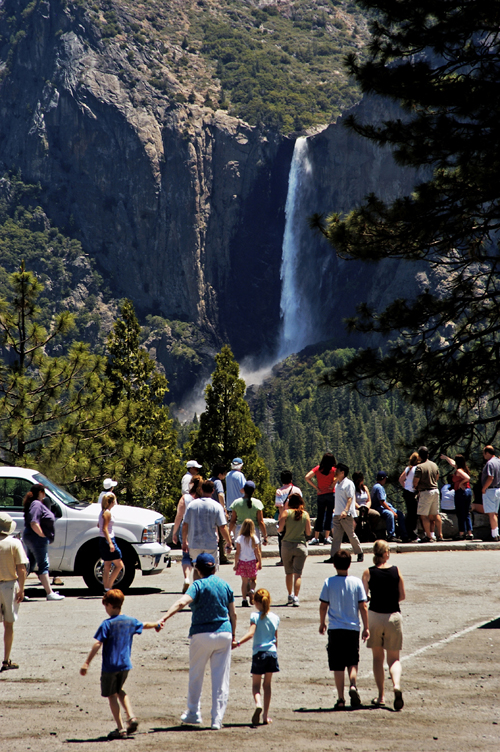
Because of the unequal division of the costs and benefits, each rationally behaving farmer concludes that the highest utility to him is to add another animal on the commons. And another, and another, and so on. He gains all the benefits, but the disadvantages are shared among all farmers using the commons. The benefits are privatized, and the costs are socialized. This is no big problem as long as the carrying capacity of the commons is not exceeded. As soon as the number of farmers surmounts a certain threshold, however, the tragedy of the commons takes effect: The carrying capacity is exceeded, but each farmer still seeks to pursue his short-term interest. Because all farmers reach the same conclusion, the long-term consequence is that everyone loses their share in the collective resource.
The tragedy herein lies in the paradox that individually rational strategies lead to collectively irrational outcomes. The rational behavior of each individual leads—in a finite world—inevitably to the ruin of the commons. In a nutshell, the central cause of any tragedy of the commons is that individuals do not have to bear the entire costs of their behavior when using a public good. The consequences are externalized. Individuals gain by internalizing benefits and externalizing costs.
Central to the tragedy of the commons is the perception that humans are rational self-interested actors. Actors behave purposefully in maximizing their utility. They assess the costs and benefits associated with possible options and choose the option that they expect will be the most beneficiary to them at no great cost, regardless of the costs to others. This assumption, that humans are rational self-interested actors, serves as the ontological basis for the factors causing a tragedy of the commons to arise.
...
- Politics and Ecology
- Politics and People
- Politics Challenges
- Acid Rain
- Afforestation
- Anti-Toxics Movement
- Appropriate Technology
- Biodiversity
- Decentralization
- Deforestation
- Domination of Nature
- Endocrine Disrupters
- Environmental Justice
- Environmental Management
- Equity
- Future Generations
- Global Climate Change
- Globalization
- Groundwater
- Industrial Revolution
- Innovation, Environmental
- Kuznets Curve
- Limits to Growth
- Malthusianism
- Megacities
- Millennium Development Goals
- Nonviolence
- North–South Issues
- Nuclear Politics
- PCBs
- Precautionary Principle
- Regulatory Approaches
- Resource Curse
- Revolving Door
- Risk Assessment
- Risk Society
- Silent Spring
- Structural Adjustment
- Suburban Sprawl
- Sustainable Development
- Technology
- Toxics Release Inventory
- Tragedy of the Commons
- Transportation
- Uncertainty
- Urban Planning
- Wetlands
- Wilderness
- Agenda 21
- Bhopal
- Brundtland Commission
- Bureau of Land Management, U.S.
- Clean Air Act
- Clean Water Act
- Club of Rome
- Copenhagen Summit
- Corporate Responsibility
- Department of Energy, U.S.
- Endangered Species Act
- Environmental Nongovernmental Organizations
- Environmental Protection Agency, U.S.
- Fish and Wildlife Service, U.S.
- Forest Service, U.S.
- Institutions
- Intergovernmental Panel on Climate Change
- Kyoto Protocol
- Land Ethic
- Marine Mammal Protection Act
- Montreal Protocol
- NIMBY
- North American Free Trade Agreement Organizations
- Sagebrush Rebellion
- Stockholm Convention
- Transnational Advocacy Organizations
- Wise Use Movement
- World Trade Organization
- Politics Parties, Systems, and Economics
- Anarchism
- Basel Convention
- Biophilia
- Capitalism
- Citizen Juries
- Commodification
- Common Property Theory
- Conservation Enclosures
- Conservation Movement
- Consumer Politics
- Convention on Biodiversity
- Cost-Benefit Analysis
- Death of Environmentalism
- Democratic Party
- Ecocapitalism
- Ecofascism
- Ecosocialism
- Environmental Movement
- Federalism
- Gaia Hypothesis
- Gender
- Governmentality
- Green Discourse
- Green Neoliberalism
- Green Parties
- Green Washing
- International Whaling Commission
- Intrinsic Value
- Iron Triangle
- Participatory Democracy
- Petro-Capitalism
- Policy Process
- Political Ideology
- Politics of Scale
- Postmaterialism
- Power
- Pragmatism
- Skeptical Environmentalism
- Steady State Economy
- Transnational Capitalist Class
- UN Conference on Environment and Development
- UN Framework Convention on Climate Change
- Utilitarianism
- Water Politics
- Loading...
Get a 30 day FREE TRIAL
-
 Watch videos from a variety of sources bringing classroom topics to life
 -
Read modern, diverse business cases
-
Explore hundreds of books and reference titles

Read next

More like this
Sage Recommends
We found other relevant content for you on other Sage platforms.
Have you created a personal profile? Login or create a profile so that you can save clips, playlists and searches