
Entry
Reader's guide
Entries A-Z
Subject index
Suburban Sprawl
The phrase suburban sprawl is a pejorative term that has not only become part of the popular lexicon of cities but is also shorthand for all that is ugly, inefficient, crass, and dysfunctional in metropolitan areas. Although commonly discussed in a North American context, sprawling development patterns may also be found elsewhere, notably in Europe, Australia, and more recently, China. Despite its widespread use, there often is lacking in the literature proper empirical support for or sufficient definition of the term, resulting in some confusion among conditions, causes, and impacts. However, whatever imprecision may plague its definition, the land use patterns characterized as suburban sprawl are recognized as being the result of a combination of such political factors as land economics, tax policies, zoning regulations, master planning processes, and—according to some critics—exclusionary lending and insurance practices motivated by race and class.
Given that suburbanization has for so long been associated with the “American Dream” and all that implies, it is unsurprising that a number of enduring debates have emerged over suburban sprawl, ranging from the validity of the term itself to the very validity of the planning function.
William H. Whyte was the first to use the term urban sprawl in his 1958 essay of the same name, which set the tone for much of the discourse to follow by disparaging much of newer postwar America as “a mess.” Since then, there has been an enormous body of literature criticizing suburban America on economic, aesthetic, and social equity grounds, but several reviews of this literature have revealed little in the way of common definitions or attempts to empirically operationalize the term suburban sprawl. Generally, however, suburban sprawl is seen as a combination of low residential densities; the segregation of land uses through zoning, so that homes are separated from jobs, retail, and services; little in the way of identifiable town “centers;” and a car-dependent street network with poor connectivity. All of these factors make for developments in which public transportation is uneconomical and people become separated by economic class.
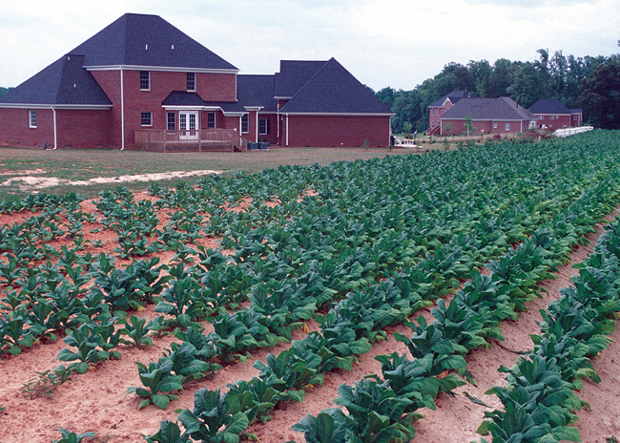
Suburban developments have encroached on farmland all over the United States. These houses in Forsyth County, North Carolina, abut the edge of a farmer's vegetable field.
In a landmark paper, G. Galster et al. determined that sprawl should be seen as a pattern of land use that exhibits low levels of a combination of the following empirically verifiable eight dimensions: density (number of residents within a developable square mile in an urban area), continuity (extent to which such developable land has been built upon in an unbroken manner), concentration (degree to which most development occurs within a few square miles in an urban area), clustering (minimizing of land used in development), centrality (concentration of development close to the Central Business District), nuclearity (concentration of developments within a single center or in multiple ones), mixed uses (multiple land found throughout an urban area), and proximity (these mixed uses are close together).
As verifiable as these dimensions may be, it is important to stress that none of these can be seen only as the result of urban design decisions: They are also the manifestations of a decades-long process of economic restructuring and globalization, in which American cities lost manufacturing capacity to low-wage centers in the developing world and the economy became characterized instead by highly paid financial, communication, and information service professions as well as low-wage retail and service sector employment.
...
- Politics and Ecology
- Politics and People
- Politics Challenges
- Acid Rain
- Afforestation
- Anti-Toxics Movement
- Appropriate Technology
- Biodiversity
- Decentralization
- Deforestation
- Domination of Nature
- Endocrine Disrupters
- Environmental Justice
- Environmental Management
- Equity
- Future Generations
- Global Climate Change
- Globalization
- Groundwater
- Industrial Revolution
- Innovation, Environmental
- Kuznets Curve
- Limits to Growth
- Malthusianism
- Megacities
- Millennium Development Goals
- Nonviolence
- North–South Issues
- Nuclear Politics
- PCBs
- Precautionary Principle
- Regulatory Approaches
- Resource Curse
- Revolving Door
- Risk Assessment
- Risk Society
- Silent Spring
- Structural Adjustment
- Suburban Sprawl
- Sustainable Development
- Technology
- Toxics Release Inventory
- Tragedy of the Commons
- Transportation
- Uncertainty
- Urban Planning
- Wetlands
- Wilderness
- Agenda 21
- Bhopal
- Brundtland Commission
- Bureau of Land Management, U.S.
- Clean Air Act
- Clean Water Act
- Club of Rome
- Copenhagen Summit
- Corporate Responsibility
- Department of Energy, U.S.
- Endangered Species Act
- Environmental Nongovernmental Organizations
- Environmental Protection Agency, U.S.
- Fish and Wildlife Service, U.S.
- Forest Service, U.S.
- Institutions
- Intergovernmental Panel on Climate Change
- Kyoto Protocol
- Land Ethic
- Marine Mammal Protection Act
- Montreal Protocol
- NIMBY
- North American Free Trade Agreement Organizations
- Sagebrush Rebellion
- Stockholm Convention
- Transnational Advocacy Organizations
- Wise Use Movement
- World Trade Organization
- Politics Parties, Systems, and Economics
- Anarchism
- Basel Convention
- Biophilia
- Capitalism
- Citizen Juries
- Commodification
- Common Property Theory
- Conservation Enclosures
- Conservation Movement
- Consumer Politics
- Convention on Biodiversity
- Cost-Benefit Analysis
- Death of Environmentalism
- Democratic Party
- Ecocapitalism
- Ecofascism
- Ecosocialism
- Environmental Movement
- Federalism
- Gaia Hypothesis
- Gender
- Governmentality
- Green Discourse
- Green Neoliberalism
- Green Parties
- Green Washing
- International Whaling Commission
- Intrinsic Value
- Iron Triangle
- Participatory Democracy
- Petro-Capitalism
- Policy Process
- Political Ideology
- Politics of Scale
- Postmaterialism
- Power
- Pragmatism
- Skeptical Environmentalism
- Steady State Economy
- Transnational Capitalist Class
- UN Conference on Environment and Development
- UN Framework Convention on Climate Change
- Utilitarianism
- Water Politics
- Loading...
Get a 30 day FREE TRIAL
-
 Watch videos from a variety of sources bringing classroom topics to life
 -
Read modern, diverse business cases
-
Explore hundreds of books and reference titles

Read next

More like this
Sage Recommends
We found other relevant content for you on other Sage platforms.
Have you created a personal profile? Login or create a profile so that you can save clips, playlists and searches