
Entry
Reader's guide
Entries A-Z
Subject index
Resource Curse
The resource curse posits a negative relationship between resource abundance and economic performance. Also known as the “paradox of plenty,” it suggests that nations with bountiful quantities of extractable natural resources such as oil, timber, and precious metals are associated with disappointing rates of economic development and are more likely to become mired in political violence.
Intellectual interest in this phenomenon began in the 1920s and 1930s, sparked by the decline in Latin American economies hit hard by a global slump in commodity prices. Postwar scholarship suggested that this negative relationship between resource wealth and economic performance was independent of price fluctuations. Economists tested this hypothesis using repeated regression analysis, which compared resource intensity and economic growth data. Nations with abundant natural resources (such as Venezuela, Nigeria, and Guyana) saw their economies expand slower than those nations (such as Taiwan, Singapore, and Korea) that started out with little resource wealth. These findings confirmed that high resource intensity correlates with ragged economic growth.
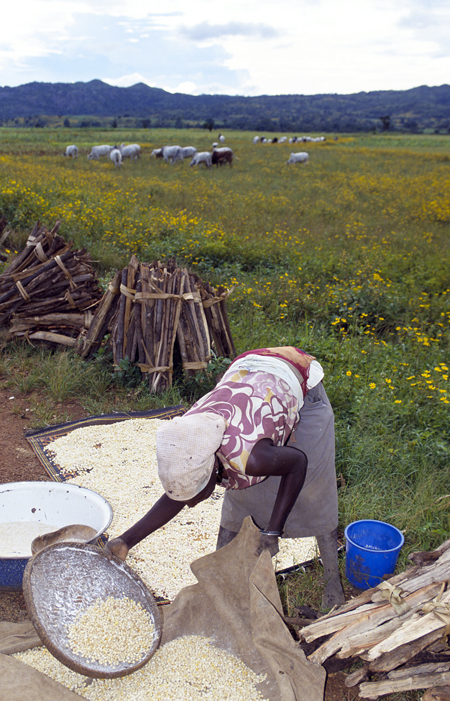
A woman working on a farm in Nigeria, a country whose oil wealth is thought to be an example of a resource curse. Its oil industry spurred a self-determination movement by the indigenous Ogoni people.
The economic mechanisms underpinning this phenomenon have been subject to intense debate. Scholars argue that export booms caused by the discovery of natural resources distort long-term economic growth by making other financial sectors (such as manufacturing and tourism) less attractive, leading investment dollars away from these slow-growth enterprises. Resource wealth is also linked with “Dutch disease,” whereby a booming resource sector inflates the exchange rate, reducing the competitiveness of other industries. Labor demands for resource extraction are generally for unskilled labor, pushing wages up and decreasing the incentive for education. Large natural resource endowments tend to result in little diversification, lower overall education rates, and few spin-offs into the broader economy.
Natural resources can further undermine political governance. States undergoing resource booms are flooded with more revenue than they can manage effectively. Many spend and borrow heavily on the strength of their resource, leaving them vulnerable to commodity price fluctuations. In this way, the volatility of commodity markets can overwhelm normal budgeting procedures and weaken state institutions.
Resource wealth also tends to make governments less accountable and less democratic. This occurs though a number of mechanisms: First, the rentier state effect, in which resource rents decrease the comparative importance of tax revenues, allowing states to govern based on networks of patronage rather than meeting the needs of citizens. Second, the repression effect, in which governments use resource revenues to repress or co-opt any opposition threats to their political power. Third, the mechanization retarding effect, in which heavy reliance on resource extraction fails to bring about the socioprofessional and cultural transformations that tend to promote a strong, independent civil society. The result is shortsighted and risk-averse states that prioritize preserving the status quo over promoting development or democratization. Governments that receive most of their wealth from natural resources thus tend to become more autocratic and less accountable to their citizens. Natural resources also play a role in weakening the power of national governments by increasing the likelihood of political rupture. Resource wealth weakens the state's territorial control by increasing regionalization: Groups living among these resources generally want a disproportionate amount of the gains and feel resentful at “their” wealth being extracted by the national authority. At the same time, resource wealth strengthens the viability as well as the will for secession by providing those in resource-rich areas with the capital to launch armed struggle. Oft-cited examples of resource wealth acting as a catalyst for political fragmentation include the secession movements of the Ogoni people in Nigeria, the Katanga region in the Democratic Republic of the Congo, and the Cabinda Province in Angola.
...
- Politics and Ecology
- Politics and People
- Politics Challenges
- Acid Rain
- Afforestation
- Anti-Toxics Movement
- Appropriate Technology
- Biodiversity
- Decentralization
- Deforestation
- Domination of Nature
- Endocrine Disrupters
- Environmental Justice
- Environmental Management
- Equity
- Future Generations
- Global Climate Change
- Globalization
- Groundwater
- Industrial Revolution
- Innovation, Environmental
- Kuznets Curve
- Limits to Growth
- Malthusianism
- Megacities
- Millennium Development Goals
- Nonviolence
- North–South Issues
- Nuclear Politics
- PCBs
- Precautionary Principle
- Regulatory Approaches
- Resource Curse
- Revolving Door
- Risk Assessment
- Risk Society
- Silent Spring
- Structural Adjustment
- Suburban Sprawl
- Sustainable Development
- Technology
- Toxics Release Inventory
- Tragedy of the Commons
- Transportation
- Uncertainty
- Urban Planning
- Wetlands
- Wilderness
- Agenda 21
- Bhopal
- Brundtland Commission
- Bureau of Land Management, U.S.
- Clean Air Act
- Clean Water Act
- Club of Rome
- Copenhagen Summit
- Corporate Responsibility
- Department of Energy, U.S.
- Endangered Species Act
- Environmental Nongovernmental Organizations
- Environmental Protection Agency, U.S.
- Fish and Wildlife Service, U.S.
- Forest Service, U.S.
- Institutions
- Intergovernmental Panel on Climate Change
- Kyoto Protocol
- Land Ethic
- Marine Mammal Protection Act
- Montreal Protocol
- NIMBY
- North American Free Trade Agreement Organizations
- Sagebrush Rebellion
- Stockholm Convention
- Transnational Advocacy Organizations
- Wise Use Movement
- World Trade Organization
- Politics Parties, Systems, and Economics
- Anarchism
- Basel Convention
- Biophilia
- Capitalism
- Citizen Juries
- Commodification
- Common Property Theory
- Conservation Enclosures
- Conservation Movement
- Consumer Politics
- Convention on Biodiversity
- Cost-Benefit Analysis
- Death of Environmentalism
- Democratic Party
- Ecocapitalism
- Ecofascism
- Ecosocialism
- Environmental Movement
- Federalism
- Gaia Hypothesis
- Gender
- Governmentality
- Green Discourse
- Green Neoliberalism
- Green Parties
- Green Washing
- International Whaling Commission
- Intrinsic Value
- Iron Triangle
- Participatory Democracy
- Petro-Capitalism
- Policy Process
- Political Ideology
- Politics of Scale
- Postmaterialism
- Power
- Pragmatism
- Skeptical Environmentalism
- Steady State Economy
- Transnational Capitalist Class
- UN Conference on Environment and Development
- UN Framework Convention on Climate Change
- Utilitarianism
- Water Politics
- Loading...
Get a 30 day FREE TRIAL
-
 Watch videos from a variety of sources bringing classroom topics to life
 -
Read modern, diverse business cases
-
Explore hundreds of books and reference titles

Read next

More like this
Sage Recommends
We found other relevant content for you on other Sage platforms.
Have you created a personal profile? Login or create a profile so that you can save clips, playlists and searches