
Entry
Reader's guide
Entries A-Z
Subject index
Industrial Ecology
Public opinion and various legal cases against industrial accidents and/or pollution have led to greater awareness among industrialists, authorities, and communities of the urgent need for industrial sustainability. Sustainable industrialization has emerged as a strategic, balanced, and developmental trend for facilitating socioeconomic benefits for the present generation without sacrificing the net industrial profits or compromising the needs of future generations and without impairing basic environmental quality and ecosystem processes and services. This has led to the new paradigm of “industrial ecology,” or IE—a field just about 20 years old and identified as one of the eight Grand Challenges of Environmental Science we are facing today.
IE is defined as the system-oriented study of the physical, chemical, and biological interactions/interrelationships both within industrial systems and between industrial and natural ecological systems. The idea of IE is based on a straightforward analogy with the natural ecological system, in which one seeks to optimize the total materials cycle from virgin material to finished material, to component, to product, to obsolete product, and to ultimate disposal. Factors to be optimized include resources, energy, and capital. It focuses on reducing the environmental impacts of goods and services and on innovations that can significantly improve environmental performance. Thus, it could help environmental policymakers address some of the core challenges of environmental policy, ranging from climate change to waste management to land use policy. In the following sections, we discuss the tools and strategies for IE, related policy developments across the globe, limitations in prevailing policies, and future perspectives.
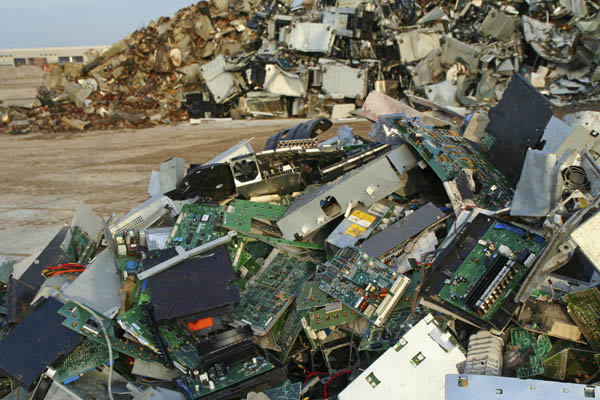
Industrial ecology considers the environmental effects of a product over its entire life cycle. The discipline attempts to address such problems as the disposal of electronics, such as these collected at an “e-waste” dump site.
Tools and Strategies for IE
The following are the most important tools of IE that can complement and enhance an integrated framework for sustainable industrialization:
Materials flow analysis or mass balance uses numerical data for direct inputs of materials in combination with chemical or engineering details of the processes being studied for analyzing resource flows. It is based on the fundamental physical principle that matter can neither be created nor destroyed. Therefore, the mass of inputs to a process, industry, or region equals the mass of outputs as products, emissions, and wastes, plus any change in stocks.
Life cycle assessment is used to determine the total environmental impact of a product throughout its life cycle (i.e., from cradle to grave). There are three basic stages in life cycle assessment: inventory analysis, impact analysis, and improvement analysis.
Strategic environmental assessment is conducted to ensure that the environmental consequences of proposed policies, plans, and programs are within prescribed limits and allows the integration of sustainability objectives at the earliest stage of the decision-making process.
In environmental risk assessment, the inherent hazards involved in processes or situations and the risks posed by these hazards are estimated either quantitatively or qualitatively. Environmental risk assessment includes human health risk assessments, ecological or eco-toxicological risk assessments, and specific industrial applications of risk assessment. Environmental risk assessment includes a number of
...
- Politics and Ecology
- Politics and People
- Politics Challenges
- Acid Rain
- Afforestation
- Anti-Toxics Movement
- Appropriate Technology
- Biodiversity
- Decentralization
- Deforestation
- Domination of Nature
- Endocrine Disrupters
- Environmental Justice
- Environmental Management
- Equity
- Future Generations
- Global Climate Change
- Globalization
- Groundwater
- Industrial Revolution
- Innovation, Environmental
- Kuznets Curve
- Limits to Growth
- Malthusianism
- Megacities
- Millennium Development Goals
- Nonviolence
- North–South Issues
- Nuclear Politics
- PCBs
- Precautionary Principle
- Regulatory Approaches
- Resource Curse
- Revolving Door
- Risk Assessment
- Risk Society
- Silent Spring
- Structural Adjustment
- Suburban Sprawl
- Sustainable Development
- Technology
- Toxics Release Inventory
- Tragedy of the Commons
- Transportation
- Uncertainty
- Urban Planning
- Wetlands
- Wilderness
- Agenda 21
- Bhopal
- Brundtland Commission
- Bureau of Land Management, U.S.
- Clean Air Act
- Clean Water Act
- Club of Rome
- Copenhagen Summit
- Corporate Responsibility
- Department of Energy, U.S.
- Endangered Species Act
- Environmental Nongovernmental Organizations
- Environmental Protection Agency, U.S.
- Fish and Wildlife Service, U.S.
- Forest Service, U.S.
- Institutions
- Intergovernmental Panel on Climate Change
- Kyoto Protocol
- Land Ethic
- Marine Mammal Protection Act
- Montreal Protocol
- NIMBY
- North American Free Trade Agreement Organizations
- Sagebrush Rebellion
- Stockholm Convention
- Transnational Advocacy Organizations
- Wise Use Movement
- World Trade Organization
- Politics Parties, Systems, and Economics
- Anarchism
- Basel Convention
- Biophilia
- Capitalism
- Citizen Juries
- Commodification
- Common Property Theory
- Conservation Enclosures
- Conservation Movement
- Consumer Politics
- Convention on Biodiversity
- Cost-Benefit Analysis
- Death of Environmentalism
- Democratic Party
- Ecocapitalism
- Ecofascism
- Ecosocialism
- Environmental Movement
- Federalism
- Gaia Hypothesis
- Gender
- Governmentality
- Green Discourse
- Green Neoliberalism
- Green Parties
- Green Washing
- International Whaling Commission
- Intrinsic Value
- Iron Triangle
- Participatory Democracy
- Petro-Capitalism
- Policy Process
- Political Ideology
- Politics of Scale
- Postmaterialism
- Power
- Pragmatism
- Skeptical Environmentalism
- Steady State Economy
- Transnational Capitalist Class
- UN Conference on Environment and Development
- UN Framework Convention on Climate Change
- Utilitarianism
- Water Politics
- Loading...
Get a 30 day FREE TRIAL
-
 Watch videos from a variety of sources bringing classroom topics to life
 -
Read modern, diverse business cases
-
Explore hundreds of books and reference titles

Read next

More like this
Sage Recommends
We found other relevant content for you on other Sage platforms.
Have you created a personal profile? Login or create a profile so that you can save clips, playlists and searches