
Entry
Reader's guide
Entries A-Z
Subject index
Indigenous Peoples
This article presents an overview of the environmental values, knowledge, and subsistence strategies of indigenous peoples both in their traditional contexts and in the contexts of colonialism and globalization. It discusses the current status of indigenous peoples in line with the 2007 United Nations Declaration on the Rights of Indigenous Peoples. It outlines indigenous environmental activism and precedent-setting legal cases. Finally, it discusses the model of biocultural diversity illustrated in Indigenous Conservation Areas that indigenous peoples manage and protect in line with traditional human–nature partnerships.
Historical Placement of Indigenous Peoples in the Human Timeline
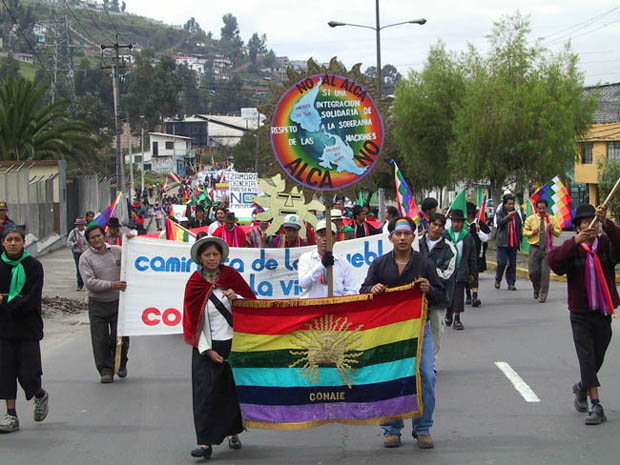
This indigenous political group called the Confederation of Indigenous Nationalities of Ecuador (CONAIE) protested the 2002 summit of the Free Trade Area of the Americas in Quito, Ecuador, on October 31, 2002.
The Industrial Revolution took place approximately seven generations ago. In contrast, the tenure on Earth of nonindustrialized peoples represented by today's indigenous cultures is an estimated 36,000 generations. Indigenous hunting-and-gathering peoples represent 99 percent of historic human cultures; in 2009, indigenous peoples still represent 90 percent of global cultural diversity. Indigenous cultures are intimately tied to their geographic homelands. Whatever the archeological evidence for the length of continuous residence for some on their lands—up to 100,000 years—indigenous peoples characteristically see themselves, their ways of life, and their lands as created in concert with one another.
Many of the indigenous peoples of the Americas, Australia, and Africa were hunters and gatherers. Others were farmers, like the dryland farmers of the American Southwest, who still live in villages thousands of years old, or the rice farmers of Asia. Others were fisherman, like the Coast Salish of Puget Sound, who lived in multifamily cedar longhouses that might cover an acre of ground. Still others practiced shifting horticulture, like the Kayapó of Brazil, who took more than one generation to move over their traditional territory, seeding wild gardens as they went. And some lived as island fisherman and yam gardeners in the Pacific or nomadic herders in the Middle East and Africa. Altogether, subsistence strategies of indigenous peoples entail some combination of hunting, gathering, fishing, herding, agriculture, and shifting horticulture in a context of ongoing flexibility and adaptation.
Today, many indigenous peoples are bicultural, as they both adhere to their ancient values and ways of life and respond to the pressures of the modern world.
Colonialism, Development, and Indigenous Subsistence Strategies
The 2007 United Nations Declaration on the Rights of Indigenous Peoples defines indigenous peoples as cultural communities having prior residence on lands within modern nation-states. It affirms the rights of these peoples both to cultural self-determination and to control their traditional lands and natural resources. It also points out the current marginalization of these peoples, resulting from a colonial legacy of disease, poverty, violence, starvation, slavery, and forced sterilization. Though indigenous peoples traditionally stabilized their populations by various child-spacing methods, many have a higher birth rate today, as they attempt to replace populations stressed to the brink of extinction. To set the repopulation of indigenous communities in the context of environmental impact, on a daily basis, a person living in a modern industrialized nation uses as much as two dozen times the natural resources as does an individual living in an indigenous community.
...
- Politics and Ecology
- Politics and People
- Politics Challenges
- Acid Rain
- Afforestation
- Anti-Toxics Movement
- Appropriate Technology
- Biodiversity
- Decentralization
- Deforestation
- Domination of Nature
- Endocrine Disrupters
- Environmental Justice
- Environmental Management
- Equity
- Future Generations
- Global Climate Change
- Globalization
- Groundwater
- Industrial Revolution
- Innovation, Environmental
- Kuznets Curve
- Limits to Growth
- Malthusianism
- Megacities
- Millennium Development Goals
- Nonviolence
- North–South Issues
- Nuclear Politics
- PCBs
- Precautionary Principle
- Regulatory Approaches
- Resource Curse
- Revolving Door
- Risk Assessment
- Risk Society
- Silent Spring
- Structural Adjustment
- Suburban Sprawl
- Sustainable Development
- Technology
- Toxics Release Inventory
- Tragedy of the Commons
- Transportation
- Uncertainty
- Urban Planning
- Wetlands
- Wilderness
- Agenda 21
- Bhopal
- Brundtland Commission
- Bureau of Land Management, U.S.
- Clean Air Act
- Clean Water Act
- Club of Rome
- Copenhagen Summit
- Corporate Responsibility
- Department of Energy, U.S.
- Endangered Species Act
- Environmental Nongovernmental Organizations
- Environmental Protection Agency, U.S.
- Fish and Wildlife Service, U.S.
- Forest Service, U.S.
- Institutions
- Intergovernmental Panel on Climate Change
- Kyoto Protocol
- Land Ethic
- Marine Mammal Protection Act
- Montreal Protocol
- NIMBY
- North American Free Trade Agreement Organizations
- Sagebrush Rebellion
- Stockholm Convention
- Transnational Advocacy Organizations
- Wise Use Movement
- World Trade Organization
- Politics Parties, Systems, and Economics
- Anarchism
- Basel Convention
- Biophilia
- Capitalism
- Citizen Juries
- Commodification
- Common Property Theory
- Conservation Enclosures
- Conservation Movement
- Consumer Politics
- Convention on Biodiversity
- Cost-Benefit Analysis
- Death of Environmentalism
- Democratic Party
- Ecocapitalism
- Ecofascism
- Ecosocialism
- Environmental Movement
- Federalism
- Gaia Hypothesis
- Gender
- Governmentality
- Green Discourse
- Green Neoliberalism
- Green Parties
- Green Washing
- International Whaling Commission
- Intrinsic Value
- Iron Triangle
- Participatory Democracy
- Petro-Capitalism
- Policy Process
- Political Ideology
- Politics of Scale
- Postmaterialism
- Power
- Pragmatism
- Skeptical Environmentalism
- Steady State Economy
- Transnational Capitalist Class
- UN Conference on Environment and Development
- UN Framework Convention on Climate Change
- Utilitarianism
- Water Politics
- Loading...
Get a 30 day FREE TRIAL
-
 Watch videos from a variety of sources bringing classroom topics to life
 -
Read modern, diverse business cases
-
Explore hundreds of books and reference titles

Read next

More like this
Sage Recommends
We found other relevant content for you on other Sage platforms.
Have you created a personal profile? Login or create a profile so that you can save clips, playlists and searches