
Entry
Reader's guide
Entries A-Z
Subject index
Groundwater
Water exists in many forms including water vapor, liquid, and ice, all of which are found on Earth including atmospheric moisture, precipitation, soil moisture, groundwater, ice, snow, oceans, and seas; within plants and animals; in lakes, streams, and rivers; and in man-made reservoirs. Water cycles between these forms both visibly, as when atmospheric moisture falls as rain, and invisibly, as when precipitation seeps into the soil to become groundwater. Water makes up 70 percent of the Earth's surface. Most of the water is contained in the oceans, with only a small percentage available as freshwater, most of which is frozen in glaciers.
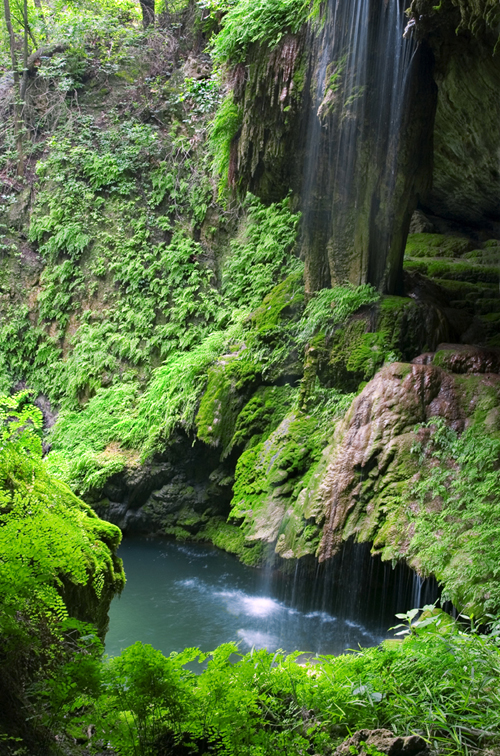
Groundwater reaches the surface through springs like this one in the Westcave Preserve in Texas. Groundwater is the biggest source of freshwater for human consumption.
Freshwater constitutes approximately 2.5 percent of all terrestrial water sources, with only 0.75 percent being groundwater. This amount of water sounds minuscule, but a comparison between available surface and groundwater resources reveals quite a difference. At any given time, the Earth contains roughly 30,300 cubic miles of surface water resources contained in lakes and streams compared with millions of cubic miles of groundwater available within a half-mile of the land surface. With that comparison in mind, it comes as no surprise that groundwater is the largest single supply of freshwater available for human consumption. Groundwater resides below the surface of the Earth in porous layers of rock and sand called aquifers. Soil and rock strata differ in porosity, in the amount of water that can be held in the soil, and in permeability—the rate at which water flows through the soil. An aquifer that holds groundwater between layers of relatively impermeable rock or soil (e.g., clay or shale) is called a confined aquifer. Some confined aquifers are under pressure, such that when a natural opening, such as an artesian spring, or a man-made opening, such as a well, taps into the confined aquifer, water emerges from the surface under pressure. Unconfined aquifers are characterized by relative permeability between the ground surface and the water table below the surface where groundwater is stored.
Groundwater can be found almost everywhere on Earth at varying depths, some very near the surface, as in the case of wetlands, or at some depth below the surface, as in some dry areas in the western United States. Groundwater close to the surface may be just a few hours old, whereas groundwater located far beneath the surface of the Earth might be thousands of years old. Often, the older the groundwater, the more difficult it is to replenish by natural means.
Recharging Groundwater
Groundwater is most often recharged through percolation from rainfall and snowmelt or from nearby surface water. Surface water under the influence of groundwater describes locations where groundwater and surface water are interconnected. In these cases, either water from lakes, rivers, and streams can flow into the groundwater, in essence recharging the aquifer, or groundwater can flow into the surface water, diminishing the aquifer. Rivers and streams can receive as much as half of their flow from groundwater. Groundwater also plays a large role in the health of wetlands.
...
- Politics and Ecology
- Politics and People
- Politics Challenges
- Acid Rain
- Afforestation
- Anti-Toxics Movement
- Appropriate Technology
- Biodiversity
- Decentralization
- Deforestation
- Domination of Nature
- Endocrine Disrupters
- Environmental Justice
- Environmental Management
- Equity
- Future Generations
- Global Climate Change
- Globalization
- Groundwater
- Industrial Revolution
- Innovation, Environmental
- Kuznets Curve
- Limits to Growth
- Malthusianism
- Megacities
- Millennium Development Goals
- Nonviolence
- North–South Issues
- Nuclear Politics
- PCBs
- Precautionary Principle
- Regulatory Approaches
- Resource Curse
- Revolving Door
- Risk Assessment
- Risk Society
- Silent Spring
- Structural Adjustment
- Suburban Sprawl
- Sustainable Development
- Technology
- Toxics Release Inventory
- Tragedy of the Commons
- Transportation
- Uncertainty
- Urban Planning
- Wetlands
- Wilderness
- Agenda 21
- Bhopal
- Brundtland Commission
- Bureau of Land Management, U.S.
- Clean Air Act
- Clean Water Act
- Club of Rome
- Copenhagen Summit
- Corporate Responsibility
- Department of Energy, U.S.
- Endangered Species Act
- Environmental Nongovernmental Organizations
- Environmental Protection Agency, U.S.
- Fish and Wildlife Service, U.S.
- Forest Service, U.S.
- Institutions
- Intergovernmental Panel on Climate Change
- Kyoto Protocol
- Land Ethic
- Marine Mammal Protection Act
- Montreal Protocol
- NIMBY
- North American Free Trade Agreement Organizations
- Sagebrush Rebellion
- Stockholm Convention
- Transnational Advocacy Organizations
- Wise Use Movement
- World Trade Organization
- Politics Parties, Systems, and Economics
- Anarchism
- Basel Convention
- Biophilia
- Capitalism
- Citizen Juries
- Commodification
- Common Property Theory
- Conservation Enclosures
- Conservation Movement
- Consumer Politics
- Convention on Biodiversity
- Cost-Benefit Analysis
- Death of Environmentalism
- Democratic Party
- Ecocapitalism
- Ecofascism
- Ecosocialism
- Environmental Movement
- Federalism
- Gaia Hypothesis
- Gender
- Governmentality
- Green Discourse
- Green Neoliberalism
- Green Parties
- Green Washing
- International Whaling Commission
- Intrinsic Value
- Iron Triangle
- Participatory Democracy
- Petro-Capitalism
- Policy Process
- Political Ideology
- Politics of Scale
- Postmaterialism
- Power
- Pragmatism
- Skeptical Environmentalism
- Steady State Economy
- Transnational Capitalist Class
- UN Conference on Environment and Development
- UN Framework Convention on Climate Change
- Utilitarianism
- Water Politics
- Loading...
Get a 30 day FREE TRIAL
-
 Watch videos from a variety of sources bringing classroom topics to life
 -
Read modern, diverse business cases
-
Explore hundreds of books and reference titles

Read next

More like this
Sage Recommends
We found other relevant content for you on other Sage platforms.
Have you created a personal profile? Login or create a profile so that you can save clips, playlists and searches