
Entry
Reader's guide
Entries A-Z
Subject index
Forest Service
From the early colonial vision of forests as a wilderness to be tamed to their current status as major recreational lands and touchstones of environmental controversy, the forests of the United States have always captured the American imagination. The national forests, and the Forest Service that manages them, provide a record of the nation's evolving relationship to the natural environment. The U.S. Forest Service is the largest natural resources research organization in the world, managing 193 million acres of national forests and grasslands. The service, and much of its approach to management, grew out of a desire to manage the timber resource for human consumption. Perhaps more than any other agency, however, the Forest Service became deeply embroiled in the contentious development of U.S. environmental law and policy.
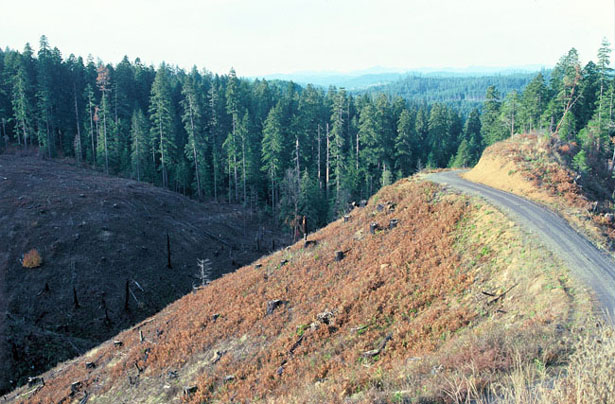
The controversy over clear-cutting forests such as this one in Oregon, which had been a habitat for the northern spotted owl, led to the adoption of new priorities for the U.S. Forest Service beginning in 2000.
In 1799, the young nation's first federal forest protections grew out of a need for timber to build the U.S. Navy's ships in the 18th century. When these ship-building needs were met by iron, however, the need for and enforcement of these protections faded. For much of the 19th century, federal land policy focused on expansion through taming the wilderness, causing rapid depletion of the United States' vast forest expanse.
By the 1870s, however, concern for the loss of forest resources began to rise. Several states enacted laws for the protection of forests. In 1876, Congress appointed a special agent to assess the state of forests and, in 1881, it established the Division of Forestry (subsequently renamed the Bureau of Forestry)—the precursor of today's Forest Service—within the Department of Agriculture. In 1891, Congress passed the Forest Reserve Act, authorizing the president to designate portions of public land as “forest reserves” managed by the Department of the Interior, and thereby laid the groundwork for today's national forests. The act did not provide significant guidelines for managing the forest reserves, however, and two visions of managing the forests competed: preservation and conservation.
Preservation versus Conservation
Preservationists, including John Muir and later Aldo Leopold, asserted that the forests should be protected for their intrinsic value and enjoyed primarily as they naturally exist. Conservationists, including Gifford Pinchot, focused on the use of forests as resources to meet human needs. In the late 19th and early 20th centuries, conservationists saw timber extraction as the primary use of the forest and sought to apply scientific management principles to ensure a consistent supply of the resource. Other recognized uses included grazing, hunting, and water supply.
In the 1897 Organic Act, Congress addressed administration of forest reserves, authorizing federal agency oversight to protect water flows and ensure timber supply. The Organic Act, therefore, marks the beginning of modern comprehensive federal forest management. It also supported conservationist management approaches.
In 1905, Congress transferred authority over the forest reserves to the U.S. Forest Service, which evolved directly from Bureau of Forestry within the Department of Agriculture. Pinchot became the first chief of the U.S. Forest Service. Pinchot maintained a close relationship with President Theodore Roosevelt, and the two men shared similar visions for the management of forest lands.
...
- Politics and Ecology
- Politics and People
- Politics Challenges
- Acid Rain
- Afforestation
- Anti-Toxics Movement
- Appropriate Technology
- Biodiversity
- Decentralization
- Deforestation
- Domination of Nature
- Endocrine Disrupters
- Environmental Justice
- Environmental Management
- Equity
- Future Generations
- Global Climate Change
- Globalization
- Groundwater
- Industrial Revolution
- Innovation, Environmental
- Kuznets Curve
- Limits to Growth
- Malthusianism
- Megacities
- Millennium Development Goals
- Nonviolence
- North–South Issues
- Nuclear Politics
- PCBs
- Precautionary Principle
- Regulatory Approaches
- Resource Curse
- Revolving Door
- Risk Assessment
- Risk Society
- Silent Spring
- Structural Adjustment
- Suburban Sprawl
- Sustainable Development
- Technology
- Toxics Release Inventory
- Tragedy of the Commons
- Transportation
- Uncertainty
- Urban Planning
- Wetlands
- Wilderness
- Agenda 21
- Bhopal
- Brundtland Commission
- Bureau of Land Management, U.S.
- Clean Air Act
- Clean Water Act
- Club of Rome
- Copenhagen Summit
- Corporate Responsibility
- Department of Energy, U.S.
- Endangered Species Act
- Environmental Nongovernmental Organizations
- Environmental Protection Agency, U.S.
- Fish and Wildlife Service, U.S.
- Forest Service, U.S.
- Institutions
- Intergovernmental Panel on Climate Change
- Kyoto Protocol
- Land Ethic
- Marine Mammal Protection Act
- Montreal Protocol
- NIMBY
- North American Free Trade Agreement Organizations
- Sagebrush Rebellion
- Stockholm Convention
- Transnational Advocacy Organizations
- Wise Use Movement
- World Trade Organization
- Politics Parties, Systems, and Economics
- Anarchism
- Basel Convention
- Biophilia
- Capitalism
- Citizen Juries
- Commodification
- Common Property Theory
- Conservation Enclosures
- Conservation Movement
- Consumer Politics
- Convention on Biodiversity
- Cost-Benefit Analysis
- Death of Environmentalism
- Democratic Party
- Ecocapitalism
- Ecofascism
- Ecosocialism
- Environmental Movement
- Federalism
- Gaia Hypothesis
- Gender
- Governmentality
- Green Discourse
- Green Neoliberalism
- Green Parties
- Green Washing
- International Whaling Commission
- Intrinsic Value
- Iron Triangle
- Participatory Democracy
- Petro-Capitalism
- Policy Process
- Political Ideology
- Politics of Scale
- Postmaterialism
- Power
- Pragmatism
- Skeptical Environmentalism
- Steady State Economy
- Transnational Capitalist Class
- UN Conference on Environment and Development
- UN Framework Convention on Climate Change
- Utilitarianism
- Water Politics
- Loading...
Get a 30 day FREE TRIAL
-
 Watch videos from a variety of sources bringing classroom topics to life
 -
Read modern, diverse business cases
-
Explore hundreds of books and reference titles

Read next

More like this
Sage Recommends
We found other relevant content for you on other Sage platforms.
Have you created a personal profile? Login or create a profile so that you can save clips, playlists and searches