
Entry
Reader's guide
Entries A-Z
Subject index
Fish & Wildlife Service
The U.S. Fish & Wildlife Service (FWS) facilitates the conservation, development, and management of the country's fish and wildlife resources, as well as conducts public outreach and education pertaining to the wise use of fish and wildlife resources. Housed within the Department of the Interior, FWS works with others to “conserve, protect and enhance fish, wildlife and plants and their habitats for the continuing benefit of the American people.” To fulfill this mission, the service seeks to cultivate an ethic of environmental stewardship guided by ecological principles, scientific knowledge, and a sense of moral responsibility. The FWS's primary tasks include enforcement of the Endangered Species Act and other wildlife laws, management of the nation's wildlife refuges including the Arctic National Wildlife Refuge, direction of the nation's fish hatcheries, distribution of federal aid to state fish and wildlife agencies, and assistance in international conservation efforts. The mission, objectives, and functions of the FWS have been crucial for propagating the ideals of the U.S. conservation movement.
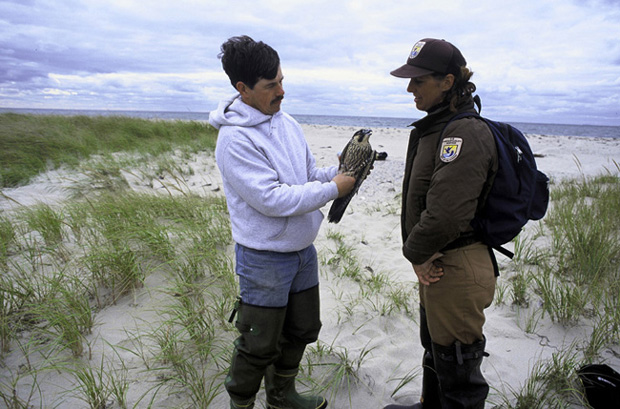
These U.S. Fish & Wildlife Service employees were working with a formerly endangered peregrine falcon at the Monomoy National Wildlife Refuge in Chatham, Massachusetts, in April 2008.
In the late 1800s, scientists, policymakers, and a growing number of citizens began to pay increasing attention to the rapid depletion and degradation of the nation's natural resources. Early conservationists organized groups such as the Sierra Club (1892) and the Audubon Society (1896) to ensure the continued use of natural resources for present and future generations. Following these actions, Congress undertook a number of conservation measures, including the establishment of the Commission on Fish and Fisheries (1871), which was the precursor to the current FWS. The commission's initial purpose was to investigate declining food fish populations and to promote their regeneration. In 1885, Congress established the Division of Economic Ornithology and Mammalogy (later renamed the Bureau of Biological Survey) within the Department of Agriculture to investigate the relationship between birds and agricultural pests and to delineate the spatial distribution of plants and animals throughout the country. In 1939, the Department of the Interior assumed control over the Commission on Fish and Fisheries and the Bureau of Biological Survey and joined the two in 1940 to create the FWS.
A series of evolving legislation and executive orders granted the FWS authority to carry out its mission to conserve the nation's fish and wildlife resources. The first federal legislation to protect wildlife, the Lacey Act (1900), prohibited the interstate shipment of illegally taken wildlife and the importation of species. In 1903, an executive order by President Theodore Roosevelt established the first Federal Bird Reservation on Pelican Island in Florida. The Migratory Bird Treaty Act of 1918 implemented the Convention Between the U.S. and Great Britain (for Canada) and set limits on migratory bird hunting in North America. In 1934, the Migratory Bird Hunting Stamp Act, known as the “Duck Stamp Act,” required waterfowl hunters to purchase a stamp, which served as a license, with the proceeds going to purchase waterfowl habitat—nearly 5 million acres purchased thus far. In 1937, the Pittman-Robertson Act provided funds for the improvement of wildlife research and dissemination, and the 1950 Dingell-Johnson Act created programs for restoring and improving U.S. fishery resources. The 1956 Fish and Wildlife Act created two new bureaus within the FWS, the Bureau of Commercial Fisheries and the Bureau of Sport Fisheries and Wildlife. The Bureau of Commercial Fisheries was transferred to the Department of Commerce in 1970 and renamed the National Marine Fisheries Service.
...
- Politics and Ecology
- Politics and People
- Politics Challenges
- Acid Rain
- Afforestation
- Anti-Toxics Movement
- Appropriate Technology
- Biodiversity
- Decentralization
- Deforestation
- Domination of Nature
- Endocrine Disrupters
- Environmental Justice
- Environmental Management
- Equity
- Future Generations
- Global Climate Change
- Globalization
- Groundwater
- Industrial Revolution
- Innovation, Environmental
- Kuznets Curve
- Limits to Growth
- Malthusianism
- Megacities
- Millennium Development Goals
- Nonviolence
- North–South Issues
- Nuclear Politics
- PCBs
- Precautionary Principle
- Regulatory Approaches
- Resource Curse
- Revolving Door
- Risk Assessment
- Risk Society
- Silent Spring
- Structural Adjustment
- Suburban Sprawl
- Sustainable Development
- Technology
- Toxics Release Inventory
- Tragedy of the Commons
- Transportation
- Uncertainty
- Urban Planning
- Wetlands
- Wilderness
- Agenda 21
- Bhopal
- Brundtland Commission
- Bureau of Land Management, U.S.
- Clean Air Act
- Clean Water Act
- Club of Rome
- Copenhagen Summit
- Corporate Responsibility
- Department of Energy, U.S.
- Endangered Species Act
- Environmental Nongovernmental Organizations
- Environmental Protection Agency, U.S.
- Fish and Wildlife Service, U.S.
- Forest Service, U.S.
- Institutions
- Intergovernmental Panel on Climate Change
- Kyoto Protocol
- Land Ethic
- Marine Mammal Protection Act
- Montreal Protocol
- NIMBY
- North American Free Trade Agreement Organizations
- Sagebrush Rebellion
- Stockholm Convention
- Transnational Advocacy Organizations
- Wise Use Movement
- World Trade Organization
- Politics Parties, Systems, and Economics
- Anarchism
- Basel Convention
- Biophilia
- Capitalism
- Citizen Juries
- Commodification
- Common Property Theory
- Conservation Enclosures
- Conservation Movement
- Consumer Politics
- Convention on Biodiversity
- Cost-Benefit Analysis
- Death of Environmentalism
- Democratic Party
- Ecocapitalism
- Ecofascism
- Ecosocialism
- Environmental Movement
- Federalism
- Gaia Hypothesis
- Gender
- Governmentality
- Green Discourse
- Green Neoliberalism
- Green Parties
- Green Washing
- International Whaling Commission
- Intrinsic Value
- Iron Triangle
- Participatory Democracy
- Petro-Capitalism
- Policy Process
- Political Ideology
- Politics of Scale
- Postmaterialism
- Power
- Pragmatism
- Skeptical Environmentalism
- Steady State Economy
- Transnational Capitalist Class
- UN Conference on Environment and Development
- UN Framework Convention on Climate Change
- Utilitarianism
- Water Politics
- Loading...
Get a 30 day FREE TRIAL
-
 Watch videos from a variety of sources bringing classroom topics to life
 -
Read modern, diverse business cases
-
Explore hundreds of books and reference titles

Read next

More like this
Sage Recommends
We found other relevant content for you on other Sage platforms.
Have you created a personal profile? Login or create a profile so that you can save clips, playlists and searches