
Entry
Reader's guide
Entries A-Z
Subject index
Environmental Justice
Although there is not a standard definition of what constitutes environmental justice, the environmental justice movement grew out of the inequitable distribution of environmental hazards among poor and minority citizens. Their advocacy is based on the premise that all people deserve to live in a clean and safe environment free from industrial waste and pollution that can adversely affect their health and well-being. Environmental justice seeks to bring this ideal state of the world into reality. A society that embraced environmental justice would ensure that all of the costs that accompany living in an industrialized nation are equally and fairly distributed among citizens and that a nation's minority and/or underprivileged populations are not facing inequitable environmental burdens. From a policy perspective, practicing environmental justice entails ensuring that all citizens receive the same degree of protection from environmental hazards by the government.
The environmental justice movement combines traditional environmentalism with the conviction that all individuals have the right to live in a safe environment. It started as a grassroots movement during the early 1980s in pockets of the country where minorities and the underprivileged faced environmental burdens. It has evolved into community initiatives, federal offices, and a presidential executive order. A criticism of the environmental justice movement is sometimes levied from mainstream environmentalists who believe this is not an environmental movement but a social justice movement.
Since the early 1980s, the environmental justice movement has been working toward ending the practice of siting waste-storing or waste-producing facilities, like this power plant, in poor or minority communities.
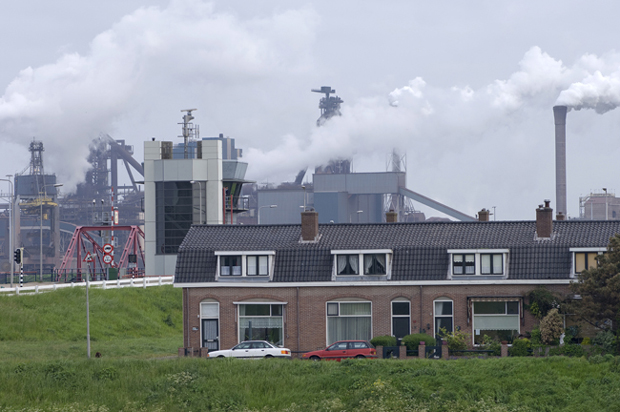
Environmental justice does not have a birthplace or date of conception. It grew out of the many movements by local groups that sought to protect their own health and well-being, and that of others in their community. One such grassroots start-up formed in the early 1980s in Warren County, North Carolina—the home of a polychlorinated biphenyl landfill. The citizens of Warren and surrounding counties had been the victims of midnight dumping, as industrial polluters dumped thousands of gallons of polychlorinated biphenyl–laden oil along their roadways in the middle of the night. The company and contractor accused of dumping explained that the motive for dumping was to avoid paying for the recycling costs of the oil. In an effort to deal with the dumping crisis, the state of North Carolina created a toxic landfill in Warren County. The residents in Warren County were mainly African American, and it was also one of the poorest counties in the state of North Carolina. Residents felt that the county was picked for the landfill based on its demographic characteristics. Citizens rallied together to try to prevent the dump. They wrote letters, held demonstrations, and blocked trucks. Although successful in gaining media attention, the landfill was eventually developed.
The events in Warren County eventually led to the coining of the term environmental racism. This term refers to the targeting of communities for the placement of waste-generating or waste-storing facilities or to the discrimination in the enforcement of environmental standards in communities or neighborhoods based on the racial characteristics of the residents. In the book Dumping in Dixie, Robert Bullard examines the location of waste disposal facilities in five communities. Using demographic data based on the Zip codes in which the facilities are located, Bullard concludes that the prosperity of a community is not as good a predictor of hazardous waste locations as is the race of the residents. He concludes that choosing where to locate a waste facility often includes racism. Racism has often been used to describe an individual's decision to discriminate against a person or group of people based on their race. This would be applicable in cases in which a company decided to site a hazardous waste–producing facility in a minority neighborhood simply because of the number of minorities living there. Environmental racism is often a form of institutional racism, however. Institutional racism is not based on individual discrimination but, rather, on discriminatory practices that become part and parcel of the practices, traditions, and polices of organizations or society.
...
- Politics and Ecology
- Politics and People
- Politics Challenges
- Acid Rain
- Afforestation
- Anti-Toxics Movement
- Appropriate Technology
- Biodiversity
- Decentralization
- Deforestation
- Domination of Nature
- Endocrine Disrupters
- Environmental Justice
- Environmental Management
- Equity
- Future Generations
- Global Climate Change
- Globalization
- Groundwater
- Industrial Revolution
- Innovation, Environmental
- Kuznets Curve
- Limits to Growth
- Malthusianism
- Megacities
- Millennium Development Goals
- Nonviolence
- North–South Issues
- Nuclear Politics
- PCBs
- Precautionary Principle
- Regulatory Approaches
- Resource Curse
- Revolving Door
- Risk Assessment
- Risk Society
- Silent Spring
- Structural Adjustment
- Suburban Sprawl
- Sustainable Development
- Technology
- Toxics Release Inventory
- Tragedy of the Commons
- Transportation
- Uncertainty
- Urban Planning
- Wetlands
- Wilderness
- Agenda 21
- Bhopal
- Brundtland Commission
- Bureau of Land Management, U.S.
- Clean Air Act
- Clean Water Act
- Club of Rome
- Copenhagen Summit
- Corporate Responsibility
- Department of Energy, U.S.
- Endangered Species Act
- Environmental Nongovernmental Organizations
- Environmental Protection Agency, U.S.
- Fish and Wildlife Service, U.S.
- Forest Service, U.S.
- Institutions
- Intergovernmental Panel on Climate Change
- Kyoto Protocol
- Land Ethic
- Marine Mammal Protection Act
- Montreal Protocol
- NIMBY
- North American Free Trade Agreement Organizations
- Sagebrush Rebellion
- Stockholm Convention
- Transnational Advocacy Organizations
- Wise Use Movement
- World Trade Organization
- Politics Parties, Systems, and Economics
- Anarchism
- Basel Convention
- Biophilia
- Capitalism
- Citizen Juries
- Commodification
- Common Property Theory
- Conservation Enclosures
- Conservation Movement
- Consumer Politics
- Convention on Biodiversity
- Cost-Benefit Analysis
- Death of Environmentalism
- Democratic Party
- Ecocapitalism
- Ecofascism
- Ecosocialism
- Environmental Movement
- Federalism
- Gaia Hypothesis
- Gender
- Governmentality
- Green Discourse
- Green Neoliberalism
- Green Parties
- Green Washing
- International Whaling Commission
- Intrinsic Value
- Iron Triangle
- Participatory Democracy
- Petro-Capitalism
- Policy Process
- Political Ideology
- Politics of Scale
- Postmaterialism
- Power
- Pragmatism
- Skeptical Environmentalism
- Steady State Economy
- Transnational Capitalist Class
- UN Conference on Environment and Development
- UN Framework Convention on Climate Change
- Utilitarianism
- Water Politics
- Loading...
Get a 30 day FREE TRIAL
-
 Watch videos from a variety of sources bringing classroom topics to life
 -
Read modern, diverse business cases
-
Explore hundreds of books and reference titles

Read next

More like this
Sage Recommends
We found other relevant content for you on other Sage platforms.
Have you created a personal profile? Login or create a profile so that you can save clips, playlists and searches