
Entry
Reader's guide
Entries A-Z
Subject index
Endocrine Disrupters
Endocrine disruptors are substances that act like hormones in a body. Examples include DDT, PCBs, and the controversial Bisphenol A. They are hormonally active agents that are exogenous (originate outside of affected organism). If present and active they may affect either cells or an individual organism. In medicine, exogenous factors may be pathogens or therapeutics. These exogenous factors include DNA transfers, viral infections, and carcinogens. When these substances act like hormones, they affect the endocrine system's functions, which are to release hormones that are chemicals used as an informational system in the body. Hormones are analogous to the signals sent through the nervous system but use blood vessels rather than nerve tissue. In humans, the major endocrine system parts include (from head to toe) the pineal gland, pituitary gland, thyroid gland, thymus, adrenal glands, and pancreas. Reproductive glands in females are the ovaries and in males the testes. Endocrine pathologies number in the hundreds—some are common (diabetes mellitus, thyroid disease, and obesity), and others such as Cushing's syndrome (pituitary gland) or Addison's disease (adrenal glands) are rare. Endocrine pathology classifies endocrine disorders as primary, secondary, and tertiary. Cancer can also affect the endocrine system in a number of ways.
Endocrine disrupters have been linked in numerous studies to negative biological effects. These studies of laboratory animals given low doses of various endocrine disrupters suggest that they can produce adverse effects in humans. Tragically, some endocrine disrupters have been administered as therapies. For example, in the 1970 the drug diethylstilbestrol was prescribed to over five million pregnant women as a way to block spontaneous abortions. However, it was discovered that the children born to women who had received diethylstilbestrol developed significant reproductive problems during puberty. The problems included disruption of reproductive development and vaginal cancer in some cases.
In 2007, the chemical bisphenol A came under scrutiny as an endocrine disrupter. In March 2007, a class action lawsuit was filed in California against manufacturers of plastic baby bottles on the grounds that the chemical was in the plastic bottles and posed a developmental health risk.
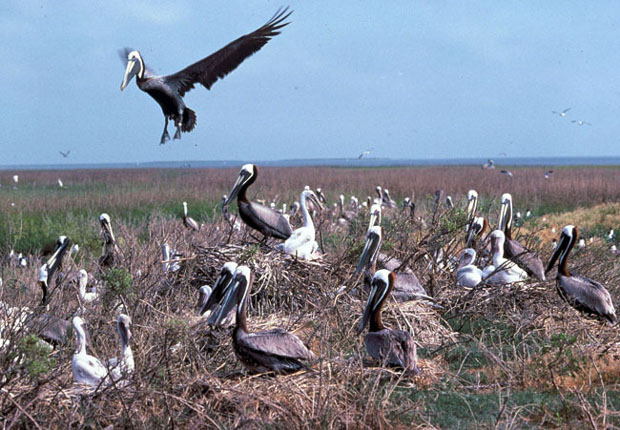
DDT (dichlorodiphenyltrichloroethane) was hailed as a magic chemical for killing insect vermin such as lice, roaches, ants, and mosquitoes, as well as other insects. However, after years of often indiscriminate use, negative effects appeared that were described by Rachel Carson in Silent Spring (1962). Her argument was that pesticides, herbicides, and other chemicals used in the environment were affecting wildlife, and thus could also affect humans. The most infamous example of DDT affecting wildlife was the effect it had on large raptors' eggshell thickness. The shell must be thick enough to withstand the stresses of incubation but not so thick that the chick cannot peck its way out at the appropriate time. DTT was found to interfere with the shell thickness as an endocrine disrupter.
Adult and juvenile brown pelicans at a nesting colony in Florida. Brown pelicans suffered population declines because dichlorodiphenyltrichloroethane (DDT) weakened the shells of their eggs, which then ruptured during incubation.
...
- Politics and Ecology
- Politics and People
- Politics Challenges
- Acid Rain
- Afforestation
- Anti-Toxics Movement
- Appropriate Technology
- Biodiversity
- Decentralization
- Deforestation
- Domination of Nature
- Endocrine Disrupters
- Environmental Justice
- Environmental Management
- Equity
- Future Generations
- Global Climate Change
- Globalization
- Groundwater
- Industrial Revolution
- Innovation, Environmental
- Kuznets Curve
- Limits to Growth
- Malthusianism
- Megacities
- Millennium Development Goals
- Nonviolence
- North–South Issues
- Nuclear Politics
- PCBs
- Precautionary Principle
- Regulatory Approaches
- Resource Curse
- Revolving Door
- Risk Assessment
- Risk Society
- Silent Spring
- Structural Adjustment
- Suburban Sprawl
- Sustainable Development
- Technology
- Toxics Release Inventory
- Tragedy of the Commons
- Transportation
- Uncertainty
- Urban Planning
- Wetlands
- Wilderness
- Agenda 21
- Bhopal
- Brundtland Commission
- Bureau of Land Management, U.S.
- Clean Air Act
- Clean Water Act
- Club of Rome
- Copenhagen Summit
- Corporate Responsibility
- Department of Energy, U.S.
- Endangered Species Act
- Environmental Nongovernmental Organizations
- Environmental Protection Agency, U.S.
- Fish and Wildlife Service, U.S.
- Forest Service, U.S.
- Institutions
- Intergovernmental Panel on Climate Change
- Kyoto Protocol
- Land Ethic
- Marine Mammal Protection Act
- Montreal Protocol
- NIMBY
- North American Free Trade Agreement Organizations
- Sagebrush Rebellion
- Stockholm Convention
- Transnational Advocacy Organizations
- Wise Use Movement
- World Trade Organization
- Politics Parties, Systems, and Economics
- Anarchism
- Basel Convention
- Biophilia
- Capitalism
- Citizen Juries
- Commodification
- Common Property Theory
- Conservation Enclosures
- Conservation Movement
- Consumer Politics
- Convention on Biodiversity
- Cost-Benefit Analysis
- Death of Environmentalism
- Democratic Party
- Ecocapitalism
- Ecofascism
- Ecosocialism
- Environmental Movement
- Federalism
- Gaia Hypothesis
- Gender
- Governmentality
- Green Discourse
- Green Neoliberalism
- Green Parties
- Green Washing
- International Whaling Commission
- Intrinsic Value
- Iron Triangle
- Participatory Democracy
- Petro-Capitalism
- Policy Process
- Political Ideology
- Politics of Scale
- Postmaterialism
- Power
- Pragmatism
- Skeptical Environmentalism
- Steady State Economy
- Transnational Capitalist Class
- UN Conference on Environment and Development
- UN Framework Convention on Climate Change
- Utilitarianism
- Water Politics
- Loading...
Get a 30 day FREE TRIAL
-
 Watch videos from a variety of sources bringing classroom topics to life
 -
Read modern, diverse business cases
-
Explore hundreds of books and reference titles

Read next

More like this
Sage Recommends
We found other relevant content for you on other Sage platforms.
Have you created a personal profile? Login or create a profile so that you can save clips, playlists and searches