
Entry
Reader's guide
Entries A-Z
Subject index
Ecology
Ecology is possibly one of the most ancient disciplines. Its evolution has been gradual, and it will continue to evolve with humankind's ability to comprehend and understand his own surroundings and the interaction of its components. Rooted in the Greek word oikos, which means home, the subject shares its origin with the study of economics. The term ecology is fairly recent, coined by German biologist Ernst Haeckel in 1869. It is pertinent for students of ecology to deeply appreciate its fundamental principles, subdivisions, constraints, and challenges and some of the recent breakthroughs ecologists have made in advancing the subject.
Engagements with the basic tenets of ecology have a long history, with some of the earliest written reflections of the natural world in the writings of Greek philosophers like Hippocrates and Aristotle. In the early 1700s, Anton van Leeuwenhoek, the philosopher and scientist, initiated the study of living beings and their linkages through the food chain and population regulation. There have been several efforts to define “ecology;” possibly the simplest definition offered by E. P. Odum was “the study of the structure and function of nature.” Hanns Reiter was probably the first to combine the words oikos (house) and logis (study of) to form the term ecology. French zoologist Isodore Geoffroy St. Hilaire proposed the term ethology for the study of the relations of the organisms within the family and society in the aggregate and in the community. Today ethology has become synonymous with animal behavior. St. George Jackson Mivart coined the term hexicology in 1894 to describe the study of relations between organisms and their environment as regards the nature of the locality they frequent, the temperatures that suit them, and their relations to other organisms as enemies, rivals, or accidental and involuntary benefactors. Concerned with the sociology and economics of animals, Charles Elton, a British ecologist, defined ecology as “scientific natural history.”
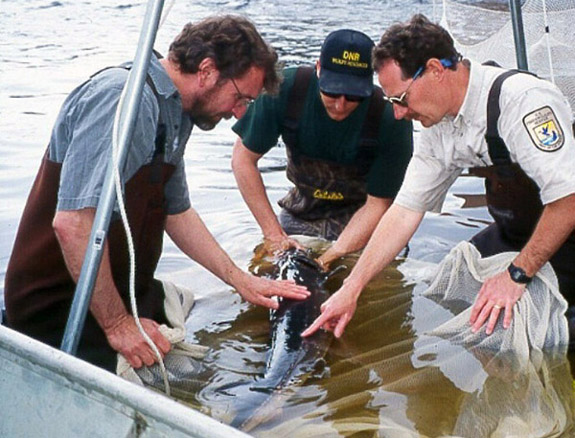
Ecologists need to understand both a species and the surrounding ecosystem to address increasing environmental pressures. These scientists are working with Native American tribes to monitor a threatened population of lake sturgeon in Wisconsin.
The domain and scope of ecology is vast and cuts across many other disciplines that entail human endeavors and nature. Broadly, the subject has two divisions: autecology, which involves study of one organism or an individual species, and synecology, which deals with a group of organisms that are associated together as a unit. A very commonly used term in the science of ecology is ecosystem, which is a community of interacting organisms together with the physical environment within which it exists, and with which the species in the community also interact. Ecosystems can be natural, such as terrestrial, including forests and deserts; aquatic (freshwater and marine); or man-made, such as an agricultural, rural, or urban landscape. The boundaries of ecosystems are not very rigid—an ecosystem can be anything from a small pond, to an ocean or a small aquarium, to a vast rainforest; thus, a hierarchy exists from very local to global.
...
- Politics and Ecology
- Politics and People
- Politics Challenges
- Acid Rain
- Afforestation
- Anti-Toxics Movement
- Appropriate Technology
- Biodiversity
- Decentralization
- Deforestation
- Domination of Nature
- Endocrine Disrupters
- Environmental Justice
- Environmental Management
- Equity
- Future Generations
- Global Climate Change
- Globalization
- Groundwater
- Industrial Revolution
- Innovation, Environmental
- Kuznets Curve
- Limits to Growth
- Malthusianism
- Megacities
- Millennium Development Goals
- Nonviolence
- North–South Issues
- Nuclear Politics
- PCBs
- Precautionary Principle
- Regulatory Approaches
- Resource Curse
- Revolving Door
- Risk Assessment
- Risk Society
- Silent Spring
- Structural Adjustment
- Suburban Sprawl
- Sustainable Development
- Technology
- Toxics Release Inventory
- Tragedy of the Commons
- Transportation
- Uncertainty
- Urban Planning
- Wetlands
- Wilderness
- Agenda 21
- Bhopal
- Brundtland Commission
- Bureau of Land Management, U.S.
- Clean Air Act
- Clean Water Act
- Club of Rome
- Copenhagen Summit
- Corporate Responsibility
- Department of Energy, U.S.
- Endangered Species Act
- Environmental Nongovernmental Organizations
- Environmental Protection Agency, U.S.
- Fish and Wildlife Service, U.S.
- Forest Service, U.S.
- Institutions
- Intergovernmental Panel on Climate Change
- Kyoto Protocol
- Land Ethic
- Marine Mammal Protection Act
- Montreal Protocol
- NIMBY
- North American Free Trade Agreement Organizations
- Sagebrush Rebellion
- Stockholm Convention
- Transnational Advocacy Organizations
- Wise Use Movement
- World Trade Organization
- Politics Parties, Systems, and Economics
- Anarchism
- Basel Convention
- Biophilia
- Capitalism
- Citizen Juries
- Commodification
- Common Property Theory
- Conservation Enclosures
- Conservation Movement
- Consumer Politics
- Convention on Biodiversity
- Cost-Benefit Analysis
- Death of Environmentalism
- Democratic Party
- Ecocapitalism
- Ecofascism
- Ecosocialism
- Environmental Movement
- Federalism
- Gaia Hypothesis
- Gender
- Governmentality
- Green Discourse
- Green Neoliberalism
- Green Parties
- Green Washing
- International Whaling Commission
- Intrinsic Value
- Iron Triangle
- Participatory Democracy
- Petro-Capitalism
- Policy Process
- Political Ideology
- Politics of Scale
- Postmaterialism
- Power
- Pragmatism
- Skeptical Environmentalism
- Steady State Economy
- Transnational Capitalist Class
- UN Conference on Environment and Development
- UN Framework Convention on Climate Change
- Utilitarianism
- Water Politics
- Loading...
Get a 30 day FREE TRIAL
-
 Watch videos from a variety of sources bringing classroom topics to life
 -
Read modern, diverse business cases
-
Explore hundreds of books and reference titles

Read next

More like this
Sage Recommends
We found other relevant content for you on other Sage platforms.
Have you created a personal profile? Login or create a profile so that you can save clips, playlists and searches