
Entry
Reader's guide
Entries A-Z
Subject index
Deforestation
Deforestation is defined as the complete removal or logging of trees in forested areas. It constitutes a serious threat to human civilization and forest ecosystems because tropical forests especially maintain the structure and function of the Earth system and deliver services from biogeochemical cycling to biotic diversity.
Deforestation contributes to global warming and is one of the major causes of the greenhouse effect. According to the Intergovernmental Panel on Climate Change, deforestation, mainly in tropical areas, accounts for up to 20 percent of the total anthropogenic emissions of carbon, a greenhouse gas that is released during burning and decay. The water cycle is also affected by deforestation. Trees extract groundwater through their roots and release it into the atmosphere; when removed, trees no longer evaporate this water. Deforestation therefore reduces the content of water in the soil, as well as in the atmosphere. Furthermore, soil cohesion is reduced, so that erosion, flooding, and landslides may occur. Deforestation has also, if not most importantly, resulted in reduced biodiversity.
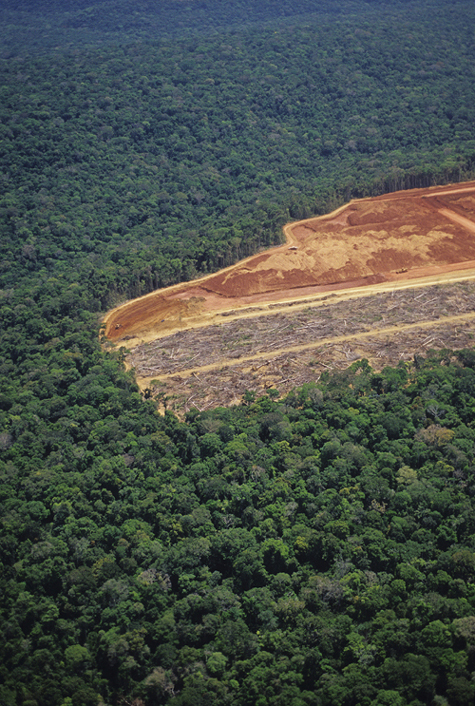
The photograph shows a swath of deforested land in the Amazonian rainforest. Such losses contributed to South America having the second-highest estimated reduction in tropical forests in the 1990s, at 0.4 percent.
Forests disappear naturally as a result of climate change, fire, hurricanes, or other disturbances; however, most deforestation has been anthropogenic. Although improperly applied logging, fuel wood collection, fire management, and grazing can lead to unintentional deforestation, most anthropogenic deforestation is deliberate. Many developing economies are converting forests and other natural habitat mainly into agriculture. Shifting cultivation is practiced over large areas of land worldwide, raising concern about the efficacy of its practice. However, the rates of deforestation caused by cultivation practices are disputed: Norman Myers attributes 54 percent to shifting cultivation; meanwhile, Edward Barbier finds that intensification of agriculture in shifting cultivation areas makes up 10 percent of tropical deforestation, and expansion of shifting cultivation into undisturbed forests only 5 percent. Gunther Fischer and Gerhard Heilig estimated that cultivated land will increase over 47 percent by 2050, with about 66 percent of it coming from deforestation and wetland conversion. Tropical forest conversion into pasture is another threat for forests in the tropics.
Logging, infrastructure, and settlement expansion, and to a minor degree mining, are other important direct drivers. Logging may be a direct source of deforestation or an indirect source resulting from logging roads enabling access for farmers into previously unreachable areas of forest to establish agricultural plots and pasture.
As for whether poverty is an important driver, there is no consensus. One argument is that poor people are more likely to clear forest because of the lack of other economic alternatives; the counterargument states that the poor lack financial ability to clear the forest. The claim that population growth drives deforestation is another disputed topic. Helmut Geist and Eric Lambin showed that population increase caused by high fertility rates is a primary driver of deforestation in only 8 percent of cases. The Food and Agriculture Organization states that global deforestation rates are not directly related to the human population growth rate but, rather, are an indicator of the lack of technological advancement and inefficient governance. Corruption, inequitable distribution of wealth and power, and globalization are also drivers of deforestation.
...
- Politics and Ecology
- Politics and People
- Politics Challenges
- Acid Rain
- Afforestation
- Anti-Toxics Movement
- Appropriate Technology
- Biodiversity
- Decentralization
- Deforestation
- Domination of Nature
- Endocrine Disrupters
- Environmental Justice
- Environmental Management
- Equity
- Future Generations
- Global Climate Change
- Globalization
- Groundwater
- Industrial Revolution
- Innovation, Environmental
- Kuznets Curve
- Limits to Growth
- Malthusianism
- Megacities
- Millennium Development Goals
- Nonviolence
- North–South Issues
- Nuclear Politics
- PCBs
- Precautionary Principle
- Regulatory Approaches
- Resource Curse
- Revolving Door
- Risk Assessment
- Risk Society
- Silent Spring
- Structural Adjustment
- Suburban Sprawl
- Sustainable Development
- Technology
- Toxics Release Inventory
- Tragedy of the Commons
- Transportation
- Uncertainty
- Urban Planning
- Wetlands
- Wilderness
- Agenda 21
- Bhopal
- Brundtland Commission
- Bureau of Land Management, U.S.
- Clean Air Act
- Clean Water Act
- Club of Rome
- Copenhagen Summit
- Corporate Responsibility
- Department of Energy, U.S.
- Endangered Species Act
- Environmental Nongovernmental Organizations
- Environmental Protection Agency, U.S.
- Fish and Wildlife Service, U.S.
- Forest Service, U.S.
- Institutions
- Intergovernmental Panel on Climate Change
- Kyoto Protocol
- Land Ethic
- Marine Mammal Protection Act
- Montreal Protocol
- NIMBY
- North American Free Trade Agreement Organizations
- Sagebrush Rebellion
- Stockholm Convention
- Transnational Advocacy Organizations
- Wise Use Movement
- World Trade Organization
- Politics Parties, Systems, and Economics
- Anarchism
- Basel Convention
- Biophilia
- Capitalism
- Citizen Juries
- Commodification
- Common Property Theory
- Conservation Enclosures
- Conservation Movement
- Consumer Politics
- Convention on Biodiversity
- Cost-Benefit Analysis
- Death of Environmentalism
- Democratic Party
- Ecocapitalism
- Ecofascism
- Ecosocialism
- Environmental Movement
- Federalism
- Gaia Hypothesis
- Gender
- Governmentality
- Green Discourse
- Green Neoliberalism
- Green Parties
- Green Washing
- International Whaling Commission
- Intrinsic Value
- Iron Triangle
- Participatory Democracy
- Petro-Capitalism
- Policy Process
- Political Ideology
- Politics of Scale
- Postmaterialism
- Power
- Pragmatism
- Skeptical Environmentalism
- Steady State Economy
- Transnational Capitalist Class
- UN Conference on Environment and Development
- UN Framework Convention on Climate Change
- Utilitarianism
- Water Politics
- Loading...
Get a 30 day FREE TRIAL
-
 Watch videos from a variety of sources bringing classroom topics to life
 -
Read modern, diverse business cases
-
Explore hundreds of books and reference titles

Read next

More like this
Sage Recommends
We found other relevant content for you on other Sage platforms.
Have you created a personal profile? Login or create a profile so that you can save clips, playlists and searches