
Entry
Reader's guide
Entries A-Z
Subject index
Clean Water Act
The U.S. Clean Water Act (CWA) is a federal law that attempts to improve surface water quality by regulating the discharge of pollutants into bodies of water. The CWA endows the U.S. Environmental Protection Agency (EPA) with the authority to protect surface water by establishing and enforcing water quality standards and by supporting state and local governments in developing pollution control plans. The CWA does not provide for the protection or regulation of groundwater pollution. The term Clean Water Act is commonly used as a blanket term referring to the body of laws included under the 1972 Federal Water Pollution Control Act (Public Law 92–500) and its amendments, including the 1977 Clean Water Act and the 1987 Water Quality Act. These amendments expanded legislation over nonpoint sources of pollution and renewed the timeline and basic principles of the 1972 act. The act is a broad effort to restore and ensure the health of national waterways to protect and promote the propagation of aquatic wildlife and the recreational use of surface water. Under the CWA, the EPA has established use-based criteria for the nation's waterways and a permit-based system for the discharge of pollutants. More than 30 years after it was enacted, the CWA enjoys both a degree of measured success and a share of continuing controversy. Of particular concern are the division of state and federal rights and responsibilities and the congressional failure to significantly revise or revisit the act's shortcomings in reference to the wetlands protection program.
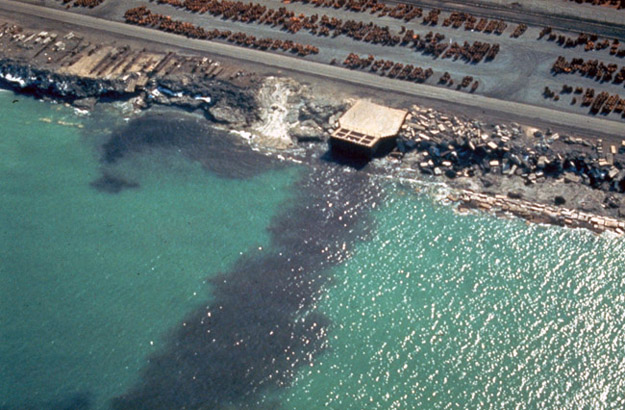
This U.S. Environmental Protection Agency photograph clearly shows waste flowing from an industrial plant into the Calumet River near Lake Michigan before companies were compelled by the Clean Water Act to reduce such emissions.
The content of the CWA (officially Title 33, Chapter 26 of the U.S. Code) includes six titles. Title I establishes grants for research and related pollution control programs that support the act's principal goal of ensuring that the nation's waterways are free from excessive amounts of harmful or toxic substances. Title II was a core provision of the original 1972 Federal Water Pollution Control Act that authorized grants for the construction or expansion of water treatment plants. Under Title II, federal grants covered up to 75 percent of the construction cost for a particular facility or program. This title was superseded by the 1987 Water Quality Act introduction of Title VI, which established the Clean Water State Revolving Fund, a program that requires state governments to match federal loan financing for wastewater treatment projects (see following). Title III mandates the creation of treatment and discharge standards for municipal and industrial point sources of water pollution and frames enforcement standards for noncompliant facilities. One of the most important contributions of Title III is the Water Quality Standards program, which directs the EPA to set allowable pollutant levels for surface water bodies based on their designated use (recreation, agriculture, aquatic life, etc.) and the hazards or risks posed to those activities by various pollutants. Each body of water is assigned a designated use by state authorities, who are responsible for ensuring that it meets the associated water quality criteria. The CWA also employs standards that mandate the adoption of “best practicable technologies” and, later, “best available technologies” for treating wastewater and industrial effluents. States calculate a total maximum daily load—the maximum allowable concentration of a pollutant that can be discharged into a body of water without exceeding water quality standards, and allocate permits to facilities for the discharge of specific pollutants. The 1987 Water Quality Act expanded Title III to include sources of nonpoint pollution. Title IV governs the National Pollution Discharge Elimination System of permit allocation. Permits are allotted according to individual water body total maximum daily load standards. Federal and state permit agencies are required to reissue permits every 5 years and to provide public notice and opportunity for public commentary for pending permits. Although the EPA and state authorities administer the permit program for most bodies of water, permits for the discharge of “dredge and fill” material into national wetlands are managed by the Army Corps of Engineers. Title V addresses the general provisions included in the CWA, including those allowing U.S. citizens to file suit against CWA violators and protecting so-called whistleblowers from negative repercussions of CWA enforcement. Finally, Title VI added to the CWA with the 1987 amendment establishing the Clean Water State Revolving Fund, which replaced the Title II construction grants program. The fund provides long-term, low-interest loans to states and municipalities for the construction or expansion of publicly owned treatment works and other projects to control nonpoint source pollution.
...
- Politics and Ecology
- Politics and People
- Politics Challenges
- Acid Rain
- Afforestation
- Anti-Toxics Movement
- Appropriate Technology
- Biodiversity
- Decentralization
- Deforestation
- Domination of Nature
- Endocrine Disrupters
- Environmental Justice
- Environmental Management
- Equity
- Future Generations
- Global Climate Change
- Globalization
- Groundwater
- Industrial Revolution
- Innovation, Environmental
- Kuznets Curve
- Limits to Growth
- Malthusianism
- Megacities
- Millennium Development Goals
- Nonviolence
- North–South Issues
- Nuclear Politics
- PCBs
- Precautionary Principle
- Regulatory Approaches
- Resource Curse
- Revolving Door
- Risk Assessment
- Risk Society
- Silent Spring
- Structural Adjustment
- Suburban Sprawl
- Sustainable Development
- Technology
- Toxics Release Inventory
- Tragedy of the Commons
- Transportation
- Uncertainty
- Urban Planning
- Wetlands
- Wilderness
- Agenda 21
- Bhopal
- Brundtland Commission
- Bureau of Land Management, U.S.
- Clean Air Act
- Clean Water Act
- Club of Rome
- Copenhagen Summit
- Corporate Responsibility
- Department of Energy, U.S.
- Endangered Species Act
- Environmental Nongovernmental Organizations
- Environmental Protection Agency, U.S.
- Fish and Wildlife Service, U.S.
- Forest Service, U.S.
- Institutions
- Intergovernmental Panel on Climate Change
- Kyoto Protocol
- Land Ethic
- Marine Mammal Protection Act
- Montreal Protocol
- NIMBY
- North American Free Trade Agreement Organizations
- Sagebrush Rebellion
- Stockholm Convention
- Transnational Advocacy Organizations
- Wise Use Movement
- World Trade Organization
- Politics Parties, Systems, and Economics
- Anarchism
- Basel Convention
- Biophilia
- Capitalism
- Citizen Juries
- Commodification
- Common Property Theory
- Conservation Enclosures
- Conservation Movement
- Consumer Politics
- Convention on Biodiversity
- Cost-Benefit Analysis
- Death of Environmentalism
- Democratic Party
- Ecocapitalism
- Ecofascism
- Ecosocialism
- Environmental Movement
- Federalism
- Gaia Hypothesis
- Gender
- Governmentality
- Green Discourse
- Green Neoliberalism
- Green Parties
- Green Washing
- International Whaling Commission
- Intrinsic Value
- Iron Triangle
- Participatory Democracy
- Petro-Capitalism
- Policy Process
- Political Ideology
- Politics of Scale
- Postmaterialism
- Power
- Pragmatism
- Skeptical Environmentalism
- Steady State Economy
- Transnational Capitalist Class
- UN Conference on Environment and Development
- UN Framework Convention on Climate Change
- Utilitarianism
- Water Politics
- Loading...
Get a 30 day FREE TRIAL
-
 Watch videos from a variety of sources bringing classroom topics to life
 -
Read modern, diverse business cases
-
Explore hundreds of books and reference titles

Read next

More like this
Sage Recommends
We found other relevant content for you on other Sage platforms.
Have you created a personal profile? Login or create a profile so that you can save clips, playlists and searches