
Entry
Reader's guide
Entries A-Z
Subject index
Clean Air Act
The U.S. Clean Air Act (CAA) is a federal law that attempts to improve air quality by regulating air pollution. The CAA was first enacted in 1970 but underwent major amendments in 1977 and 1990. These amendments added measures to prevent depletion of the stratospheric ozone layer and to control emissions related to acid rain. The act frames the responsibilities of the Environmental Protection Agency (EPA) for establishing national air quality standards and sets deadlines for compliance. Although the CAA seeks to protect the environment from damage caused by air pollutants, the primary goal of the law is to safeguard public health. Many of the programs associated with the CAA are often regarded as successful; however, controversy surrounds the EPA's use of scientific evidence, its lack of conformity with review schedules, the establishment of implementation deadlines, and the costs of emissions compliance.
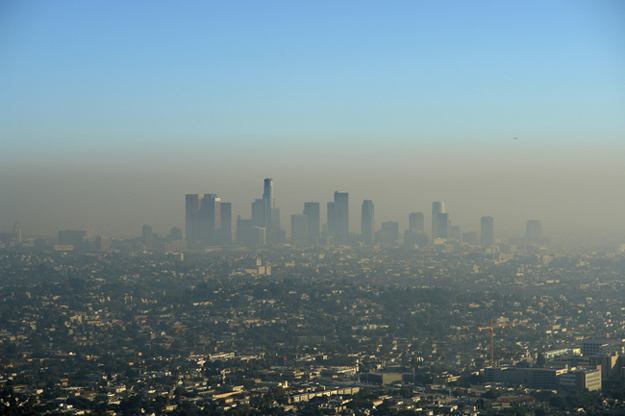
Smog above the city of Los Angeles, California, whose severe air pollution helped spur the development of the first Clean Air Act in 1963. In the following decades, parts of the country have enjoyed improved air quality.
The content of the CAA (officially Title 42, Chapter 85 of the U.S. Code) includes six titles. Title I addresses the six most common pollutants, referred to as “criteria pollutants” (sulfur dioxide, nitrogen dioxide, carbon monoxide, ozone, lead, and particulate matter). It requires the EPA to determine National Ambient Air Quality Standards, which set permissible levels for each of these pollutants, and that each state to draft State Implementation Plans that describe measures for ensuring compliance. Noncompliant states must implement specified control measures and are subject to possible penalties. Title II regulates the emissions of motor vehicles, aircraft, and other “moving sources.” It also supports requirements related to the emissions of vehicle-assembly plants, adoption of low-sulfur diesel fuels, and in certain metropolitan areas, use of reformulated gasoline and vapor recovery nozzles. Title III controls the emission of hazardous or toxic pollutants connected with serious illness, including lead, mercury, and dichlorodiphenyltrichloroethane (DDT). The CAA Amendment of 1990 expanded the list of included hazardous pollutants from 7 to 187 and called for a shift from a focus on discrete pollutants to industry-wide regulation. Title IV provides oversight of industrial emissions related to acid deposition (“acid rain”). Control measures aim to reduce sulfur dioxide and nitrogen oxides to half of 1980 emission levels. Title V introduces a program for issuing and trading pollution emission permits. The permit-trading program is run by individual states and allows for temporal and spatial distribution of pollutant emissions within and between industries.
Finally, Title VI regulates the production and use of ozone-depleting chemical substances, such as chlorofluorocarbons. It requires the EPA to establish a program to gradually phase out all ozone-destroying chemicals and support the development of “ozone-friendly” substitutes. Although the CAA endows the EPA with the powers to establish and enforce regulations, and in some cases to fund research programs and government initiatives, individual states retain the primary responsibility for implementing plans, issuing permits, and ensuring compliance. Many states have expanded on the CAA by enacting their own legislation detailing implementation procedures or increasing standards beyond those stipulated by federal agencies.
...
- Politics and Ecology
- Politics and People
- Politics Challenges
- Acid Rain
- Afforestation
- Anti-Toxics Movement
- Appropriate Technology
- Biodiversity
- Decentralization
- Deforestation
- Domination of Nature
- Endocrine Disrupters
- Environmental Justice
- Environmental Management
- Equity
- Future Generations
- Global Climate Change
- Globalization
- Groundwater
- Industrial Revolution
- Innovation, Environmental
- Kuznets Curve
- Limits to Growth
- Malthusianism
- Megacities
- Millennium Development Goals
- Nonviolence
- North–South Issues
- Nuclear Politics
- PCBs
- Precautionary Principle
- Regulatory Approaches
- Resource Curse
- Revolving Door
- Risk Assessment
- Risk Society
- Silent Spring
- Structural Adjustment
- Suburban Sprawl
- Sustainable Development
- Technology
- Toxics Release Inventory
- Tragedy of the Commons
- Transportation
- Uncertainty
- Urban Planning
- Wetlands
- Wilderness
- Agenda 21
- Bhopal
- Brundtland Commission
- Bureau of Land Management, U.S.
- Clean Air Act
- Clean Water Act
- Club of Rome
- Copenhagen Summit
- Corporate Responsibility
- Department of Energy, U.S.
- Endangered Species Act
- Environmental Nongovernmental Organizations
- Environmental Protection Agency, U.S.
- Fish and Wildlife Service, U.S.
- Forest Service, U.S.
- Institutions
- Intergovernmental Panel on Climate Change
- Kyoto Protocol
- Land Ethic
- Marine Mammal Protection Act
- Montreal Protocol
- NIMBY
- North American Free Trade Agreement Organizations
- Sagebrush Rebellion
- Stockholm Convention
- Transnational Advocacy Organizations
- Wise Use Movement
- World Trade Organization
- Politics Parties, Systems, and Economics
- Anarchism
- Basel Convention
- Biophilia
- Capitalism
- Citizen Juries
- Commodification
- Common Property Theory
- Conservation Enclosures
- Conservation Movement
- Consumer Politics
- Convention on Biodiversity
- Cost-Benefit Analysis
- Death of Environmentalism
- Democratic Party
- Ecocapitalism
- Ecofascism
- Ecosocialism
- Environmental Movement
- Federalism
- Gaia Hypothesis
- Gender
- Governmentality
- Green Discourse
- Green Neoliberalism
- Green Parties
- Green Washing
- International Whaling Commission
- Intrinsic Value
- Iron Triangle
- Participatory Democracy
- Petro-Capitalism
- Policy Process
- Political Ideology
- Politics of Scale
- Postmaterialism
- Power
- Pragmatism
- Skeptical Environmentalism
- Steady State Economy
- Transnational Capitalist Class
- UN Conference on Environment and Development
- UN Framework Convention on Climate Change
- Utilitarianism
- Water Politics
- Loading...
Get a 30 day FREE TRIAL
-
 Watch videos from a variety of sources bringing classroom topics to life
 -
Read modern, diverse business cases
-
Explore hundreds of books and reference titles

Read next

More like this
Sage Recommends
We found other relevant content for you on other Sage platforms.
Have you created a personal profile? Login or create a profile so that you can save clips, playlists and searches