
Entry
Reader's guide
Entries A-Z
Subject index
Biosphere
The biosphere is the highest level of organization of the Earth's biological activity. It processes matter and energy transfer with an efficiency of 10 percent across the Earth's atmosphere, lithosphere, hydrosphere, cryosphere, and anthrosphere. The atmospheric processes involve a vast number of chemical reactions and gas exchanges within the atmosphere. The hydrosphere consists of the Earth's water systems, needed for organisms living on the planet to survive. The geosphere and biosphere are closely connected through soils that consist of an admixture of air, mineral matter, organic matter, and water. The anthrosphere is the dimension of the biosphere that has been—and continues to be—altered by humans for human activities. The human population is now a direct threat to the biosphere through habitat destruction and atmospheric degradation, especially deforestation and greenhouse gas emissions. Human activities are recognized to be the cause of a mass extinction of other species and an ensuing depletion of genetic variation and biological diversity (biodiversity).
The biosphere encompasses all biological activity on Earth, which is of vital importance to the functioning of natural and human-engineered ecosystems, and by extension, the services that nature provides free of charge to human society. The value of these services to the human economy is so huge as to defy quantification, though ecological economists continue the effort to more fully account for costs of production endured by the biosphere as “ecosystem services.” The biosphere performs all biological functions, including photosynthesis, decomposition, nitrogen fixation, respiration, and denitrification. The biosphere is structured into a hierarchy of life-forms known as the food chain, in which all life evolves toward increasing complexity. The biosphere makes our planet unique among the planets in the solar system.
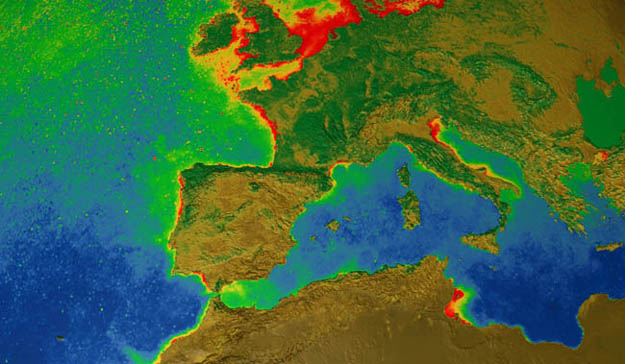
This image of Western Europe created by a NASA remote-sensing satellite is part of an attempt to capture information about the biosphere, such as vegetation cover, that may help scientists better understand changes on a global level.
The history of the term biosphere goes back to 1875, when geologist Eduard Suess originated the term, defining it as “the place on earth's surface where life dwells.” Russian scientist Vladimir Vernadsky extended the term in 1929, refining its definition into a form resembling its current ecological sense in his obscure book The Biosphere, published in 1926. Thanks to Vernadsky's work, ecology was redefined as the science of the biosphere, and the biosphere concept began to occupy its current central position in Earth systems science.
The biosphere is studied within the scientific fields of biology and ecology. It exists as the highest level of biological organization, beginning with parts of cells and rising to populations, species, ecoregions, and biomes. Biomes describe global patterns of biodiversity within the biosphere's many ecosystems. Living organisms and their remains in the biosphere interact with the other spheres (above) in global biogeochemical cycles and energy budgets, as the biosphere plays it central part in the nurturing of life on Earth.
Researchers directly observe biosphere activity using global remote-sensing platforms, some dispersed on Earth's surface and many launched aboard remote-sensing satellites into near-Earth space over the past few decades. Direct observation has greatly benefited from advanced space-based remote-sensing systems, which are capable of scanning the entire Earth's surface at least once a day. These observations help determine the extent and amount of activity in the biosphere, mainly in terms of vegetation cover and function and characteristic spectrum responses in sensing spectrometers. More remote-sensing efforts in the future will directly observe global patterns of carbon dioxide exchange in the biosphere, caused by respiration, photosynthesis, greenhouse gas emissions, and the combustion of biomass and fossil fuels.
...
- Politics and Ecology
- Politics and People
- Politics Challenges
- Acid Rain
- Afforestation
- Anti-Toxics Movement
- Appropriate Technology
- Biodiversity
- Decentralization
- Deforestation
- Domination of Nature
- Endocrine Disrupters
- Environmental Justice
- Environmental Management
- Equity
- Future Generations
- Global Climate Change
- Globalization
- Groundwater
- Industrial Revolution
- Innovation, Environmental
- Kuznets Curve
- Limits to Growth
- Malthusianism
- Megacities
- Millennium Development Goals
- Nonviolence
- North–South Issues
- Nuclear Politics
- PCBs
- Precautionary Principle
- Regulatory Approaches
- Resource Curse
- Revolving Door
- Risk Assessment
- Risk Society
- Silent Spring
- Structural Adjustment
- Suburban Sprawl
- Sustainable Development
- Technology
- Toxics Release Inventory
- Tragedy of the Commons
- Transportation
- Uncertainty
- Urban Planning
- Wetlands
- Wilderness
- Agenda 21
- Bhopal
- Brundtland Commission
- Bureau of Land Management, U.S.
- Clean Air Act
- Clean Water Act
- Club of Rome
- Copenhagen Summit
- Corporate Responsibility
- Department of Energy, U.S.
- Endangered Species Act
- Environmental Nongovernmental Organizations
- Environmental Protection Agency, U.S.
- Fish and Wildlife Service, U.S.
- Forest Service, U.S.
- Institutions
- Intergovernmental Panel on Climate Change
- Kyoto Protocol
- Land Ethic
- Marine Mammal Protection Act
- Montreal Protocol
- NIMBY
- North American Free Trade Agreement Organizations
- Sagebrush Rebellion
- Stockholm Convention
- Transnational Advocacy Organizations
- Wise Use Movement
- World Trade Organization
- Politics Parties, Systems, and Economics
- Anarchism
- Basel Convention
- Biophilia
- Capitalism
- Citizen Juries
- Commodification
- Common Property Theory
- Conservation Enclosures
- Conservation Movement
- Consumer Politics
- Convention on Biodiversity
- Cost-Benefit Analysis
- Death of Environmentalism
- Democratic Party
- Ecocapitalism
- Ecofascism
- Ecosocialism
- Environmental Movement
- Federalism
- Gaia Hypothesis
- Gender
- Governmentality
- Green Discourse
- Green Neoliberalism
- Green Parties
- Green Washing
- International Whaling Commission
- Intrinsic Value
- Iron Triangle
- Participatory Democracy
- Petro-Capitalism
- Policy Process
- Political Ideology
- Politics of Scale
- Postmaterialism
- Power
- Pragmatism
- Skeptical Environmentalism
- Steady State Economy
- Transnational Capitalist Class
- UN Conference on Environment and Development
- UN Framework Convention on Climate Change
- Utilitarianism
- Water Politics
- Loading...
Get a 30 day FREE TRIAL
-
 Watch videos from a variety of sources bringing classroom topics to life
 -
Read modern, diverse business cases
-
Explore hundreds of books and reference titles

Read next

More like this
Sage Recommends
We found other relevant content for you on other Sage platforms.
Have you created a personal profile? Login or create a profile so that you can save clips, playlists and searches