
Entry
Reader's guide
Entries A-Z
Subject index
Bhopal
Founded in the early 18th century, Bhopal is the capital and second most populous city (with an estimated population in 2001 of 1.4 million) of the central Indian state Madhya Pradesh, located 750 kilometers (460 miles) south of New Delhi. Major industries in the region include textiles, jewelry, jute, cotton, sugar, power-related products (e.g., transformers), and chemicals. However, it was the founding of the Union Carbide India, Limited (UCIL), pesticide plant by the Union Carbide Corporation (UCC) in 1969 and the industrial catastrophe 15 years later that have become synonymous with Bhopal. In the late evening to early morning hours of December 2–3, 1984, a poisonous gas created from methyl isocyanate leaked from the UCIL plant, forming a toxic cloud that enveloped the city, killing and injuring thousands. The Bhopal event highlights the tragic consequences that can result from rapid industrialization in developing countries with substandard safety regulations and from locating hazardous industrial facilities within urban areas. The largest chemical disaster in the world was the product of technological, human, and managerial oversights that led to enduring human health, environmental, and legal ramifications.
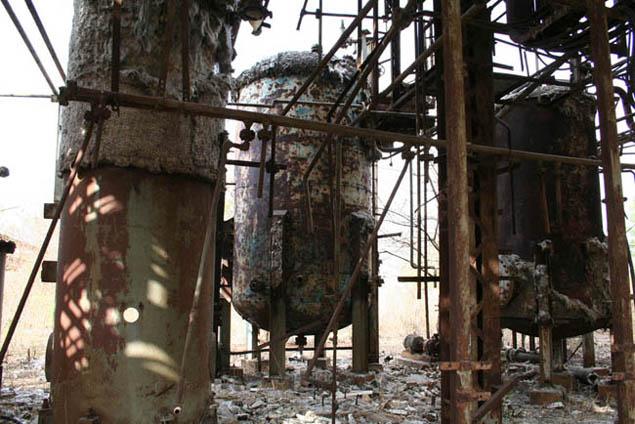
The photo shows Union Carbide's abandoned methyl isocyanate tanks as they appeared in 2008. These tanks were at the epicenter of the chemical leak that killed as many as 7,000–10,000 people within days and sickened thousands.
The construction of the Bhopal industrial facility was part of larger green revolution efforts begun by the Indian government starting in the 1960s—an agenda designed to improve agricultural productivity. In addition to increasing the usage of genetically modified crops and irrigation techniques, the Indian green revolution included financing agrochemicals in an effort to increase crop yields and become self-sufficient in food production for one of the world's most populous nations. Bhopal was selected as the site for the UCIL pesticide plant for its centralized location within India, available labor force, transportation linkages via railways, and local resource accessibility (e.g., water, electricity). The UCIL facility produced agrochemicals for the local Indian agricultural market such as Sevin, a carbaryl insecticide that was manufactured using the highly volatile methyl isocyanate (MIC). The colorless liquid MIC is an extremely chemically reactive substance, interacting with widespread materials such as common metals (e.g., iron, copper, tin) and water. Although Sevin and other pesticide products can be produced using less dangerous materials, MIC is a more cost-effective chemical intermediate that reduces production time.
A Disaster Waiting to Happen
Initially, MIC was imported from the parent company, but starting in 1979 the Bhopal plant began producing and storing MIC on-site. By 1979, the UCIL facility had been in operation for almost a decade, and the once remote area on the Bhopal outskirts was now a densely populated community. Nearly 100,000 residents lived within a 1-kilometer radius of the facility, primarily in low-income housing and “squatter settlements.” Although the corporation was offered a secondary building site in a less-inhabited region, UCIL insisted on building the MIC division next to the existing facility to reduce transport costs. The amount of MIC produced surpassed daily usage requirements by nearly 10-fold, leading to excess MIC being stored in several large holding tanks with capacities four times greater than safely recommended. Safety regulations were further compromised in the overall design and maintenance of the plant. In comparison to similar facilities in North America and Europe, UCIL lacked modern safety systems and precautionary measures for dealing with MIC storage, including preventive maintenance, routine safety inspections, skilled operators, and an emergency plan. Furthermore, the facility was not profitable. Natural calamities (e.g., droughts) limited the ability of Indian farmers to purchase pesticide products, and the Carbide plant, including the MIC storage units, began to fall into disrepair as revenues diminished.
...
- Politics and Ecology
- Politics and People
- Politics Challenges
- Acid Rain
- Afforestation
- Anti-Toxics Movement
- Appropriate Technology
- Biodiversity
- Decentralization
- Deforestation
- Domination of Nature
- Endocrine Disrupters
- Environmental Justice
- Environmental Management
- Equity
- Future Generations
- Global Climate Change
- Globalization
- Groundwater
- Industrial Revolution
- Innovation, Environmental
- Kuznets Curve
- Limits to Growth
- Malthusianism
- Megacities
- Millennium Development Goals
- Nonviolence
- North–South Issues
- Nuclear Politics
- PCBs
- Precautionary Principle
- Regulatory Approaches
- Resource Curse
- Revolving Door
- Risk Assessment
- Risk Society
- Silent Spring
- Structural Adjustment
- Suburban Sprawl
- Sustainable Development
- Technology
- Toxics Release Inventory
- Tragedy of the Commons
- Transportation
- Uncertainty
- Urban Planning
- Wetlands
- Wilderness
- Agenda 21
- Bhopal
- Brundtland Commission
- Bureau of Land Management, U.S.
- Clean Air Act
- Clean Water Act
- Club of Rome
- Copenhagen Summit
- Corporate Responsibility
- Department of Energy, U.S.
- Endangered Species Act
- Environmental Nongovernmental Organizations
- Environmental Protection Agency, U.S.
- Fish and Wildlife Service, U.S.
- Forest Service, U.S.
- Institutions
- Intergovernmental Panel on Climate Change
- Kyoto Protocol
- Land Ethic
- Marine Mammal Protection Act
- Montreal Protocol
- NIMBY
- North American Free Trade Agreement Organizations
- Sagebrush Rebellion
- Stockholm Convention
- Transnational Advocacy Organizations
- Wise Use Movement
- World Trade Organization
- Politics Parties, Systems, and Economics
- Anarchism
- Basel Convention
- Biophilia
- Capitalism
- Citizen Juries
- Commodification
- Common Property Theory
- Conservation Enclosures
- Conservation Movement
- Consumer Politics
- Convention on Biodiversity
- Cost-Benefit Analysis
- Death of Environmentalism
- Democratic Party
- Ecocapitalism
- Ecofascism
- Ecosocialism
- Environmental Movement
- Federalism
- Gaia Hypothesis
- Gender
- Governmentality
- Green Discourse
- Green Neoliberalism
- Green Parties
- Green Washing
- International Whaling Commission
- Intrinsic Value
- Iron Triangle
- Participatory Democracy
- Petro-Capitalism
- Policy Process
- Political Ideology
- Politics of Scale
- Postmaterialism
- Power
- Pragmatism
- Skeptical Environmentalism
- Steady State Economy
- Transnational Capitalist Class
- UN Conference on Environment and Development
- UN Framework Convention on Climate Change
- Utilitarianism
- Water Politics
- Loading...
Get a 30 day FREE TRIAL
-
 Watch videos from a variety of sources bringing classroom topics to life
 -
Read modern, diverse business cases
-
Explore hundreds of books and reference titles

Read next

More like this
Sage Recommends
We found other relevant content for you on other Sage platforms.
Have you created a personal profile? Login or create a profile so that you can save clips, playlists and searches