
Entry
Reader's guide
Entries A-Z
Subject index
Agriculture
Agriculture (agar + culture: agar meaning land and culture meaning cultivation) is the science, art, and business of cultivating soil, producing crops, and raising livestock鑲simply known as farming, it is a bedrock of human civilization. Thus, by definition, farmers include resource-poor cultivators, pastoralists, fisher-folk, indigenous peoples, women, and agricultural laborers. Domestication of plants and animals was necessary for the evolution of agriculture ca. 10,000–7,000 years b.p. Agricultural practices enabled people to establish permanent settlements and expand urban-based societies. Domestication of plants and animals transformed the profession of the early humans from hunting and gathering to selective hunting, herding, and settled agriculture. Agriculture addresses food/nutrient security and self-sufficiency and is thus very vital to achieving several millennium development goals; it is inseparably linked to several internationally agreed conventions/strategies: the Convention on Biological Diversity, Poverty Reduction Strategy Papers, and Local Agenda 21.
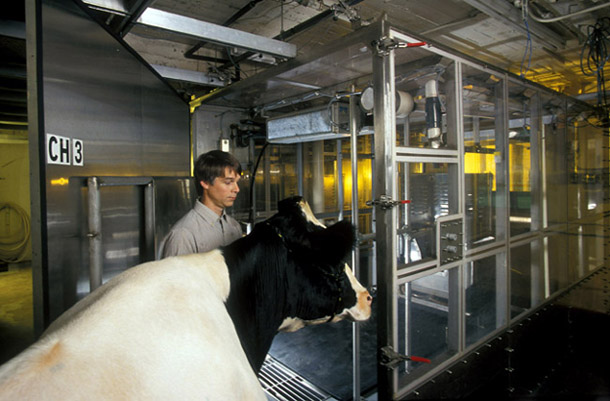
Agriculture may be responsible for as much as 12 percent of greenhouse gas emissions, including methane emissions from cattle. This animal scientist is using a plastic chamber to measure a cow's production of heat and methane.
Until about four decades ago, crop yields in agricultural systems depended on internal resources, recycling of organic matter, built-in biological control mechanisms, and rainfall patterns. Agricultural yields were modest, but stable. Production was safeguarded by growing more than one crop or variety in space and time in a field as insurance against pest outbreaks or severe weather. Inputs of nitrogen were gained by rotating major field crops with legumes. In turn, rotations suppressed insects, weeds, and diseases by effectively breaking the life cycles of these pests. As agricultural modernization progressed, however, the ecology-farming linkage was often broken as ecological principles were ignored and/or overridden. In fact, several agricultural scientists have arrived at a general consensus that modern agriculture confronts an environmental crisis. A growing number of people have become concerned about the long-term sustainability of existing food production systems. Evidence has accumulated showing that although the present capital-and technology-intensive farming systems have been extremely productive and competitive, they also bring a variety of economic, environmental, and social problems.
Of the total land area of about 13 billion hectares globally, crops and pasture occupy almost 5 billion hectares. Thus, agriculture has closer inseparable linkages with ecosystem services. Ecosystem services are the irreplaceable services derived (directly or indirectly) from natural/managed ecosystems on which human welfare depends. Hence ecosystem services must be conserved for sustaining agricultural production. This view is supported by the following facts:
- Three-fourths of the world's poor are rural (will account for 60 percent in 2025) with very limited external support, technological/financial/market/information access
- Two-thirds of the rural poor live on “marginal” farmlands
- Sixteen of 25 biodiversity hot spots are areas with very high malnutrition (one-fifth undernourished)
- Food demand in less developed countries will exceed 50–60 percent by 2030, where 90 percent of the food is grown domestically
- Agriculture is the main employer and creator of wealth in poor, biodiversity-rich countries
Although land and tenurial reforms have been enacted in many countries, their implementation remains fraught with problems. This situation is complicated by the increasing privatization of the commons, which in turn has become a major source of land and resource conflicts that have inseparable linkages for the food security of the poor.
...
- Politics and Ecology
- Politics and People
- Politics Challenges
- Acid Rain
- Afforestation
- Anti-Toxics Movement
- Appropriate Technology
- Biodiversity
- Decentralization
- Deforestation
- Domination of Nature
- Endocrine Disrupters
- Environmental Justice
- Environmental Management
- Equity
- Future Generations
- Global Climate Change
- Globalization
- Groundwater
- Industrial Revolution
- Innovation, Environmental
- Kuznets Curve
- Limits to Growth
- Malthusianism
- Megacities
- Millennium Development Goals
- Nonviolence
- North–South Issues
- Nuclear Politics
- PCBs
- Precautionary Principle
- Regulatory Approaches
- Resource Curse
- Revolving Door
- Risk Assessment
- Risk Society
- Silent Spring
- Structural Adjustment
- Suburban Sprawl
- Sustainable Development
- Technology
- Toxics Release Inventory
- Tragedy of the Commons
- Transportation
- Uncertainty
- Urban Planning
- Wetlands
- Wilderness
- Agenda 21
- Bhopal
- Brundtland Commission
- Bureau of Land Management, U.S.
- Clean Air Act
- Clean Water Act
- Club of Rome
- Copenhagen Summit
- Corporate Responsibility
- Department of Energy, U.S.
- Endangered Species Act
- Environmental Nongovernmental Organizations
- Environmental Protection Agency, U.S.
- Fish and Wildlife Service, U.S.
- Forest Service, U.S.
- Institutions
- Intergovernmental Panel on Climate Change
- Kyoto Protocol
- Land Ethic
- Marine Mammal Protection Act
- Montreal Protocol
- NIMBY
- North American Free Trade Agreement Organizations
- Sagebrush Rebellion
- Stockholm Convention
- Transnational Advocacy Organizations
- Wise Use Movement
- World Trade Organization
- Politics Parties, Systems, and Economics
- Anarchism
- Basel Convention
- Biophilia
- Capitalism
- Citizen Juries
- Commodification
- Common Property Theory
- Conservation Enclosures
- Conservation Movement
- Consumer Politics
- Convention on Biodiversity
- Cost-Benefit Analysis
- Death of Environmentalism
- Democratic Party
- Ecocapitalism
- Ecofascism
- Ecosocialism
- Environmental Movement
- Federalism
- Gaia Hypothesis
- Gender
- Governmentality
- Green Discourse
- Green Neoliberalism
- Green Parties
- Green Washing
- International Whaling Commission
- Intrinsic Value
- Iron Triangle
- Participatory Democracy
- Petro-Capitalism
- Policy Process
- Political Ideology
- Politics of Scale
- Postmaterialism
- Power
- Pragmatism
- Skeptical Environmentalism
- Steady State Economy
- Transnational Capitalist Class
- UN Conference on Environment and Development
- UN Framework Convention on Climate Change
- Utilitarianism
- Water Politics
- Loading...
Get a 30 day FREE TRIAL
-
 Watch videos from a variety of sources bringing classroom topics to life
 -
Read modern, diverse business cases
-
Explore hundreds of books and reference titles

Read next

More like this
Sage Recommends
We found other relevant content for you on other Sage platforms.
Have you created a personal profile? Login or create a profile so that you can save clips, playlists and searches