
Entry
Reader's guide
Entries A-Z
Subject index
Afforestation
Globally, forest cover continues to decline as a result of high deforestation rates (13 million hectares [ha]/year), primarily as a result of agricultural expansion in the tropics. At a national and regional level, however, afforestation and reforestation have led to an increase in forest and tree cover in some areas, often despite continued rapid economic and population growth. Such forest resurgence, particularly in Europe and China, lowered the global net forest loss to 7.3 million ha/year between 2000 and 2005. Afforestation refers to the planting of trees in areas that have not been forested in the last 50 years. This includes afforestation of native grassland and shrubland as well as of pasture and croplands that may have been deforested over a half century ago. Afforestation also occurs through the naturalization and invasive spread of trees into nonforested regions. This contrasts with reforestation, which denotes spontaneous forest regeneration or intentional tree planting on previously forested land. As described here, the wide-ranging landscapes that may be described as “afforested” have similarly wide-ranging biophysical and socioeconomic characteristics.
Plantations
Approximately 45 percent of the mentioned forest resurgence is a result of the expansion of plantation forests established through afforestation, reforestation, and conversion of primary forest. It is estimated that half of the 139.1 million ha of plantations are established through reforestation and afforestation, and half through deforestation and conversion of natural forest in the tropics. Extensive plantation establishment on agricultural land occurred during 1990–2005 in eastern China, southern Europe, and several other industrialized and industrializing nations. The majority (78 percent) of plantations are established for wood and fiber production, with the rest (22 percent) established primarily for soil and water protection purposes. Between 1990 and 2005, productive plantations increased 2.2 million ha/year, whereas protective plantations increased by 380,000 ha/year.
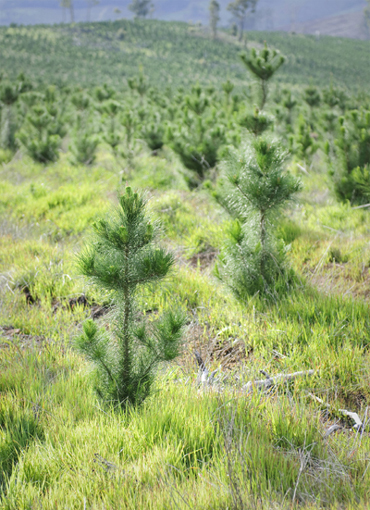
Reforestation and afforestation projects, such as these thousands of newly planted pine trees, reduced the annual net loss of the world's forest cover to 7.3 million hectares between 2000 and 2005.
Forest Transition Theory
Drawing on data primarily from developed countries, forest transition theory postulates that economic development leads to a predictable transition from a period of forest contraction to a period of forest expansion (with no distinction made between afforestation and reforestation). Thomas Rudel expanded on forest transition theory and proposed two paths in this forest transition: “the economic development path” and “the forest scarcity path.” In the economic development path, increased economic opportunity leads to an increase in nonfarm jobs, leading to an abandonment of agricultural lands followed by spontaneous forest regeneration. Alternatively, the forest scarcity path occurs when landowners plant trees in response to a shortage of forest products. Kathleen Farley proposed a third path, “the reverse economic development path,” by which afforestation, funded through national or international forestry programs and, more recently, carbon sequestration initiatives, “seeks” rather than responds to economic development.
Benefits of Afforestation
Afforestation is promoted to support a range of economic, social, and environmental initiatives. Although accounting for approximately 3.5 percent of the total forest area, timber plantations, for example, are approaching 50 percent of global wood production. Tree plantations can additionally provide important revenue for landowners through the extraction of fuel wood and nontimber forest products. Shade coffee production also has led to increased tree cover in Honduras, El Salvador, and Costa Rica, some of which has been established on land deforested more than 50 years ago. Many governments also support forest expansion with the perception that planting trees enhances environmental conditions through decreasing erosion, improving soil and water quality, and increasing water supply. More recently, global climate initiatives, such as the Kyoto Protocol Clean Development Mechanism, have supported afforestation and reforestation projects because of their potential to sequester carbon.
...
- Politics and Ecology
- Politics and People
- Politics Challenges
- Acid Rain
- Afforestation
- Anti-Toxics Movement
- Appropriate Technology
- Biodiversity
- Decentralization
- Deforestation
- Domination of Nature
- Endocrine Disrupters
- Environmental Justice
- Environmental Management
- Equity
- Future Generations
- Global Climate Change
- Globalization
- Groundwater
- Industrial Revolution
- Innovation, Environmental
- Kuznets Curve
- Limits to Growth
- Malthusianism
- Megacities
- Millennium Development Goals
- Nonviolence
- North–South Issues
- Nuclear Politics
- PCBs
- Precautionary Principle
- Regulatory Approaches
- Resource Curse
- Revolving Door
- Risk Assessment
- Risk Society
- Silent Spring
- Structural Adjustment
- Suburban Sprawl
- Sustainable Development
- Technology
- Toxics Release Inventory
- Tragedy of the Commons
- Transportation
- Uncertainty
- Urban Planning
- Wetlands
- Wilderness
- Agenda 21
- Bhopal
- Brundtland Commission
- Bureau of Land Management, U.S.
- Clean Air Act
- Clean Water Act
- Club of Rome
- Copenhagen Summit
- Corporate Responsibility
- Department of Energy, U.S.
- Endangered Species Act
- Environmental Nongovernmental Organizations
- Environmental Protection Agency, U.S.
- Fish and Wildlife Service, U.S.
- Forest Service, U.S.
- Institutions
- Intergovernmental Panel on Climate Change
- Kyoto Protocol
- Land Ethic
- Marine Mammal Protection Act
- Montreal Protocol
- NIMBY
- North American Free Trade Agreement Organizations
- Sagebrush Rebellion
- Stockholm Convention
- Transnational Advocacy Organizations
- Wise Use Movement
- World Trade Organization
- Politics Parties, Systems, and Economics
- Anarchism
- Basel Convention
- Biophilia
- Capitalism
- Citizen Juries
- Commodification
- Common Property Theory
- Conservation Enclosures
- Conservation Movement
- Consumer Politics
- Convention on Biodiversity
- Cost-Benefit Analysis
- Death of Environmentalism
- Democratic Party
- Ecocapitalism
- Ecofascism
- Ecosocialism
- Environmental Movement
- Federalism
- Gaia Hypothesis
- Gender
- Governmentality
- Green Discourse
- Green Neoliberalism
- Green Parties
- Green Washing
- International Whaling Commission
- Intrinsic Value
- Iron Triangle
- Participatory Democracy
- Petro-Capitalism
- Policy Process
- Political Ideology
- Politics of Scale
- Postmaterialism
- Power
- Pragmatism
- Skeptical Environmentalism
- Steady State Economy
- Transnational Capitalist Class
- UN Conference on Environment and Development
- UN Framework Convention on Climate Change
- Utilitarianism
- Water Politics
- Loading...
Get a 30 day FREE TRIAL
-
 Watch videos from a variety of sources bringing classroom topics to life
 -
Read modern, diverse business cases
-
Explore hundreds of books and reference titles

Read next

More like this
Sage Recommends
We found other relevant content for you on other Sage platforms.
Have you created a personal profile? Login or create a profile so that you can save clips, playlists and searches