
Entry
Reader's guide
Entries A-Z
Subject index
Urban Green
“Urban green” refers to an approach to ecological predicaments that arise most frequently in a metropolitan setting and to green spaces within cities. As increasing proportions of the population elect to live in metropolitan areas, urban green has become an important approach to reducing society's ecological footprint and increasing the quality of life of city residents. Urban green approaches seek to consider economic, social, and environmental concerns when formulating solutions that allow populations to live in an environmentally friendly, sustainable manner. In considering urban green policies and projects, concepts such as energy efficiency, light, air quality, noise levels, and citizens’ health and well-being are considered.
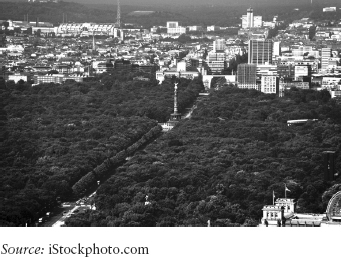
Parks and other urban green spaces, such as Tiergarten in Berlin, help moderate local climates by slowing wind and water and providing homes and businesses shade that assists in the conservation of energy. Green spaces also improve nearby property values.
Access to green space has always been a consideration in urban planning, but during the 1990s, highlighting the natural environment in land use and other decisions grew increasingly popular. A growing understanding that natural ecosystems provide important functions to cities helped promote urban green as a way to support long-term sustainability. An urban green approach is predicated upon analyzing the function of the natural environment and then using planning policy and regulations to safeguard critical natural areas. Urban green seeks a sustainable and efficient use of natural resources. Urban green is also highly contextual in practice. Major metropolitan areas such as London, New York, and Los Angeles, for example, have different needs and concerns than smaller cities, although all may seek more environmentally sustainable ways of dealing with problems related to water usage. In the United States, the Environmental Protection Agency (EPA) has partnered with cities to improve water quality through wide-ranging control of storm water runoff. Seeking to reduce stress on traditional drainage infrastructure, the EPA has sponsored improved storm water management, focusing on such innovations as permeable alley paving in city alleys in places such as Chicago and Los Angeles.
Urban green also applies to placement and management of parkland and other shared spaces within cities. The benefits of green spaces are considerable, augmenting and improving the human environment in many ways. Green spaces filter air, water, and sunlight as well as provide habitat for wildlife and recreational areas for humans. Parks and other green spaces, such as Central Park in New York City and Tiergarten in Berlin, help moderate local climates, slowing as they do wind and water and providing homes and businesses shade that assists in the conservation of energy. In addition to health benefits, green space improves values of property adjoining it.
Private initiatives also are part of the urban green movement. Many landlords, hospitals, universities, and other entities have sought Leadership in Energy and Environmental Design (LEED) certification for buildings they construct or remodel. LEED certification was begun in 1998, since which time it has involved over 14,000 projects worldwide. LEED certification seeks to define and standardize green practices, promote environmentally friendly design processes, stimulate consumer awareness of sustainable building practices, and transform the building market through recognition of ecological leadership. Although LEED-certified buildings operate more efficiently than those merely built to code, they are more expensive to construct. Higher costs of construction are mitigated over time, however, as maintenance and operational costs are reduced. Municipalities sometimes encourage LEED-certified projects through waivers of property taxes, density bonuses, reduction or elimination of building fees, or other assistance. As architects and builders have become more familiar with LEED-certified building practices, the initial costs to attain this status have decreased.
...
- Animal Products
- Biological Control of Pests
- Chemical Pesticides
- Fast Food
- Fertilizers
- Food Allergies
- Genetically Engineered Crops
- Home-Grown Food
- Obesity
- Organic Produce
- Supplements
- Wine and Other Alcohols
- Airborne Diseases
- Air Filters/Scrubbers
- Asthma
- Climate Change
- Indoor Air Quality
- Ozone
- Particulate Matter
- Regional Dust
- Smog
- Smoking
- Ultraviolet Radiation
- Cities
- Fungi and Sick Building Syndrome
- Highways
- Occupational Hazards
- Radon and Basements
- Recreational Space
- Rural Areas
- Solid Waste Management
- Suburbs
- Topophilia
- Urban Green
- Automobiles (Emissions)
- Cell Phones
- Computers and Printers (Ink)
- Dry Cleaning
- Ergonomics
- Fabrics
- Hobby Products
- Lighting
- Microwave Ovens
- Paper Products
- Pest Control
- Plastics in Daily Use
- Radiation Sources
- Alternative Energy Resources (Solar)
- Biodiesel
- Clean Coal
- Electricity
- Firewood and Charcoal
- Hydroelectricity
- Lead Sources and Health
- Light Bulbs
- Manganese Sources and Health
- Mercury Sources and Health
- Methane/Biogas
- Nuclear Power
- Petrochemicals
- Cost-Benefit Analysis for Alternative Products
- Emergency Rooms
- Healthcare Delivery
- Health Disparities
- Health Insurance Reform
- Nursing, Lack of
- Pharmaceutical Industry Reform
- Cancers
- Cardiovascular Diseases
- Degenerative Diseases
- Immune System Diseases
- Injuries
- Kidney Diseases
- Liver Diseases
- Lung Diseases
- Mental Exercises
- Metabolic Syndrome Diseases
- Musculoskeletal Diseases
- Neurobehavioral Diseases
- Oral Diseases
- Physical Activity and Health
- Reproductive System Diseases
- Skin Disorders
- Acquired Immune Deficiency Syndrome
- Biological Weapons
- Bird Flu
- Gastroenteritis
- International Travel
- Malaria
- Methicillin-Resistant Staphylococcus Aureus
- Seasonal Flu
- Severe Acute Respiratory Syndrome
- Sexually Transmitted Diseases
- Stomach Ulcers and Helicobacter Pylori
- Streptococcus Infections
- Tuberculosis
- Vaccination/Herd Immunity
- Antiseptics
- Children's Health
- Dental Mercury Amalgams
- Health Insurance Industry
- Hospitals (Carbon Footprints)
- Infectious Waste
- Low-Level Radioactive Waste
- Men's Health
- Mental Health
- Nosocomial Infections
- Women's Health
- Biomedicine
- California's Green Chemistry Initiative
- Calorie Labeling for Restaurants
- Centers for Disease Control and Prevention (U.S.)
- Education and Green Health
- Environmental Protection Agency (U.S.)
- Fast Food Warnings
- Government Role in Green Health
- Green Chemistry
- Industrial Ecology
- International Policies
- Metrics of Green Health
- Personal Consumer Role in Green Health
- Phaseout of Toxic Chemicals
- Private Industry Role in Green Health
- Taxation of Unhealthy Products
- United Nations Environment Programme
- World Health Organization's Environmental Burden of Disease
- Advertising and Marketing
- Antibiotic Resistance
- Antibiotics
- Anti-Cholesterol Drugs
- Anti-Depressant Drugs
- Caffeine
- Hormone Therapy
- Pain Medication
- Pharmaceutical Industry
- Prescription Drug Addiction
- Arsenic Pollution
- Bottled Water
- Carbon Filters
- Chlorination By-Products
- Dehydration
- Groundwater
- Ozonation By-Products
- Recycled Water
- Reverse Osmosis
- Supplying Water
- Swimming Pools
- Tap Water/Fluoride
- Waterborne Diseases
- Water Scarcity
- Loading...
Get a 30 day FREE TRIAL
-
 Watch videos from a variety of sources bringing classroom topics to life
 -
Read modern, diverse business cases
-
Explore hundreds of books and reference titles

Read next

More like this
Sage Recommends
We found other relevant content for you on other Sage platforms.
Have you created a personal profile? Login or create a profile so that you can save clips, playlists and searches