
Entry
Reader's guide
Entries A-Z
Subject index
Tuberculosis
The persistence of tuberculosis (TB) as a public health problem is as much a social phenomenon as it is a biological one. As far back as the time of Hippocrates in classical antiquity, TB was commonly referred to as “consumption” because of the characteristic deterioration of the body associated with the disease. Evidence extracted from the mummies of ancient civilizations has revealed that the TB bacillus has plagued human beings for tens of thousands of years. Still in the early 21st century, it is estimated that there are 8 to 12 million new cases of TB worldwide each year. The disease exhibits one of the highest infection rates of all known diseases. The causative agent of TB was discovered by Robert Koch in 1882 to be the rod-shaped bacterium Mycobacterium tuberculosis. The bacteria may infect the lungs and spread to others through sneezing, coughing, spitting, or talking. Notably, only a smaller number of the bacilli need to be inhaled for a person to become infected. Although pulmonary TB is the most well-known variant, TB may also affect the brain, bones, skin and lymph nodes, genitals, and other tissues, which can be eaten away by the bacteria. In addition to weight loss, other symptoms include breathlessness, coughing, fever, malaise, anemia, the disruption of metabolic functions, and psychological disturbances. Pulmonary TB may be identified through sputum (i.e., phlegm from deep inside the chest) microscopy, chest X-rays, or a skin test.
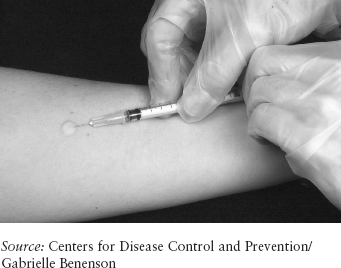
A technician conducts a tuberculin skin test. Recent tuberculosis (TB) outbreaks in cities such as New York and London in the 1980s and 1990s have shown that TB is not simply a disease affecting the developing world.
The Etiology of Tuberculosis
The development of TB follows various stages based upon the progression of various defense mechanisms initiated by the human immune response system. Initially, toxic chemicals released by the TB bacteria induce the human body to produce characteristic swellings or lesions at sites where the bacteria become clustered in the infected tissue. During the later stages, the immune system attempts to prevent the spread of TB to other parts of the body by enveloping the lesions in a thick fibrous coating of collagen, while bacteria that do escape the encapsulation are destroyed by immune response agents known as macrophages. The encapsulation eventually forms a hard grain called a granuloma that appears as a small dot on a chest X-ray. The resultant walled-off bacterial clusters can lie dormant in this latent phase for many years. At this stage, the individual is otherwise healthy and noninfectious and is classified as a nonactive case. In roughly 5 to 10 percent of the latent cases, the disease may become activated if the individual's immune system becomes weakened or damaged later in time. During this active stage, the bacteria may overcome the body's defense mechanisms and proliferate in the lungs, where they can be spread more easily to others through respiratory secretions, or be discharged into the circulatory and lymph system, where they can spread to other parts of the body. In terms of developing and implementing effective public health responses to TB, it is important to distinguish between cases that are the result of recent transmission (i.e., secondary cases) and those resulting from reactivation of old infections, especially since the original site of infection may be very distant from where the latent case currently resides, as well as very distant in the past.
...
- Animal Products
- Biological Control of Pests
- Chemical Pesticides
- Fast Food
- Fertilizers
- Food Allergies
- Genetically Engineered Crops
- Home-Grown Food
- Obesity
- Organic Produce
- Supplements
- Wine and Other Alcohols
- Airborne Diseases
- Air Filters/Scrubbers
- Asthma
- Climate Change
- Indoor Air Quality
- Ozone
- Particulate Matter
- Regional Dust
- Smog
- Smoking
- Ultraviolet Radiation
- Cities
- Fungi and Sick Building Syndrome
- Highways
- Occupational Hazards
- Radon and Basements
- Recreational Space
- Rural Areas
- Solid Waste Management
- Suburbs
- Topophilia
- Urban Green
- Automobiles (Emissions)
- Cell Phones
- Computers and Printers (Ink)
- Dry Cleaning
- Ergonomics
- Fabrics
- Hobby Products
- Lighting
- Microwave Ovens
- Paper Products
- Pest Control
- Plastics in Daily Use
- Radiation Sources
- Alternative Energy Resources (Solar)
- Biodiesel
- Clean Coal
- Electricity
- Firewood and Charcoal
- Hydroelectricity
- Lead Sources and Health
- Light Bulbs
- Manganese Sources and Health
- Mercury Sources and Health
- Methane/Biogas
- Nuclear Power
- Petrochemicals
- Cost-Benefit Analysis for Alternative Products
- Emergency Rooms
- Healthcare Delivery
- Health Disparities
- Health Insurance Reform
- Nursing, Lack of
- Pharmaceutical Industry Reform
- Cancers
- Cardiovascular Diseases
- Degenerative Diseases
- Immune System Diseases
- Injuries
- Kidney Diseases
- Liver Diseases
- Lung Diseases
- Mental Exercises
- Metabolic Syndrome Diseases
- Musculoskeletal Diseases
- Neurobehavioral Diseases
- Oral Diseases
- Physical Activity and Health
- Reproductive System Diseases
- Skin Disorders
- Acquired Immune Deficiency Syndrome
- Biological Weapons
- Bird Flu
- Gastroenteritis
- International Travel
- Malaria
- Methicillin-Resistant Staphylococcus Aureus
- Seasonal Flu
- Severe Acute Respiratory Syndrome
- Sexually Transmitted Diseases
- Stomach Ulcers and Helicobacter Pylori
- Streptococcus Infections
- Tuberculosis
- Vaccination/Herd Immunity
- Antiseptics
- Children's Health
- Dental Mercury Amalgams
- Health Insurance Industry
- Hospitals (Carbon Footprints)
- Infectious Waste
- Low-Level Radioactive Waste
- Men's Health
- Mental Health
- Nosocomial Infections
- Women's Health
- Biomedicine
- California's Green Chemistry Initiative
- Calorie Labeling for Restaurants
- Centers for Disease Control and Prevention (U.S.)
- Education and Green Health
- Environmental Protection Agency (U.S.)
- Fast Food Warnings
- Government Role in Green Health
- Green Chemistry
- Industrial Ecology
- International Policies
- Metrics of Green Health
- Personal Consumer Role in Green Health
- Phaseout of Toxic Chemicals
- Private Industry Role in Green Health
- Taxation of Unhealthy Products
- United Nations Environment Programme
- World Health Organization's Environmental Burden of Disease
- Advertising and Marketing
- Antibiotic Resistance
- Antibiotics
- Anti-Cholesterol Drugs
- Anti-Depressant Drugs
- Caffeine
- Hormone Therapy
- Pain Medication
- Pharmaceutical Industry
- Prescription Drug Addiction
- Arsenic Pollution
- Bottled Water
- Carbon Filters
- Chlorination By-Products
- Dehydration
- Groundwater
- Ozonation By-Products
- Recycled Water
- Reverse Osmosis
- Supplying Water
- Swimming Pools
- Tap Water/Fluoride
- Waterborne Diseases
- Water Scarcity
- Loading...
Get a 30 day FREE TRIAL
-
 Watch videos from a variety of sources bringing classroom topics to life
 -
Read modern, diverse business cases
-
Explore hundreds of books and reference titles

Read next

More like this
Sage Recommends
We found other relevant content for you on other Sage platforms.
Have you created a personal profile? Login or create a profile so that you can save clips, playlists and searches