
Entry
Reader's guide
Entries A-Z
Subject index
Solid Waste Management
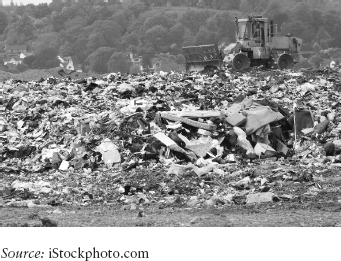
As humans have organized society toward greater productivity and prosperity, solid wastes have increased due to ever-higher levels of consumption of goods and services. Solid waste is typically an unwanted by-product from many of our daily activities, easily generated and often difficult to eliminate. Waste is best defined as material from a process that is discarded or unusable. It may occur as a liquid waste, gaseous waste, biodegradable waste, or solid waste. Some wastes are considered a pollutant, disrupting natural ecosystems, while others like biodegradable waste are more in balance with the system or process from which they are created. For this article's purpose, solid waste is commonly referred to as household trash or garbage, discarded or abandoned, including the often-used interchangeable term municipal solid waste (MSW). Several strategies exist to manage MSW, including landfilling, recycling/reusing, incineration, and source reduction.
Prior to the modern industrial age, human populations were much smaller and, hence, their solid waste outputs were a fraction of what they are today. Solid waste in ancient times consisted primarily of ash from fires, animal carcasses, and discarded tools. It was not until people gathered in ever-larger groups that solid waste became a concern. The first recorded landfill site was created around 3000 B.C.E. in the Cretan capital of Knossos. Waste was placed in large holes in the ground and covered with dirt. In response to the black plague of the mid-14th century, Britain employed “rakers” to collect refuse on the street, place it in carts, and remove it from the population centers. These two events mark the most widely adopted strategy of solid waste management to this day—collection of waste for removal and disposal in a landfill.
Modern solid waste management in the United States consists mainly of disposing of waste directly on land, incinerating it, or placing it in a sanitary landfill. The sanitary landfill process is currently the most widely used method to manage MSW. The waste industry employs over 360,000 with annual revenues of approximately $43 billion.
Modern solid waste management in the United States consists mainly of disposing of waste directly on land, incinerating it, or placing it in a sanitary landfill. The landfill option is currently the most widely used.
Life Cycle
Americans generated approximately 250 million tons of garbage in 2008 or 4.5 pounds person/day. Fifty-four percent of this waste was discarded in landfills, 33 percent was recycled or recovered, and 13 percent was incinerated. Paper, plastics, and food scraps comprise the majority of MSW. Modern MSW management begins with the collection of discarded household materials ranging from food scraps to appliances. Most local governments in the United States have responsibility for providing solid waste management services. It is collected at the source by municipalities or contracted to private collection services to be transported to a central location termed a transfer station. Once waste is placed outside the home or an establishment for collection, local government obtains ownership. After transport to the transfer station, it is unloaded from collection vehicles and held until it can be reloaded onto larger trucks, trains, or barges for shipment to its final destination of landfills or other treatment or disposal facilities.
...
- Animal Products
- Biological Control of Pests
- Chemical Pesticides
- Fast Food
- Fertilizers
- Food Allergies
- Genetically Engineered Crops
- Home-Grown Food
- Obesity
- Organic Produce
- Supplements
- Wine and Other Alcohols
- Airborne Diseases
- Air Filters/Scrubbers
- Asthma
- Climate Change
- Indoor Air Quality
- Ozone
- Particulate Matter
- Regional Dust
- Smog
- Smoking
- Ultraviolet Radiation
- Cities
- Fungi and Sick Building Syndrome
- Highways
- Occupational Hazards
- Radon and Basements
- Recreational Space
- Rural Areas
- Solid Waste Management
- Suburbs
- Topophilia
- Urban Green
- Automobiles (Emissions)
- Cell Phones
- Computers and Printers (Ink)
- Dry Cleaning
- Ergonomics
- Fabrics
- Hobby Products
- Lighting
- Microwave Ovens
- Paper Products
- Pest Control
- Plastics in Daily Use
- Radiation Sources
- Alternative Energy Resources (Solar)
- Biodiesel
- Clean Coal
- Electricity
- Firewood and Charcoal
- Hydroelectricity
- Lead Sources and Health
- Light Bulbs
- Manganese Sources and Health
- Mercury Sources and Health
- Methane/Biogas
- Nuclear Power
- Petrochemicals
- Cost-Benefit Analysis for Alternative Products
- Emergency Rooms
- Healthcare Delivery
- Health Disparities
- Health Insurance Reform
- Nursing, Lack of
- Pharmaceutical Industry Reform
- Cancers
- Cardiovascular Diseases
- Degenerative Diseases
- Immune System Diseases
- Injuries
- Kidney Diseases
- Liver Diseases
- Lung Diseases
- Mental Exercises
- Metabolic Syndrome Diseases
- Musculoskeletal Diseases
- Neurobehavioral Diseases
- Oral Diseases
- Physical Activity and Health
- Reproductive System Diseases
- Skin Disorders
- Acquired Immune Deficiency Syndrome
- Biological Weapons
- Bird Flu
- Gastroenteritis
- International Travel
- Malaria
- Methicillin-Resistant Staphylococcus Aureus
- Seasonal Flu
- Severe Acute Respiratory Syndrome
- Sexually Transmitted Diseases
- Stomach Ulcers and Helicobacter Pylori
- Streptococcus Infections
- Tuberculosis
- Vaccination/Herd Immunity
- Antiseptics
- Children's Health
- Dental Mercury Amalgams
- Health Insurance Industry
- Hospitals (Carbon Footprints)
- Infectious Waste
- Low-Level Radioactive Waste
- Men's Health
- Mental Health
- Nosocomial Infections
- Women's Health
- Biomedicine
- California's Green Chemistry Initiative
- Calorie Labeling for Restaurants
- Centers for Disease Control and Prevention (U.S.)
- Education and Green Health
- Environmental Protection Agency (U.S.)
- Fast Food Warnings
- Government Role in Green Health
- Green Chemistry
- Industrial Ecology
- International Policies
- Metrics of Green Health
- Personal Consumer Role in Green Health
- Phaseout of Toxic Chemicals
- Private Industry Role in Green Health
- Taxation of Unhealthy Products
- United Nations Environment Programme
- World Health Organization's Environmental Burden of Disease
- Advertising and Marketing
- Antibiotic Resistance
- Antibiotics
- Anti-Cholesterol Drugs
- Anti-Depressant Drugs
- Caffeine
- Hormone Therapy
- Pain Medication
- Pharmaceutical Industry
- Prescription Drug Addiction
- Arsenic Pollution
- Bottled Water
- Carbon Filters
- Chlorination By-Products
- Dehydration
- Groundwater
- Ozonation By-Products
- Recycled Water
- Reverse Osmosis
- Supplying Water
- Swimming Pools
- Tap Water/Fluoride
- Waterborne Diseases
- Water Scarcity
- Loading...
Get a 30 day FREE TRIAL
-
 Watch videos from a variety of sources bringing classroom topics to life
 -
Read modern, diverse business cases
-
Explore hundreds of books and reference titles

Read next

More like this
Sage Recommends
We found other relevant content for you on other Sage platforms.
Have you created a personal profile? Login or create a profile so that you can save clips, playlists and searches