
Entry
Reader's guide
Entries A-Z
Subject index
Radon and Basements
Radon is a chemical element (symbol Rn) with an atomic number of 86. Radon is a naturally occurring, odorless, colorless, radioactive gas produced by the radioactive decay of radium-226. Soils, rocks, and particularly granite are the major sources of radium in nature. Radon is generated from the normal radioactive decay of uranium. Uranium has been around since the Earth was formed, and one of its most common isotopes has a very long half-life (4.5 billion years), which is the amount of time required for one-half of uranium to break down. Uranium, radium, and thus radon will continue to exist indefinitely at about the same levels as they do now. A series of tiny radioactive particles are generated as radon gas decays.
Rn is one of the heaviest substances that remains as a gas in normal conditions and would be considered a health hazard. It is one of the decay products of uranium-238. It is generated by the radioactive decay of its “parent isotope” radium-226 with a half-life of 1,620 years. Radon-222 decays to its “daughter isotope” polonium-218 with a half-life of 3.05 minutes. Radon-222, which has a half-life of 3.8 days, is the most stable isotope. Therefore, radon-222 is the radon isotope of most concern to public health because of its longer half-life (3.8 days). When either the gas or these particles are breathed into the lungs, some are deposited and will continue to emit radiation. Lifelong exposures to high levels of radon can cause lung cancer.
The majority of the mean public exposure to ionizing radiations is by radon gas. It is often the single largest contributor (about 55 percent) to an individual's background radiation dose and is certainly the most variable from location to location—and is actually a function of location, varying with the composition of the underlying soil and rocks. Radon gas from natural sources can accumulate in buildings and other structures, especially in confined areas such as basements. Radon can also be found in some spring waters and hot springs.
Radon (at concentrations encountered in mines) was recognized as carcinogenic in the 1980s, in view of the lung cancer statistics for miners. Although radon may present significant risks, thousands of people annually travel to radon-contaminated mines for deliberate exposure to help with symptoms of arthritis without any serious health effects.
Detecting Radon
How is radon detected? Actually, there are two types of inexpensive indoor radon-level detectors. The short-term detectors use activated charcoal to adsorb radon from the air and are typically used for tests with duration of two to seven days. The long-term alphatrack detector consists of a piece of special plastic inside a container. It is typically used for tests of 91 days or more. The detectors are sent to special laboratories for analysis when the collection time has expired.
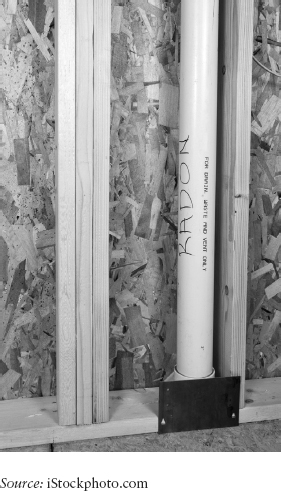
Following a highly publicized event in 1984, national radon safety standards were set, and radon detection and ventilation became a standard homeowner concern. Here, a radon vent tube made of PVC is included in a new home.
Stanley Watras in 1984 discovered the possible danger of radon exposure in dwellings when an employee at the Limerick nuclear power plant in Pennsylvania set off the radiation alarms on his way to work for two weeks while authorities searched for the source of the contamination. They found that the source was high levels of radon—about 100,000 Bq/m3 (2,700 pCi/L)—in his home's basement, and it was not related to the nuclear plant. Following this highly publicized event, national radon safety standards were set, and radon detection and ventilation became a standard homeowner concern, though typical domestic exposures are two to three order of magnitude lower (100 Bq/m3, or 2.5 pCi/l). Beginning in the late 1980s, this led to activists forming campaigns to raise awareness of radiation resulting from radon.
...
- Animal Products
- Biological Control of Pests
- Chemical Pesticides
- Fast Food
- Fertilizers
- Food Allergies
- Genetically Engineered Crops
- Home-Grown Food
- Obesity
- Organic Produce
- Supplements
- Wine and Other Alcohols
- Airborne Diseases
- Air Filters/Scrubbers
- Asthma
- Climate Change
- Indoor Air Quality
- Ozone
- Particulate Matter
- Regional Dust
- Smog
- Smoking
- Ultraviolet Radiation
- Cities
- Fungi and Sick Building Syndrome
- Highways
- Occupational Hazards
- Radon and Basements
- Recreational Space
- Rural Areas
- Solid Waste Management
- Suburbs
- Topophilia
- Urban Green
- Automobiles (Emissions)
- Cell Phones
- Computers and Printers (Ink)
- Dry Cleaning
- Ergonomics
- Fabrics
- Hobby Products
- Lighting
- Microwave Ovens
- Paper Products
- Pest Control
- Plastics in Daily Use
- Radiation Sources
- Alternative Energy Resources (Solar)
- Biodiesel
- Clean Coal
- Electricity
- Firewood and Charcoal
- Hydroelectricity
- Lead Sources and Health
- Light Bulbs
- Manganese Sources and Health
- Mercury Sources and Health
- Methane/Biogas
- Nuclear Power
- Petrochemicals
- Cost-Benefit Analysis for Alternative Products
- Emergency Rooms
- Healthcare Delivery
- Health Disparities
- Health Insurance Reform
- Nursing, Lack of
- Pharmaceutical Industry Reform
- Cancers
- Cardiovascular Diseases
- Degenerative Diseases
- Immune System Diseases
- Injuries
- Kidney Diseases
- Liver Diseases
- Lung Diseases
- Mental Exercises
- Metabolic Syndrome Diseases
- Musculoskeletal Diseases
- Neurobehavioral Diseases
- Oral Diseases
- Physical Activity and Health
- Reproductive System Diseases
- Skin Disorders
- Acquired Immune Deficiency Syndrome
- Biological Weapons
- Bird Flu
- Gastroenteritis
- International Travel
- Malaria
- Methicillin-Resistant Staphylococcus Aureus
- Seasonal Flu
- Severe Acute Respiratory Syndrome
- Sexually Transmitted Diseases
- Stomach Ulcers and Helicobacter Pylori
- Streptococcus Infections
- Tuberculosis
- Vaccination/Herd Immunity
- Antiseptics
- Children's Health
- Dental Mercury Amalgams
- Health Insurance Industry
- Hospitals (Carbon Footprints)
- Infectious Waste
- Low-Level Radioactive Waste
- Men's Health
- Mental Health
- Nosocomial Infections
- Women's Health
- Biomedicine
- California's Green Chemistry Initiative
- Calorie Labeling for Restaurants
- Centers for Disease Control and Prevention (U.S.)
- Education and Green Health
- Environmental Protection Agency (U.S.)
- Fast Food Warnings
- Government Role in Green Health
- Green Chemistry
- Industrial Ecology
- International Policies
- Metrics of Green Health
- Personal Consumer Role in Green Health
- Phaseout of Toxic Chemicals
- Private Industry Role in Green Health
- Taxation of Unhealthy Products
- United Nations Environment Programme
- World Health Organization's Environmental Burden of Disease
- Advertising and Marketing
- Antibiotic Resistance
- Antibiotics
- Anti-Cholesterol Drugs
- Anti-Depressant Drugs
- Caffeine
- Hormone Therapy
- Pain Medication
- Pharmaceutical Industry
- Prescription Drug Addiction
- Arsenic Pollution
- Bottled Water
- Carbon Filters
- Chlorination By-Products
- Dehydration
- Groundwater
- Ozonation By-Products
- Recycled Water
- Reverse Osmosis
- Supplying Water
- Swimming Pools
- Tap Water/Fluoride
- Waterborne Diseases
- Water Scarcity
- Loading...
Get a 30 day FREE TRIAL
-
 Watch videos from a variety of sources bringing classroom topics to life
 -
Read modern, diverse business cases
-
Explore hundreds of books and reference titles

Read next

More like this
Sage Recommends
We found other relevant content for you on other Sage platforms.
Have you created a personal profile? Login or create a profile so that you can save clips, playlists and searches