
Entry
Reader's guide
Entries A-Z
Subject index
Ozone
In 1840, ozone was proposed as a distinct chemical compound by Christian Friedrich Schönbein, who named it after the Greek verb ozein (to smell) from the peculiar odor in lightning storms. Twenty-five years later, in 1865, Jacques-Louis Soret suggested the formula for ozone, O3, which was confirmed by Schönbein in 1867.
Ozone, or O3, is a triatomic molecule and an allotrope of oxygen that is less stable compared to the diatomic O2. Ozone is an extremely reactive gases which is constructed of three oxygen atoms. It is a powerful oxidizing agent, far better than dioxygen. It is very unstable at high concentrations and decays into regular diatomic oxygen. The half-life of ozone in atmospheric conditions is about 30 minutes. This reaction proceeds more rapidly with increasing temperature and decreasing pressure. Deflagration of ozone can be triggered by a spark and can occur in ozone concentrations of 10 percent or higher. Ozone might have a different effect depending on its location in the atmosphere. This reactive gas has good and bad effects on life on Earth.
This reactive gas can be formed either at the stratospheric level or ground level. The stratospheric level of ozone is formed naturally through the interaction of solar ultraviolet (UV) radiation with molecules of oxygen (O2). The atmospheric ozone layer can extend up to 30 miles above the Earth's surface and reduces the amount of harmful UV radiation reaching the Earth's surface. The stratosphere is the region of the atmosphere with the highest levels of ozone. This region is also known as the ozone layer, which is located about 6 to 30 miles above the Earth's surface.
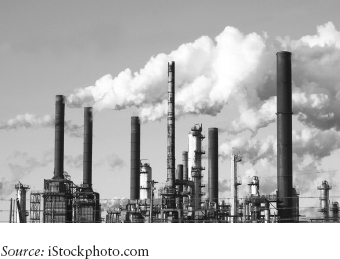
Cars, industrial plants, and power plants are significant sources for one class of air pollutant—nitrogen oxides—and are largely responsible for tropospheric, or ground-level, ozone.
Photons with shorter wavelengths (less than 320 nm) of ultraviolet light (UV) rays (270 to 400 nm) are harmful to most forms of life in large doses. These harmful photons are filtered out by the stratosphere layer. Ozone in the stratosphere region is mainly produced from UV rays reacting with oxygen. Therefore, this layer of ozone acts as a shielding layer against the UV rays and absorbs these harmful rays.
Solar UV rays make up part of the electromagnetic or photonic spectrum of light and radiant energy. A part of this spectrum can be broken down into different wavelengths. The electromagnetic spectrum within the wavelength region ranges from the vacuum ultraviolet to the far infrared. The UVs cannot be seen by human eyes since they have a shorter wavelength compared to visible light. There are three different types of UVs as explained in the following:
- UVA wavelengths (320—400 nm) are only slightly affected by ozone levels. Most UVA radiation is able to reach the Earth's surface and can contribute to tanning, skin aging, eye damage, and immune suppression.
- UVB wavelengths (280–320 nm) are strongly affected by ozone levels. Decreases in stratospheric ozone mean that more UVB radiation can reach the Earth's surface, causing sunburns, snow blindness, immune suppression, and a variety of skin problems including skin cancer and premature aging.
- UVC wavelengths (100–280 nm) are very strongly affected by ozone levels, so that the levels of UVC radiation reaching the Earth's surface are relatively small.
The effects of UV radiation on the Earth's ecosystems are not completely understood. Even isolating the effects of UVA versus UVB is somewhat arbitrary. All UV radiations can be damaging. This knowledge has prompted many manufacturers of sunscreens and sunglasses to offer products that protect against both UVA and UVB wavelengths.
...
- Animal Products
- Biological Control of Pests
- Chemical Pesticides
- Fast Food
- Fertilizers
- Food Allergies
- Genetically Engineered Crops
- Home-Grown Food
- Obesity
- Organic Produce
- Supplements
- Wine and Other Alcohols
- Airborne Diseases
- Air Filters/Scrubbers
- Asthma
- Climate Change
- Indoor Air Quality
- Ozone
- Particulate Matter
- Regional Dust
- Smog
- Smoking
- Ultraviolet Radiation
- Cities
- Fungi and Sick Building Syndrome
- Highways
- Occupational Hazards
- Radon and Basements
- Recreational Space
- Rural Areas
- Solid Waste Management
- Suburbs
- Topophilia
- Urban Green
- Automobiles (Emissions)
- Cell Phones
- Computers and Printers (Ink)
- Dry Cleaning
- Ergonomics
- Fabrics
- Hobby Products
- Lighting
- Microwave Ovens
- Paper Products
- Pest Control
- Plastics in Daily Use
- Radiation Sources
- Alternative Energy Resources (Solar)
- Biodiesel
- Clean Coal
- Electricity
- Firewood and Charcoal
- Hydroelectricity
- Lead Sources and Health
- Light Bulbs
- Manganese Sources and Health
- Mercury Sources and Health
- Methane/Biogas
- Nuclear Power
- Petrochemicals
- Cost-Benefit Analysis for Alternative Products
- Emergency Rooms
- Healthcare Delivery
- Health Disparities
- Health Insurance Reform
- Nursing, Lack of
- Pharmaceutical Industry Reform
- Cancers
- Cardiovascular Diseases
- Degenerative Diseases
- Immune System Diseases
- Injuries
- Kidney Diseases
- Liver Diseases
- Lung Diseases
- Mental Exercises
- Metabolic Syndrome Diseases
- Musculoskeletal Diseases
- Neurobehavioral Diseases
- Oral Diseases
- Physical Activity and Health
- Reproductive System Diseases
- Skin Disorders
- Acquired Immune Deficiency Syndrome
- Biological Weapons
- Bird Flu
- Gastroenteritis
- International Travel
- Malaria
- Methicillin-Resistant Staphylococcus Aureus
- Seasonal Flu
- Severe Acute Respiratory Syndrome
- Sexually Transmitted Diseases
- Stomach Ulcers and Helicobacter Pylori
- Streptococcus Infections
- Tuberculosis
- Vaccination/Herd Immunity
- Antiseptics
- Children's Health
- Dental Mercury Amalgams
- Health Insurance Industry
- Hospitals (Carbon Footprints)
- Infectious Waste
- Low-Level Radioactive Waste
- Men's Health
- Mental Health
- Nosocomial Infections
- Women's Health
- Biomedicine
- California's Green Chemistry Initiative
- Calorie Labeling for Restaurants
- Centers for Disease Control and Prevention (U.S.)
- Education and Green Health
- Environmental Protection Agency (U.S.)
- Fast Food Warnings
- Government Role in Green Health
- Green Chemistry
- Industrial Ecology
- International Policies
- Metrics of Green Health
- Personal Consumer Role in Green Health
- Phaseout of Toxic Chemicals
- Private Industry Role in Green Health
- Taxation of Unhealthy Products
- United Nations Environment Programme
- World Health Organization's Environmental Burden of Disease
- Advertising and Marketing
- Antibiotic Resistance
- Antibiotics
- Anti-Cholesterol Drugs
- Anti-Depressant Drugs
- Caffeine
- Hormone Therapy
- Pain Medication
- Pharmaceutical Industry
- Prescription Drug Addiction
- Arsenic Pollution
- Bottled Water
- Carbon Filters
- Chlorination By-Products
- Dehydration
- Groundwater
- Ozonation By-Products
- Recycled Water
- Reverse Osmosis
- Supplying Water
- Swimming Pools
- Tap Water/Fluoride
- Waterborne Diseases
- Water Scarcity
- Loading...
Get a 30 day FREE TRIAL
-
 Watch videos from a variety of sources bringing classroom topics to life
 -
Read modern, diverse business cases
-
Explore hundreds of books and reference titles

Read next

More like this
Sage Recommends
We found other relevant content for you on other Sage platforms.
Have you created a personal profile? Login or create a profile so that you can save clips, playlists and searches