
Entry
Reader's guide
Entries A-Z
Subject index
Organic Produce
As a relatively new industry, the organic food movement is a green alternative to more conventional food production. Organic food is believed by its advocates to be healthier, ecologically balanced, and free of pesticides. While quantity and mass production are the major concerns of nonorganic food producers, the major concern of organic food producers is quality. As the market for organic produce increased exponentially over the last few decades of the 20th century, confusion arose as to what precisely constitutes “organic” produce. To meet the needs of consumers, trade groups and government regulatory agencies have worked to define what organic produce is and provide special certification to protect consumers, and have conducted studies to ensure that organic farms are less damaging to the environment and provide the greater nutritional value and taste expected by consumers.
To receive the classification of “organic,” a product must abide by certain rules and regulations. Produce cannot have been genetically modified, nor can nonorganic herbicides, insecticides, or pesticides have been used during the growth process. Nonorganic fertilizers are sometimes used in raising organic produce, however. In most countries, including the United States, organic produce cannot be genetically modified, meaning that produce whose genetic material has been altered using recombinant DNA technology cannot be considered organic. Certain artificial methods, such as chemical ripening and food irradiation, also preclude produce from being labeled organic. Organic farms focus on improving soil output and controlling pests through composting, using green manure, rotating crops, controlling pests biologically, and cultivating crops mechanically. Although organic produce was historically grown on smaller, family-owned farms, as demand for the product has grown, many corporations have entered the organic field. Larger producers have sometimes engaged in practices that were controversial compared with traditional practices of organic production, such as limited use of pesticides. As organic produce sales have increased by over 20 percent annually since the early 1990s, government certification of precisely what constitutes organic produce has become more widespread.
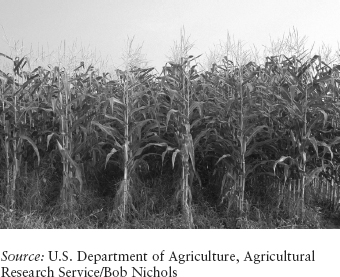
Organic farming has many benefits for the environment; namely, the practice does not release synthetic pesticides that can harm soil, water, and wildlife. Here, organic corn has more weeds late in the season, since no herbicides were used.
Many nations, including Canada, China, the European Union, Japan, and the United States, have fully implemented programs for the certification of organic produce. Certification standards vary from country to country and control standards for planting, growing, harvesting, storing, processing, packaging, and shipping organic produce. In the United States, certification originally began as the result of a private cooperative effort. Beginning in 1973, the California Certified Organic Farmers (CCOF) was founded as a membership organization to promote and attest to its members’ organic produce. As organic produce became more popular and widespread, more consistent definitions of what determined the types of organic produce that were sought by both producers and consumers. Ultimately, in 2002, the U.S. Department of Agriculture (USDA) promulgated a regulatory framework governing organic produce and other foods. This framework is known as the National Organic Program, and it sets out all aspects of production, processing, delivery, and sale to consumers of food that wishes to be labeled “organic.” All producers with sales greater than $5,000 per year must register with the USDA to have their crops labeled “USDA Organic.” The National Organic Program accredits over 100 domestic and international bodies, including cooperatives such as CCOF, that are able to offer organic certification.
...
- Animal Products
- Biological Control of Pests
- Chemical Pesticides
- Fast Food
- Fertilizers
- Food Allergies
- Genetically Engineered Crops
- Home-Grown Food
- Obesity
- Organic Produce
- Supplements
- Wine and Other Alcohols
- Airborne Diseases
- Air Filters/Scrubbers
- Asthma
- Climate Change
- Indoor Air Quality
- Ozone
- Particulate Matter
- Regional Dust
- Smog
- Smoking
- Ultraviolet Radiation
- Cities
- Fungi and Sick Building Syndrome
- Highways
- Occupational Hazards
- Radon and Basements
- Recreational Space
- Rural Areas
- Solid Waste Management
- Suburbs
- Topophilia
- Urban Green
- Automobiles (Emissions)
- Cell Phones
- Computers and Printers (Ink)
- Dry Cleaning
- Ergonomics
- Fabrics
- Hobby Products
- Lighting
- Microwave Ovens
- Paper Products
- Pest Control
- Plastics in Daily Use
- Radiation Sources
- Alternative Energy Resources (Solar)
- Biodiesel
- Clean Coal
- Electricity
- Firewood and Charcoal
- Hydroelectricity
- Lead Sources and Health
- Light Bulbs
- Manganese Sources and Health
- Mercury Sources and Health
- Methane/Biogas
- Nuclear Power
- Petrochemicals
- Cost-Benefit Analysis for Alternative Products
- Emergency Rooms
- Healthcare Delivery
- Health Disparities
- Health Insurance Reform
- Nursing, Lack of
- Pharmaceutical Industry Reform
- Cancers
- Cardiovascular Diseases
- Degenerative Diseases
- Immune System Diseases
- Injuries
- Kidney Diseases
- Liver Diseases
- Lung Diseases
- Mental Exercises
- Metabolic Syndrome Diseases
- Musculoskeletal Diseases
- Neurobehavioral Diseases
- Oral Diseases
- Physical Activity and Health
- Reproductive System Diseases
- Skin Disorders
- Acquired Immune Deficiency Syndrome
- Biological Weapons
- Bird Flu
- Gastroenteritis
- International Travel
- Malaria
- Methicillin-Resistant Staphylococcus Aureus
- Seasonal Flu
- Severe Acute Respiratory Syndrome
- Sexually Transmitted Diseases
- Stomach Ulcers and Helicobacter Pylori
- Streptococcus Infections
- Tuberculosis
- Vaccination/Herd Immunity
- Antiseptics
- Children's Health
- Dental Mercury Amalgams
- Health Insurance Industry
- Hospitals (Carbon Footprints)
- Infectious Waste
- Low-Level Radioactive Waste
- Men's Health
- Mental Health
- Nosocomial Infections
- Women's Health
- Biomedicine
- California's Green Chemistry Initiative
- Calorie Labeling for Restaurants
- Centers for Disease Control and Prevention (U.S.)
- Education and Green Health
- Environmental Protection Agency (U.S.)
- Fast Food Warnings
- Government Role in Green Health
- Green Chemistry
- Industrial Ecology
- International Policies
- Metrics of Green Health
- Personal Consumer Role in Green Health
- Phaseout of Toxic Chemicals
- Private Industry Role in Green Health
- Taxation of Unhealthy Products
- United Nations Environment Programme
- World Health Organization's Environmental Burden of Disease
- Advertising and Marketing
- Antibiotic Resistance
- Antibiotics
- Anti-Cholesterol Drugs
- Anti-Depressant Drugs
- Caffeine
- Hormone Therapy
- Pain Medication
- Pharmaceutical Industry
- Prescription Drug Addiction
- Arsenic Pollution
- Bottled Water
- Carbon Filters
- Chlorination By-Products
- Dehydration
- Groundwater
- Ozonation By-Products
- Recycled Water
- Reverse Osmosis
- Supplying Water
- Swimming Pools
- Tap Water/Fluoride
- Waterborne Diseases
- Water Scarcity
- Loading...
Get a 30 day FREE TRIAL
-
 Watch videos from a variety of sources bringing classroom topics to life
 -
Read modern, diverse business cases
-
Explore hundreds of books and reference titles

Read next

More like this
Sage Recommends
We found other relevant content for you on other Sage platforms.
Have you created a personal profile? Login or create a profile so that you can save clips, playlists and searches