
Entry
Reader's guide
Entries A-Z
Subject index
Alternative Energy Resources (Solar)
The sun's rays may have been the very first energy source utilized by man. There is evidence that primitive societies captured the heat energy from the sun to heat their homes and for cooking, two uses that remain common today in some parts of the world. Legend has it that in the third century B.C.E., Archimedes used a giant lens to concentrate the sun's rays and set fire to an invading Roman fleet, utilizing a principle that today is used to generate solar energy. The use of the sun's rays as a light source is also ancient, and the principle of using sunlight to light the interiors of buildings is enshrined in law in some countries.
For instance, Great Britain recognizes a “right to light” principle. This law limits construction that would cut off the source of natural daylight to other buildings that have traditionally enjoyed access to that light. More recently, Antoine Lavoisier developed a solar furnace in France in the late 18th century; solar water heaters were developed in the United States in the 1890s; and solar powered water pumps were used for irrigation in Egypt from the early 20th century. Harnessing solar radiation to produce electricity became possible with the development of photovoltaic cells in the 1950s, although the photoelectric effect had been described in 1839. Photovoltaic cells were used to provide power to spacecraft in the 1960s. By the 1970s, solar power was beginning to be seen as a reasonable supplement or alternative to other methods of generating power.
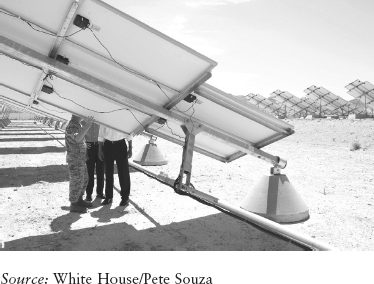
The amount of electricity that photovoltaic solar cells generate depends on the amount of sunlight and the angle at which that sunlight hits the panels. Here, President Obama views a photovoltaic array of solar panels with the base commander during a tour of the Nellis Air Force Base in May 2009.
Types of Solar Power
There are three methods in common use today to capture the energy of the sun's rays for practical use. The first is through passive or active thermal systems, which use the sun's energy to heat buildings, water, and so on. Passive solar heating requires only that a building or installation be designed to capture the sun's rays through orientation, placement of windows, and so on, and requires no additional energy to operate the system. Active solar heating, which is generally more efficient but also more complex and requires the use of electrical or mechanical equipment, uses collectors to capture the energy of the sun. The captured energy is then transmitted to the building through means such as a pump or fan. Both methods are used to heat water. A simple example of passive solar water heating is a painted black barrel placed on a roof—similar to systems used by some campers to heat water in a black bag for use in bathing and dishwashing—while sophisticated systems involve collectors and pumps. These latter systems are commonly used in Europe and Asia.
Photovoltaic cells, also called solar cells, are used to convert solar energy to electricity. The first working photovoltaic cells were developed at Bell Laboratories in the United States in 1954. Although originally considered a curiosity, solar cells proved useful as a power source for spacecraft in the 1960s and 1970s since they were a nonpolluting alternative to power generated from coal or petroleum. The heart of a solar cell is a wafer of semiconductor material (generally silicon) that has been treated so it is positive on one side and negative on the other. Electrical conductors are attached to both sides to form an electrical circuit to capture the energy created when the sun's rays strike the cell and knock electrons loose from the atoms in the semiconductor material. This creates electricity, which can be used as power such as a light. More electricity may be created by connecting multiple solar cells in a module; multiple modules form an array. Modules and arrays produce direct current and are designed to output electricity at a particular voltage (e.g., 12 volts). In general, the greater the area exposed to the sun, the greater the electricity generated.
...
- Animal Products
- Biological Control of Pests
- Chemical Pesticides
- Fast Food
- Fertilizers
- Food Allergies
- Genetically Engineered Crops
- Home-Grown Food
- Obesity
- Organic Produce
- Supplements
- Wine and Other Alcohols
- Airborne Diseases
- Air Filters/Scrubbers
- Asthma
- Climate Change
- Indoor Air Quality
- Ozone
- Particulate Matter
- Regional Dust
- Smog
- Smoking
- Ultraviolet Radiation
- Cities
- Fungi and Sick Building Syndrome
- Highways
- Occupational Hazards
- Radon and Basements
- Recreational Space
- Rural Areas
- Solid Waste Management
- Suburbs
- Topophilia
- Urban Green
- Automobiles (Emissions)
- Cell Phones
- Computers and Printers (Ink)
- Dry Cleaning
- Ergonomics
- Fabrics
- Hobby Products
- Lighting
- Microwave Ovens
- Paper Products
- Pest Control
- Plastics in Daily Use
- Radiation Sources
- Alternative Energy Resources (Solar)
- Biodiesel
- Clean Coal
- Electricity
- Firewood and Charcoal
- Hydroelectricity
- Lead Sources and Health
- Light Bulbs
- Manganese Sources and Health
- Mercury Sources and Health
- Methane/Biogas
- Nuclear Power
- Petrochemicals
- Cost-Benefit Analysis for Alternative Products
- Emergency Rooms
- Healthcare Delivery
- Health Disparities
- Health Insurance Reform
- Nursing, Lack of
- Pharmaceutical Industry Reform
- Cancers
- Cardiovascular Diseases
- Degenerative Diseases
- Immune System Diseases
- Injuries
- Kidney Diseases
- Liver Diseases
- Lung Diseases
- Mental Exercises
- Metabolic Syndrome Diseases
- Musculoskeletal Diseases
- Neurobehavioral Diseases
- Oral Diseases
- Physical Activity and Health
- Reproductive System Diseases
- Skin Disorders
- Acquired Immune Deficiency Syndrome
- Biological Weapons
- Bird Flu
- Gastroenteritis
- International Travel
- Malaria
- Methicillin-Resistant Staphylococcus Aureus
- Seasonal Flu
- Severe Acute Respiratory Syndrome
- Sexually Transmitted Diseases
- Stomach Ulcers and Helicobacter Pylori
- Streptococcus Infections
- Tuberculosis
- Vaccination/Herd Immunity
- Antiseptics
- Children's Health
- Dental Mercury Amalgams
- Health Insurance Industry
- Hospitals (Carbon Footprints)
- Infectious Waste
- Low-Level Radioactive Waste
- Men's Health
- Mental Health
- Nosocomial Infections
- Women's Health
- Biomedicine
- California's Green Chemistry Initiative
- Calorie Labeling for Restaurants
- Centers for Disease Control and Prevention (U.S.)
- Education and Green Health
- Environmental Protection Agency (U.S.)
- Fast Food Warnings
- Government Role in Green Health
- Green Chemistry
- Industrial Ecology
- International Policies
- Metrics of Green Health
- Personal Consumer Role in Green Health
- Phaseout of Toxic Chemicals
- Private Industry Role in Green Health
- Taxation of Unhealthy Products
- United Nations Environment Programme
- World Health Organization's Environmental Burden of Disease
- Advertising and Marketing
- Antibiotic Resistance
- Antibiotics
- Anti-Cholesterol Drugs
- Anti-Depressant Drugs
- Caffeine
- Hormone Therapy
- Pain Medication
- Pharmaceutical Industry
- Prescription Drug Addiction
- Arsenic Pollution
- Bottled Water
- Carbon Filters
- Chlorination By-Products
- Dehydration
- Groundwater
- Ozonation By-Products
- Recycled Water
- Reverse Osmosis
- Supplying Water
- Swimming Pools
- Tap Water/Fluoride
- Waterborne Diseases
- Water Scarcity
- Loading...
Get a 30 day FREE TRIAL
-
 Watch videos from a variety of sources bringing classroom topics to life
 -
Read modern, diverse business cases
-
Explore hundreds of books and reference titles

Read next

More like this
Sage Recommends
We found other relevant content for you on other Sage platforms.
Have you created a personal profile? Login or create a profile so that you can save clips, playlists and searches