
Entry
Reader's guide
Entries A-Z
Subject index
Wheat
Wheat is the major food resource for about half of the world's population. At the same time, wheat production provides for the income of millions of small farmers and agribusiness firms likewise in developed and developing countries. The resources for producing wheat can be also used for producing fuels and for maintaining natural forest and prairies. Although some consumers are able to choose among practically hundreds of bread types, others obtain their main protein intake from wheat flour. Different answers are being put forward to the questions posed by the interdependence of resources involved in food production and the incompatible use of their outcomes. The total world wheat production is 500–600 million tons, of which more than half is produced in developing countries. The main producing countries include China, the United States, India, Kazakhstan, Pakistan, Russia, Turkey, the Ukraine, Canada, and Australia, which together account for about 80 percent of total production. Estimations for the year 2010 indicate that total wheat production will increase to about 680 million tons, especially driven by the need to replenish remarkably low present world stocks. Long-term factors affecting agricultural global production, however, indicate a slight decline in the planted area and the supply in the coming 10 years. This is a definite slowdown from previous growth, which doubled production in 30 years. The most important driver of this trend is the competition of soybeans and corn that turn out more profitable alternatives for farmers than wheat in the near future.
The demand for wheat-based products has slightly declined in recent years and is expected to remain steady in contrast to the strong growth in demand for vegetable oil and protein meal from soybeans and corn. The consumption of wheat bread is pervaded by economics but also by political, aesthetic, social, symbolic, and health aspects of each society. Although wheat demand is relatively steady in terms of quantity, there are changes in the demanded quality associated with consumption trends in quality food upgrading, health concerns, and social and environmental responsibility. These changes translate to all food system participants in the form of business opportunities and coordination and innovation challenges. For example, a growing niche of organic wheat bread requires a tighter coordination between organic producer, wheat miller (not to mix organic with nonorganic wheat), and baker.
International trade of wheat is about 128 million tons. Soybeans and corn have outpaced this figure in recent years and moved wheat from its traditional lead in global agricultural commodity markets to third place. The traditional wheat-exporting countries are the United States, Canada, Australia, the European Union, and Argentina. In recent years, there has been a strong increase of exported wheat from the Black Sea countries, especially from Russia and from the Ukraine, making wheat global trade become less concentrated.
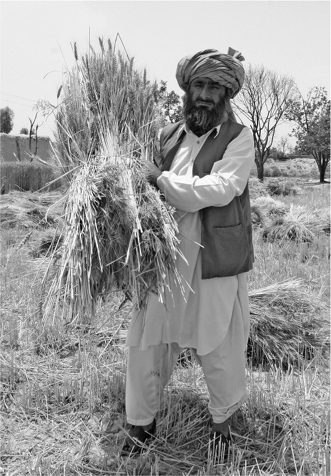
A Pakistani farmer in the Loralai District bringing in some of his wheat harvest, which was grown from a drought-tolerant strain appropriate to local conditions.
The trade flow is primarily from North to South, as developed countries account for about 85 percent of exports, whereas developing countries account for 75 percent of imports. Two main types of wheat are traded globally: milling wheat, which accounts for about 95 percent of total world wheat production, and durum wheat. The milling market is further segmented into the highest quality, demanded by developed countries (about 10 percent of the milling wheat market) and a lower quality, demanded by developing countries including Iraq, Iran, Indonesia, and Egypt. China, the largest wheat producer in the world, has been a small net exporter in recent years; it is expected, however, that production constraints will lead it to become a small net importer in the next 10 years. Brazil is the largest wheat importer but also the place where agriculture is growing the most from land expansion in the Cerrados (a large savanna environment in the center of the country).
...
- Food Challenges
- Animal Welfare
- Beyond Organic
- Cheap Food Policy
- Crop Genetic Diversity
- DDT
- Debt Crisis
- Disappearing Middle
- Export Dependency
- Famine
- Farm Crisis
- Fast Food
- Food Processing Industry
- Food Safety
- Food Security
- Genetically Modified Organisms
- Grain-Fed Beef
- High Fructose Corn Syrup
- Integrated Pest Management
- Irradiation
- Mad Cow Disease
- Malthusianism
- Mechanization
- Millennium Development Goals
- Modernization
- Nitrogen Fixation
- Organochlorines
- Origin Labeling
- Peasant
- Pesticide
- Productionism
- Proletarianization
- Recombinant Bovine Growth Hormone
- Roundup Ready Crops
- Salmonella
- Sewage Sludge
- Soil Erosion
- Sustainable Agriculture
- Swidden Agriculture
- Weed Management
- Food Economics and Trade
- Food Farm and Industry
- Agrarian Question
- Agrarianism
- Agribusiness
- Agricultural Commodity Programs
- Agricultural Extension
- Agrodiversity
- Agroecology
- Agrofood System (Agrifood)
- Aquaculture
- Biodynamic Agriculture
- Biological Control
- Bt
- Composting
- Confined Animal Feeding Operation
- Contract Farming
- Cooperative
- Corn
- Cover Cropping
- Crop Rotation
- Dairy
- Dioxins
- Factory Farm
- Family Farm
- Fertilizer
- Fruits
- Grazing
- Hunting
- Intercropping
- Irrigation
- Legume Crops
- Low-Input Agriculture
- Meats
- Nanotechnology and Food
- Organic Farming
- Plantation
- Rice
- Salmon
- Seed Industry
- Soil Nutrient Cycling
- Soybeans
- Substitutionism
- Sugarcane
- Urban Agriculture
- Vegetables
- Wheat
- Yeoman Farmer
- Food Laws, Agreements, and Organizations
- Archer Daniels Midland
- California Certified Organic Farmers
- Certified Humane
- Certified Organic
- Codex Alimentarius
- Commons ConAgra
- Department of Agriculture, U.S
- Diamond v. Chakrabarty
- Doha Round, World Trade Organization
- Fair Labor Association
- Fair Trade
- Farm Bill
- Federal Insecticide, Fungicide, and Rodenticide Act
- Food and Agriculture Organization
- Food and Drug Administration
- Food First
- Food Justice Movement
- Food Quality Protection Act
- Food Sovereignty
- Institute for Agriculture and Trade Policy
- International Coffee Agreement
- Land Grant University
- National Organic Program
- North American Free Trade Agreement
- Northeast Organic Farming Association
- Ogallala Aquifer
- Public Law 480, Food Aid
- Sustainable Fisheries Act
- United Farm Workers
- Wal-Mart
- Foods and Lifestyle
- Loading...
Get a 30 day FREE TRIAL
-
 Watch videos from a variety of sources bringing classroom topics to life
 -
Read modern, diverse business cases
-
Explore hundreds of books and reference titles

Read next

More like this
Sage Recommends
We found other relevant content for you on other Sage platforms.
Have you created a personal profile? Login or create a profile so that you can save clips, playlists and searches