
Entry
Reader's guide
Entries A-Z
Subject index
Weed Management
An informal definition and subjective definition of a weed is a plant growing anywhere that it is not wanted. Sometimes plants such as flowers or vegetables stray and come up spontaneously as volunteers. Quite often for gardeners these are acceptable, even if technically these are weeds. At other times, a weed is a plant in a place where humans do not want it to grow.
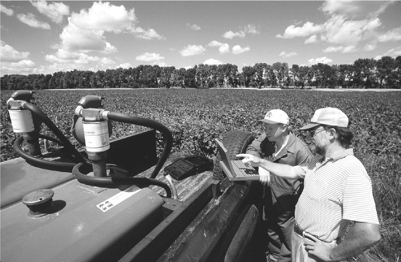
A farmer (left) and an agronomist used specialized computer software to develop a carefully timed weed management strategy to counter the emergence of pigweed in a soybean field.
Weeds are nuisances that infest areas humans cultivate including lawns, gardens, parks, farm fields, rangelands, or fish ponds. Weeds may be native plants or invasive imports. They are undesirable in lawns because they are unsightly. They are undesirable also because they rob nutrition from cultivated plants. If not cleared, they can choke gardens and fields to the point that crop yields are reduced or almost completely eliminated. In the case of horticultural plants, they can be unsightly as well as damaging. Weeds can spread plant pathogens. They can also be an irritating nuisance with thorns or prickles. Others such as poison ivy can be skin irritants. Others are poisonous if eaten by either humans or animals. Loco weed in the western areas of the United States extracts arsenic from the soil. If eaten by a horse or cow, it causes poisoning. There have been cases of large numbers of cattle or horses being sickened or killed from eating poisonous weeds. Other weeds have burrs or parts that stick to fur or skin. All of these characteristics of weeds make them undesirable where humans cultivate other plants. These types of weeds are a nuisance to hunters, domestic animals, and farmers.
Weeds from the fields are often produced by wind-blown seeds that arrive in the garden, in horticultural displays, or in vast agricultural fields. Gardeners are faced with the need to use hoes or other implements to free their gardens from weeds that otherwise will overwhelm the cultivated plants. Farmers face the same problems, only on a larger scale.
Adaptations by weedy plants give them the ability to spread widely and thickly. Often weeds spread seeds, which have a high fertility rate. If the soil has been disturbed by nature or by humans, it gives weeds the opportunity to grow abundantly. Part of the adaptation of weeds is quick growth—the source of the expression “growing like a weed.” Rapid growth rates allow weeds to outgrow plants used for crops. They also have the ability to remain dormant for years. Some weeds can be dormant for 20 or 40 years. Some weeds have extensive root systems that inhibit the growth of other plants. Other species of weeds are allelopathic, producing chemicals that prevent germination or growth by other plants.
Weeds have been part of the human story since the beginning. Literature and religion contain references to weeds. William Shakespeare wrote a sonnet on weeds. The book of Genesis records that God punished Adam for his disobedience with a curse of weeds on the ground Adam cultivated.
...
- Food Challenges
- Animal Welfare
- Beyond Organic
- Cheap Food Policy
- Crop Genetic Diversity
- DDT
- Debt Crisis
- Disappearing Middle
- Export Dependency
- Famine
- Farm Crisis
- Fast Food
- Food Processing Industry
- Food Safety
- Food Security
- Genetically Modified Organisms
- Grain-Fed Beef
- High Fructose Corn Syrup
- Integrated Pest Management
- Irradiation
- Mad Cow Disease
- Malthusianism
- Mechanization
- Millennium Development Goals
- Modernization
- Nitrogen Fixation
- Organochlorines
- Origin Labeling
- Peasant
- Pesticide
- Productionism
- Proletarianization
- Recombinant Bovine Growth Hormone
- Roundup Ready Crops
- Salmonella
- Sewage Sludge
- Soil Erosion
- Sustainable Agriculture
- Swidden Agriculture
- Weed Management
- Food Economics and Trade
- Food Farm and Industry
- Agrarian Question
- Agrarianism
- Agribusiness
- Agricultural Commodity Programs
- Agricultural Extension
- Agrodiversity
- Agroecology
- Agrofood System (Agrifood)
- Aquaculture
- Biodynamic Agriculture
- Biological Control
- Bt
- Composting
- Confined Animal Feeding Operation
- Contract Farming
- Cooperative
- Corn
- Cover Cropping
- Crop Rotation
- Dairy
- Dioxins
- Factory Farm
- Family Farm
- Fertilizer
- Fruits
- Grazing
- Hunting
- Intercropping
- Irrigation
- Legume Crops
- Low-Input Agriculture
- Meats
- Nanotechnology and Food
- Organic Farming
- Plantation
- Rice
- Salmon
- Seed Industry
- Soil Nutrient Cycling
- Soybeans
- Substitutionism
- Sugarcane
- Urban Agriculture
- Vegetables
- Wheat
- Yeoman Farmer
- Food Laws, Agreements, and Organizations
- Archer Daniels Midland
- California Certified Organic Farmers
- Certified Humane
- Certified Organic
- Codex Alimentarius
- Commons ConAgra
- Department of Agriculture, U.S
- Diamond v. Chakrabarty
- Doha Round, World Trade Organization
- Fair Labor Association
- Fair Trade
- Farm Bill
- Federal Insecticide, Fungicide, and Rodenticide Act
- Food and Agriculture Organization
- Food and Drug Administration
- Food First
- Food Justice Movement
- Food Quality Protection Act
- Food Sovereignty
- Institute for Agriculture and Trade Policy
- International Coffee Agreement
- Land Grant University
- National Organic Program
- North American Free Trade Agreement
- Northeast Organic Farming Association
- Ogallala Aquifer
- Public Law 480, Food Aid
- Sustainable Fisheries Act
- United Farm Workers
- Wal-Mart
- Foods and Lifestyle
- Loading...
Get a 30 day FREE TRIAL
-
 Watch videos from a variety of sources bringing classroom topics to life
 -
Read modern, diverse business cases
-
Explore hundreds of books and reference titles

Read next

More like this
Sage Recommends
We found other relevant content for you on other Sage platforms.
Have you created a personal profile? Login or create a profile so that you can save clips, playlists and searches