
Entry
Reader's guide
Entries A-Z
Subject index
Vegan
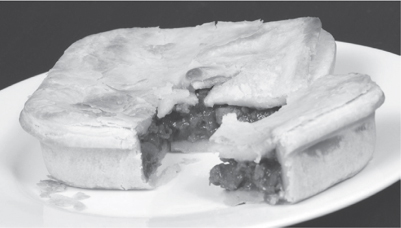
This vegan pie was made with peas, mushrooms, vegan gravy, and mock meat produced from soy protein. Vegans can get most necessary nutrients from a plant-based diet, with the exception of vitamin B-12.
A vegan is a pure vegetarian who chooses to eat a totally plant-based diet, avoiding any food taken from an animal, such as flesh, eggs, or dairy. Veganism is typically motivated by ethical concerns over animal rights or welfare but can also be motivated by health and environmentalism. Ethically motivated vegans often embrace it as a lifestyle rather than just a diet, boycotting all animal products, including clothing and products tested on nonhuman animals. Donald Watson, founder of England's Vegan Society, coined the term vegan in 1944 to differentiate vegans from “ovo-lacto” vegetarians, who will eat nonflesh animal products such as eggs and dairy. Because veganism is stricter, there are fewer vegans than vegetarians. For example, vegans make up no more than 1 percent of North Americans, whereas 2–3 percent of the population is likely to be vegetarian. National percentages for Europeans are similar, but the United Kingdom is an exception, with vegetarianism being twice as popular there. Worldwide statistics on veganism do not exist, but a portion of Buddhists, Hindus, Taoists, and Krishnas worldwide practice some version of vegetarianism, with India possessing the largest concentration of vegetarians—several hundred million—based on class and religious beliefs.
When it comes to ethical and spiritual dilemmas related to animal farming, killing has been the primary contention, which is why so many spiritual principles exist to regulate how and if animals can be slaughtered morally. Before the advent of industrialized animal farming, or “factory farming,” nonfatal animal products such as eggs and dairy were less of an ethical issue. However, modern egg and dairy industries kill the hens and cows who work for them once individual production dies down to less-profitable levels. This results in increased suffering for these animals, more so than for animals raised primarily for meat, as egg-laying hens and dairy cows endure a year or more of intense production in confinement before being killed for low-grade meat.
Hens are typically raised in dark warehouses, where they are confined in cramped, stacked cages. The tips of their beaks are seared off at birth to prevent them from pecking their cage-mates in a futile attempt to establish a pecking order in these crowded conditions. Calcium depletion causes bone fractures, especially during the rough trip from crate to slaughter. Cows used for dairy are increasingly raised on dry lots instead of pastureland. Constantly impregnated to keep their unnaturally engorged udders lactating, they are attached to milking machines several times daily for the majority of their pregnancies. When a mother delivers, she is typically only allowed to nurse her calf for a few days before the farmer separates them, despite the mournful bellowing of both. Male calves are either killed immediately or crated for veal, and female calves become the next generation of dairy producers.
A minor proportion of eggs and dairy come from small, free-range farms that may be more sustainable and humane than factory farms. Welfare proponents may find these products ethically acceptable because they reduce suffering. However, vegans tend to adhere to an animal rights philosophy that goes beyond a concern for suffering toward a concern for the rights of the individual animals to live freely and control their own bodies, eggs, milk, and offspring. This philosophy eschews domestication and breeding animals in captivity for human use and boycotts all animal agriculture products, including clothing such as leather, fur, wool, and silk and by-products such as gelatin, casein, and whey. Depending on strictness, some vegans avoid honey and refined sugars (which use animal bones in processing). Ethically motivated vegans also tend to boycott any products tested on nonhuman animals, primarily cosmetic and cleaning products.
...
- Food Challenges
- Animal Welfare
- Beyond Organic
- Cheap Food Policy
- Crop Genetic Diversity
- DDT
- Debt Crisis
- Disappearing Middle
- Export Dependency
- Famine
- Farm Crisis
- Fast Food
- Food Processing Industry
- Food Safety
- Food Security
- Genetically Modified Organisms
- Grain-Fed Beef
- High Fructose Corn Syrup
- Integrated Pest Management
- Irradiation
- Mad Cow Disease
- Malthusianism
- Mechanization
- Millennium Development Goals
- Modernization
- Nitrogen Fixation
- Organochlorines
- Origin Labeling
- Peasant
- Pesticide
- Productionism
- Proletarianization
- Recombinant Bovine Growth Hormone
- Roundup Ready Crops
- Salmonella
- Sewage Sludge
- Soil Erosion
- Sustainable Agriculture
- Swidden Agriculture
- Weed Management
- Food Economics and Trade
- Food Farm and Industry
- Agrarian Question
- Agrarianism
- Agribusiness
- Agricultural Commodity Programs
- Agricultural Extension
- Agrodiversity
- Agroecology
- Agrofood System (Agrifood)
- Aquaculture
- Biodynamic Agriculture
- Biological Control
- Bt
- Composting
- Confined Animal Feeding Operation
- Contract Farming
- Cooperative
- Corn
- Cover Cropping
- Crop Rotation
- Dairy
- Dioxins
- Factory Farm
- Family Farm
- Fertilizer
- Fruits
- Grazing
- Hunting
- Intercropping
- Irrigation
- Legume Crops
- Low-Input Agriculture
- Meats
- Nanotechnology and Food
- Organic Farming
- Plantation
- Rice
- Salmon
- Seed Industry
- Soil Nutrient Cycling
- Soybeans
- Substitutionism
- Sugarcane
- Urban Agriculture
- Vegetables
- Wheat
- Yeoman Farmer
- Food Laws, Agreements, and Organizations
- Archer Daniels Midland
- California Certified Organic Farmers
- Certified Humane
- Certified Organic
- Codex Alimentarius
- Commons ConAgra
- Department of Agriculture, U.S
- Diamond v. Chakrabarty
- Doha Round, World Trade Organization
- Fair Labor Association
- Fair Trade
- Farm Bill
- Federal Insecticide, Fungicide, and Rodenticide Act
- Food and Agriculture Organization
- Food and Drug Administration
- Food First
- Food Justice Movement
- Food Quality Protection Act
- Food Sovereignty
- Institute for Agriculture and Trade Policy
- International Coffee Agreement
- Land Grant University
- National Organic Program
- North American Free Trade Agreement
- Northeast Organic Farming Association
- Ogallala Aquifer
- Public Law 480, Food Aid
- Sustainable Fisheries Act
- United Farm Workers
- Wal-Mart
- Foods and Lifestyle
- Loading...
Get a 30 day FREE TRIAL
-
 Watch videos from a variety of sources bringing classroom topics to life
 -
Read modern, diverse business cases
-
Explore hundreds of books and reference titles

Read next

More like this
Sage Recommends
We found other relevant content for you on other Sage platforms.
Have you created a personal profile? Login or create a profile so that you can save clips, playlists and searches