
Entry
Reader's guide
Entries A-Z
Subject index
Sugarcane
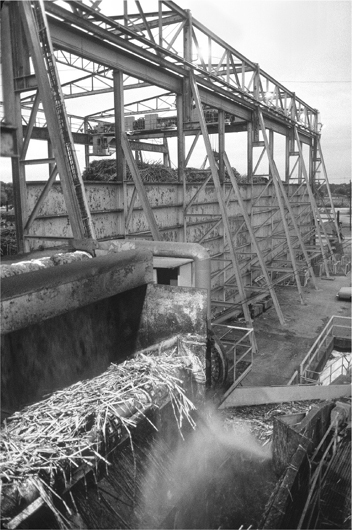
These washed stalks of sugarcane are moving to a mill for processing. Over 1 billion tons of sugarcane are produced every year in Asia and the Americas.
Sugarcane has always been sweet, but its cultivation, usage, and meaning have evolved and expanded over time and space over eight millennia. Sugarcane is a tall, bamboo-like plant that falls under the genus Saccharum, but it is difficult to classify into specific species, as species within the genus easily crossbreed among each other, and species themselves also cross easily with other species in similar genera. Hence there are many species and varieties of sugarcane, although sugar production is generally limited to four specific species or their hybrids. Early hybridization between domesticated and wild sugarcane varieties resulted in two main categories of sugarcane: the “thin” varieties, which favor cooler tropical or subtropical regions, and the “thick” or “noble” varieties, which favor warmer tropical zones. The sugarcane plant itself is made up of a shallow root system, a jointed stalk, and leaves that grow out of the stalk. It is the sucrose stored in the stalk that is harvested for sugar production.
Sugarcane cultivation originated in what is now New Guinea around 8,000 years ago and began to spread into southeast Asia and India about 1000 b.c.e. The Arab conquests of North Africa and Europe were responsible for the spread of the plant cultivar into these regions, first to Egypt and then to the Middle East in the 7th century C.E., finally entering Spain at the beginning of the 8th century. Portuguese colonizers further expanded the reach of sugarcane into the Canary Islands, the Azores, and then into West Africa in the 15th century. From there the plant made its first foray into the Americas, entering what is now the Dominican Republic in 1493. It spread into Central and South America in the mid-16th century and later into the West Indies. The development of the West Indies was centered on sugarcane production until the independence movements in the early 19th century, and production depended on imported African slave labor. As a consequence to the growth of sugar plantations in the new world, sugar developed into a major commodity during the industrial revolution and initiated changes in European and North American diets. Today over one billion tons of sugarcane are produced annually in North and South America, East Asia, and the Indian subcontinent.
Sugarcane's early use in southeast Asia was restricted to chewing, and it was cultivated strictly for this purpose. It is believed that the technique of boiling the cane juices to make solid sugar was not discovered until the 1st century b.c.e. in the Indian subcontinent. Sugar production and its usage as a sweetener were unknown outside south Asia in ancient times, and travelers to the region from Europe, where honey was the only sweetener, would marvel at the vast fields under cultivation. Sugar itself is produced by crushing and extracting the juice from the cane, and then heating and evaporating the clear juice to produce sugar crystals. This raw sugar is then further refined to produce white and other kinds of sugar. Sugarcane juice is consumed as a beverage by itself, or fermented and distilled into rum, Brazilian cachaça, or other cane liquors. Bagasse, the fibrous waste material left over after crushing the cane, is also used as a fuel source in sugar production as well as a source of paper pulp. Sugarcane is moreover used as a source of ethanol—an alcohol fuel made by distilling the cane juices. Ethanol is available as a by-product of hard sugar production, but it is increasingly being produced in dedicated processing plants for fuel production, especially in Brazil.
...
- Food Challenges
- Animal Welfare
- Beyond Organic
- Cheap Food Policy
- Crop Genetic Diversity
- DDT
- Debt Crisis
- Disappearing Middle
- Export Dependency
- Famine
- Farm Crisis
- Fast Food
- Food Processing Industry
- Food Safety
- Food Security
- Genetically Modified Organisms
- Grain-Fed Beef
- High Fructose Corn Syrup
- Integrated Pest Management
- Irradiation
- Mad Cow Disease
- Malthusianism
- Mechanization
- Millennium Development Goals
- Modernization
- Nitrogen Fixation
- Organochlorines
- Origin Labeling
- Peasant
- Pesticide
- Productionism
- Proletarianization
- Recombinant Bovine Growth Hormone
- Roundup Ready Crops
- Salmonella
- Sewage Sludge
- Soil Erosion
- Sustainable Agriculture
- Swidden Agriculture
- Weed Management
- Food Economics and Trade
- Food Farm and Industry
- Agrarian Question
- Agrarianism
- Agribusiness
- Agricultural Commodity Programs
- Agricultural Extension
- Agrodiversity
- Agroecology
- Agrofood System (Agrifood)
- Aquaculture
- Biodynamic Agriculture
- Biological Control
- Bt
- Composting
- Confined Animal Feeding Operation
- Contract Farming
- Cooperative
- Corn
- Cover Cropping
- Crop Rotation
- Dairy
- Dioxins
- Factory Farm
- Family Farm
- Fertilizer
- Fruits
- Grazing
- Hunting
- Intercropping
- Irrigation
- Legume Crops
- Low-Input Agriculture
- Meats
- Nanotechnology and Food
- Organic Farming
- Plantation
- Rice
- Salmon
- Seed Industry
- Soil Nutrient Cycling
- Soybeans
- Substitutionism
- Sugarcane
- Urban Agriculture
- Vegetables
- Wheat
- Yeoman Farmer
- Food Laws, Agreements, and Organizations
- Archer Daniels Midland
- California Certified Organic Farmers
- Certified Humane
- Certified Organic
- Codex Alimentarius
- Commons ConAgra
- Department of Agriculture, U.S
- Diamond v. Chakrabarty
- Doha Round, World Trade Organization
- Fair Labor Association
- Fair Trade
- Farm Bill
- Federal Insecticide, Fungicide, and Rodenticide Act
- Food and Agriculture Organization
- Food and Drug Administration
- Food First
- Food Justice Movement
- Food Quality Protection Act
- Food Sovereignty
- Institute for Agriculture and Trade Policy
- International Coffee Agreement
- Land Grant University
- National Organic Program
- North American Free Trade Agreement
- Northeast Organic Farming Association
- Ogallala Aquifer
- Public Law 480, Food Aid
- Sustainable Fisheries Act
- United Farm Workers
- Wal-Mart
- Foods and Lifestyle
- Loading...
Get a 30 day FREE TRIAL
-
 Watch videos from a variety of sources bringing classroom topics to life
 -
Read modern, diverse business cases
-
Explore hundreds of books and reference titles

Read next

More like this
Sage Recommends
We found other relevant content for you on other Sage platforms.
Have you created a personal profile? Login or create a profile so that you can save clips, playlists and searches