
Entry
Reader's guide
Entries A-Z
Subject index
Soybeans
Soybeans (cultivated variety, Glycine max; wild variety, Glycine soja), are native to Asia and were originally cultivated in north China. Soybeans are one of the world's most important crops because of their high protein content and their high production of edible oil. Along with rice, wheat, barley, and millet, soybeans have been an important part of the Chinese diet for many centuries. They did not arrive in Europe until the 18th century, and the first known report of their cultivation in the Americas was not until the early 19th century. Today, most of the world's soybeans are produced in the Americas, with the United States and Brazil being the leading producers. Soybeans are used to produce a variety of foods for human consumption, but their main use today is the manufacture of feed for livestock and soybean oil. Soybean cultivation in the Brazilian Amazon basin and the manufacture of soy-based biodiesel have been at the center of important debates about conservation, agriculture, and renewable energy since the end of the 20th century.
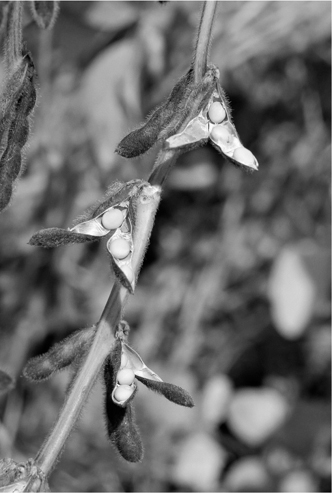
Mature soybeans in the pod. Soybeans are used in a wide variety of foods, but it is their use in livestock feed and for soybean oil that makes them one of the world's most important crops.
The soybean was domesticated by the Chinese by the beginning of the 11th century B.C.E., during the Zhou Dynasty (1100 b.c.e.-256 c.e.), although the domestication process likely began several hundred years earlier, during the Chang Dynasty (ca. 1700–1100 b.c.e.). The earliest depictions of the archaic Chinese character for soybean (shu) can be found throughout the Book of Odes, a collection of Chinese poems written between the 11th century and the 7th century b.c.e. Though there is no explicit mention of the cultivation of soybeans in this book, scholars have interpreted these first depictions as evidence of domestication, because of the somewhat intimate knowledge of the soybean that the authors of the book must have had to create the pictograph for the soybean. The first specific reference to cultivated soybeans was not until 644 b.c.e., when it was recorded that the Shan-Jung tribe paid a tribute to the House of Zhou with soybeans. By the 1st century c.e., the soybean had spread to other parts of China as well as to the Korean Peninsula, closely mirroring the spread, rise, and fall of ancient Chinese dynasties. Soybean cultivation began to take off in Japan and southeast and central Asia starting in the 1st century c.e. The spread of soybeans throughout Asia was closely related to the establishment of land and sea trade routes, including the Silk Road.
Soybeans first arrived in Europe by way of the Netherlands and France in the middle of the 18th century. They were introduced in the United States by the turn of the 19th century. The first seeds were likely sent from France to the Philadelphia Society for Promoting Agriculture by the U.S. ambassador to France, Benjamin Franklin, who established a seed exchange program between the two countries during his ambassadorship in the late 18th century. The first specific mention of soybeans in U.S. literature was an 1804 recommendation for their cultivation in Pennsylvania from the president of the Philadelphia Society for Promoting Agriculture. The soybean is known to have arrived in South America by 1882.
...
- Food Challenges
- Animal Welfare
- Beyond Organic
- Cheap Food Policy
- Crop Genetic Diversity
- DDT
- Debt Crisis
- Disappearing Middle
- Export Dependency
- Famine
- Farm Crisis
- Fast Food
- Food Processing Industry
- Food Safety
- Food Security
- Genetically Modified Organisms
- Grain-Fed Beef
- High Fructose Corn Syrup
- Integrated Pest Management
- Irradiation
- Mad Cow Disease
- Malthusianism
- Mechanization
- Millennium Development Goals
- Modernization
- Nitrogen Fixation
- Organochlorines
- Origin Labeling
- Peasant
- Pesticide
- Productionism
- Proletarianization
- Recombinant Bovine Growth Hormone
- Roundup Ready Crops
- Salmonella
- Sewage Sludge
- Soil Erosion
- Sustainable Agriculture
- Swidden Agriculture
- Weed Management
- Food Economics and Trade
- Food Farm and Industry
- Agrarian Question
- Agrarianism
- Agribusiness
- Agricultural Commodity Programs
- Agricultural Extension
- Agrodiversity
- Agroecology
- Agrofood System (Agrifood)
- Aquaculture
- Biodynamic Agriculture
- Biological Control
- Bt
- Composting
- Confined Animal Feeding Operation
- Contract Farming
- Cooperative
- Corn
- Cover Cropping
- Crop Rotation
- Dairy
- Dioxins
- Factory Farm
- Family Farm
- Fertilizer
- Fruits
- Grazing
- Hunting
- Intercropping
- Irrigation
- Legume Crops
- Low-Input Agriculture
- Meats
- Nanotechnology and Food
- Organic Farming
- Plantation
- Rice
- Salmon
- Seed Industry
- Soil Nutrient Cycling
- Soybeans
- Substitutionism
- Sugarcane
- Urban Agriculture
- Vegetables
- Wheat
- Yeoman Farmer
- Food Laws, Agreements, and Organizations
- Archer Daniels Midland
- California Certified Organic Farmers
- Certified Humane
- Certified Organic
- Codex Alimentarius
- Commons ConAgra
- Department of Agriculture, U.S
- Diamond v. Chakrabarty
- Doha Round, World Trade Organization
- Fair Labor Association
- Fair Trade
- Farm Bill
- Federal Insecticide, Fungicide, and Rodenticide Act
- Food and Agriculture Organization
- Food and Drug Administration
- Food First
- Food Justice Movement
- Food Quality Protection Act
- Food Sovereignty
- Institute for Agriculture and Trade Policy
- International Coffee Agreement
- Land Grant University
- National Organic Program
- North American Free Trade Agreement
- Northeast Organic Farming Association
- Ogallala Aquifer
- Public Law 480, Food Aid
- Sustainable Fisheries Act
- United Farm Workers
- Wal-Mart
- Foods and Lifestyle
- Loading...
Get a 30 day FREE TRIAL
-
 Watch videos from a variety of sources bringing classroom topics to life
 -
Read modern, diverse business cases
-
Explore hundreds of books and reference titles

Read next

More like this
Sage Recommends
We found other relevant content for you on other Sage platforms.
Have you created a personal profile? Login or create a profile so that you can save clips, playlists and searches