
Entry
Reader's guide
Entries A-Z
Subject index
Soil Erosion
Soil erosion caused by wind and water is the most destructive phenomenon worldwide because it is like a slow death. Civilizations have been lost as a result of the scourge of soil erosion. Barren hills in central India, parts of Greece, Lebanon, and Syria are some of the civilizations lost because of washed-away deep and productive topsoil, a result of ignorance or mismanagement of soil. Soil erosion is a major environmental concern in industrialized nations, as well as in developing countries. A good-quality (fertile) soil is essential to meet the objectives of attaining self-sufficiency in food and keeping the food price low. Excessive soil erosion is responsible for topsoil loss and subsequent decrease in agricultural production. According to a study conducted by R. Morgan (1986), the rate of soil erosion in developing and developed countries is at an alarming level—more than the allowable limit of around 5 tons/hectare/year. Countries like the United Kingdom, the United States, and Belgium have succeeded in arresting the soil loss close to the allowable limit, but soil loss from cultivated and bare land is still very high in all the countries of the world. The soil erosion rate is higher in the developing countries, where the farmers are less engaged in soil conservation programs and practices.
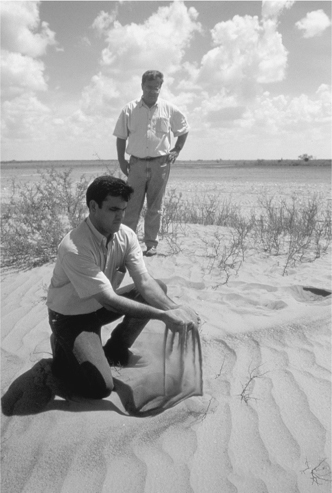
This scientist with the U.S. Department of Agriculture Agricultural Research Service (standing) consults with a farmer in the Lower Rio Grande Valley who demonstrates the effects of severe wind erosion on his land.
Soil erosion is a natural phenomenon of detachment and transportation of soil particles by natural agents like water, snow, or wind. Not only does it reduce productivity, but it also has much more destructive effects such as siltation in reservoirs; deposition of infertile materials on good land; harmful effects on water supply, fishing, and power generation; and above all, increased flood potential of rivers. However, soil erosion has become more ominous since 1960. The burgeoning world population is responsible for this because farmers of the world are now desperate to grow double or triple the amount of food they once grew, using intensified cultivation. They achieve this by expanding the land for cultivation by clearing forests and other bushy areas, plowing grasslands, and performing slash-and-burn culture on mountain or hill slopes. Incessant population growth is paving the way for overgrazing of rangelands and overexploiting timber resources. Thus, more and more land is becoming devoid of natural vegetation, making it an excellent medium for soil erosion reduction. This is a downward cycle of deterioration. The soil erosion process accelerates as a result of such land degradation, and food production diminishes; as a consequence, people become desperate to grow more food, clear more forested land, and cultivate grasslands, indirectly encouraging overgrazing by cattle.
There are two types of soil erosion—geological erosion and accelerated or man-made erosion. Canyons, buttes, rounded hills, river valleys, deltas, plains, and pediments are examples of geologic erosion. Accelerated erosion is the consequence of livestock overgrazing, forest clearing for agriculture, hillside plowing, and creating impervious surfaces like roads and buildings by tearing up pervious land cover. Accelerated erosion is 10 to 1,000 times as destructive as geologic erosion.
...
- Food Challenges
- Animal Welfare
- Beyond Organic
- Cheap Food Policy
- Crop Genetic Diversity
- DDT
- Debt Crisis
- Disappearing Middle
- Export Dependency
- Famine
- Farm Crisis
- Fast Food
- Food Processing Industry
- Food Safety
- Food Security
- Genetically Modified Organisms
- Grain-Fed Beef
- High Fructose Corn Syrup
- Integrated Pest Management
- Irradiation
- Mad Cow Disease
- Malthusianism
- Mechanization
- Millennium Development Goals
- Modernization
- Nitrogen Fixation
- Organochlorines
- Origin Labeling
- Peasant
- Pesticide
- Productionism
- Proletarianization
- Recombinant Bovine Growth Hormone
- Roundup Ready Crops
- Salmonella
- Sewage Sludge
- Soil Erosion
- Sustainable Agriculture
- Swidden Agriculture
- Weed Management
- Food Economics and Trade
- Food Farm and Industry
- Agrarian Question
- Agrarianism
- Agribusiness
- Agricultural Commodity Programs
- Agricultural Extension
- Agrodiversity
- Agroecology
- Agrofood System (Agrifood)
- Aquaculture
- Biodynamic Agriculture
- Biological Control
- Bt
- Composting
- Confined Animal Feeding Operation
- Contract Farming
- Cooperative
- Corn
- Cover Cropping
- Crop Rotation
- Dairy
- Dioxins
- Factory Farm
- Family Farm
- Fertilizer
- Fruits
- Grazing
- Hunting
- Intercropping
- Irrigation
- Legume Crops
- Low-Input Agriculture
- Meats
- Nanotechnology and Food
- Organic Farming
- Plantation
- Rice
- Salmon
- Seed Industry
- Soil Nutrient Cycling
- Soybeans
- Substitutionism
- Sugarcane
- Urban Agriculture
- Vegetables
- Wheat
- Yeoman Farmer
- Food Laws, Agreements, and Organizations
- Archer Daniels Midland
- California Certified Organic Farmers
- Certified Humane
- Certified Organic
- Codex Alimentarius
- Commons ConAgra
- Department of Agriculture, U.S
- Diamond v. Chakrabarty
- Doha Round, World Trade Organization
- Fair Labor Association
- Fair Trade
- Farm Bill
- Federal Insecticide, Fungicide, and Rodenticide Act
- Food and Agriculture Organization
- Food and Drug Administration
- Food First
- Food Justice Movement
- Food Quality Protection Act
- Food Sovereignty
- Institute for Agriculture and Trade Policy
- International Coffee Agreement
- Land Grant University
- National Organic Program
- North American Free Trade Agreement
- Northeast Organic Farming Association
- Ogallala Aquifer
- Public Law 480, Food Aid
- Sustainable Fisheries Act
- United Farm Workers
- Wal-Mart
- Foods and Lifestyle
- Loading...
Get a 30 day FREE TRIAL
-
 Watch videos from a variety of sources bringing classroom topics to life
 -
Read modern, diverse business cases
-
Explore hundreds of books and reference titles

Read next

More like this
Sage Recommends
We found other relevant content for you on other Sage platforms.
Have you created a personal profile? Login or create a profile so that you can save clips, playlists and searches