
Entry
Reader's guide
Entries A-Z
Subject index
Salmonella
Salmonella is a one-celled, gramnegative, rod-shaped, microscopic bacteria family containing over 2,300 different strains (also called serotypes). U.S. scientist Daniel E. Salmon's laboratory discovered the first strain, Salmonella choleraesuis, in 1885. Salmonella can live in the intestinal tracts of both humans and animals and can be transmitted through contact with feces and contracted through the consumption of tainted foods. According to the U.S. Centers for Disease Control and Prevention, Salmonella has become the most frequently reported cause of food-borne illness since the early 1990s, with Salmonella enterica serotype typhimurium and Salmonella enterica serotype enteritidis the most frequently reported U.S. strains. Persons infected with Salmonella may develop moderate to severe cases of salmonellosis, with symptoms lasting from four to seven days on average.
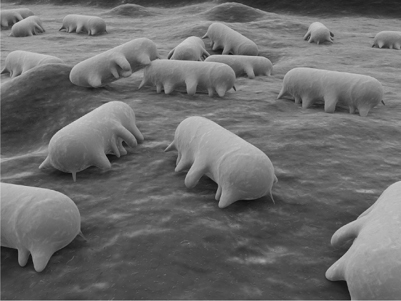
A highly magnified image of Salmonella bacteria reveals their rod-shaped form. Since the early 1990s, Salmonella has been the most common cause of reported food-borne illness, with the most common sources being milk and eggs.
Common symptoms of salmonellosis include diarrhea and abdominal cramps that may be accompanied by nausea, vomiting, fever, chills, or headaches. Dehydration is also a common threat and cause of hospitalization. Most people recover with or without the use of antibiotics, but the disease can be life threatening in certain vulnerable populations, such as infants, children, the elderly, pregnant women, and those whose immune symptoms are already compromised by other illnesses or chronic conditions. A minority of those patients who develop salmonellosis later develop Reiter syndrome—a condition that can cause joint pain resulting in arthritis, eye irritation, and painful urination. Food-borne illnesses such as salmonellosis cost the United States billions of dollars annually for medical expenses related to treatment.
Prevention of Salmonella contamination can occur at all points along the production, distribution, preparation, and consumption process. Prevention is critical because food contaminated with Salmonella cannot be identified by taste, smell, or appearance. The U.S. Department of Agriculture's Food Safety and Inspection Service (FSIS) sets the standards for food processing companies to help ensure the safety of commercial meat, poultry, and egg products. They established industry guidelines in the 1996 Pathogen Reduction/Hazard Analysis and Critical Control Point System. FSIS randomly samples consumer products, testing them in FSIS laboratories for the presence of Salmonella. The U.S. Department of Agriculture has also partnered with the U.S. Food and Drug Administration, the Centers for Disease Control and Prevention, and others to form FoodNet to study the effectiveness of current preventative measures in food production and consumption.
Food safety guidelines for commercial and domestic food preparation are readily available. Food preparers should cook foods to safe internal temperatures, as measured with a food thermometer, and thoroughly wash raw fruits and vegetables. Leftovers should be frozen or refrigerated promptly at proper temperatures and reheated thoroughly; reheated liquids should come to a boil. Frozen food should not be thawed at room temperature. Preparers should also wash their hands and preparation surfaces thoroughly after contact with raw meat or poultry, as remaining juices can transfer present Salmonella to other surfaces or foods in a process known as cross-contamination. Salmonella that may be present can survive the food preparation and cooking process if such safety guidelines are not followed.
...
- Food Challenges
- Animal Welfare
- Beyond Organic
- Cheap Food Policy
- Crop Genetic Diversity
- DDT
- Debt Crisis
- Disappearing Middle
- Export Dependency
- Famine
- Farm Crisis
- Fast Food
- Food Processing Industry
- Food Safety
- Food Security
- Genetically Modified Organisms
- Grain-Fed Beef
- High Fructose Corn Syrup
- Integrated Pest Management
- Irradiation
- Mad Cow Disease
- Malthusianism
- Mechanization
- Millennium Development Goals
- Modernization
- Nitrogen Fixation
- Organochlorines
- Origin Labeling
- Peasant
- Pesticide
- Productionism
- Proletarianization
- Recombinant Bovine Growth Hormone
- Roundup Ready Crops
- Salmonella
- Sewage Sludge
- Soil Erosion
- Sustainable Agriculture
- Swidden Agriculture
- Weed Management
- Food Economics and Trade
- Food Farm and Industry
- Agrarian Question
- Agrarianism
- Agribusiness
- Agricultural Commodity Programs
- Agricultural Extension
- Agrodiversity
- Agroecology
- Agrofood System (Agrifood)
- Aquaculture
- Biodynamic Agriculture
- Biological Control
- Bt
- Composting
- Confined Animal Feeding Operation
- Contract Farming
- Cooperative
- Corn
- Cover Cropping
- Crop Rotation
- Dairy
- Dioxins
- Factory Farm
- Family Farm
- Fertilizer
- Fruits
- Grazing
- Hunting
- Intercropping
- Irrigation
- Legume Crops
- Low-Input Agriculture
- Meats
- Nanotechnology and Food
- Organic Farming
- Plantation
- Rice
- Salmon
- Seed Industry
- Soil Nutrient Cycling
- Soybeans
- Substitutionism
- Sugarcane
- Urban Agriculture
- Vegetables
- Wheat
- Yeoman Farmer
- Food Laws, Agreements, and Organizations
- Archer Daniels Midland
- California Certified Organic Farmers
- Certified Humane
- Certified Organic
- Codex Alimentarius
- Commons ConAgra
- Department of Agriculture, U.S
- Diamond v. Chakrabarty
- Doha Round, World Trade Organization
- Fair Labor Association
- Fair Trade
- Farm Bill
- Federal Insecticide, Fungicide, and Rodenticide Act
- Food and Agriculture Organization
- Food and Drug Administration
- Food First
- Food Justice Movement
- Food Quality Protection Act
- Food Sovereignty
- Institute for Agriculture and Trade Policy
- International Coffee Agreement
- Land Grant University
- National Organic Program
- North American Free Trade Agreement
- Northeast Organic Farming Association
- Ogallala Aquifer
- Public Law 480, Food Aid
- Sustainable Fisheries Act
- United Farm Workers
- Wal-Mart
- Foods and Lifestyle
- Loading...
Get a 30 day FREE TRIAL
-
 Watch videos from a variety of sources bringing classroom topics to life
 -
Read modern, diverse business cases
-
Explore hundreds of books and reference titles

Read next

More like this
Sage Recommends
We found other relevant content for you on other Sage platforms.
Have you created a personal profile? Login or create a profile so that you can save clips, playlists and searches