
Entry
Reader's guide
Entries A-Z
Subject index
Salmon
Salmon are anadromous fish, meaning that they migrate from oceans to freshwater streams to reproduce. There are six distinct species of Pacific salmon and one species of Atlantic salmon. The six Pacific species are: (1) chinook, also known as king, Tyee, and spring; (2) chum, also known as dog and keta; (3) coho, also known as silver; (4) pink, also known as humpie; (5) sockeye, also known as red; and (6) steelhead.
About 1 million metric tons of Atlantic salmon like this are produced every year through aquaculture.
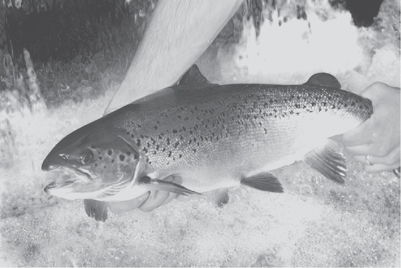
These large, red-fleshed fish are an increasingly important foodstuff for the residents of the United States and the European Union. Over half of this demand is met through the production of a million metric tons of farmed Atlantic salmon annually. Wild salmon are culturally and economically important for Native Americans in the Pacific Northwest, as well as for many relative newcomers to the region. Atlantic salmon were once similarly important to the Northeast, but habitat destruction long ago reduced their prevalence. Salmon can migrate vast distances through the ocean and then return to the location of their birth, often far inland, to spawn. Small numbers of Atlantic salmon still return to the rivers of northeastern United States and Canada, though they are best known to modern food shoppers as farmed salmon, raised in cold oceanic waters around the world. Wild salmon, once prolific along both coasts, have suffered a long and slow demise throughout most of their range.
Salmon farming, an example of aquaculture, typically takes the form of raising hatchery-born Atlantic salmon in floating nets in oceans around the world. Significant producers include northern Europe, Chile, Canada, and the United States. Although salmon aquaculture helps meet the increasing demand for salmon, it introduces a number of environmental problems. For instance, the densely populated nets become breeding grounds for diseases affecting wild salmon, antibiotics used in aquaculture affect other organisms, and vast quantities of fish must be caught to feed to the carnivorous farmed salmon. Also worrisome, some research indicates that farmed salmon contain significant amounts of pollutants and toxins, and therefore may constitute health risks to consumers.
Wild salmon once migrated up the rivers of the Pacific and Atlantic coasts to spawn in great numbers. Historically, salmon “ran,” meaning that they migrated through or reproduced in all accessible streams and rivers from Southern California to northern Alaska. Early European settlers to the Pacific Northwest reported massive runs of salmon. Some chinooks in the Columbia River, known as “June Hogs,” were as large as 70 pounds. Some steelhead and coho migrated inland as far as Nevada. The range of all species has been severely reduced because of a number of factors, and many of the remaining runs are precarious at best. Because salmon are genetically unique in each stream, they are regulated by the Endangered Species Act at the level of “Evolutionarily Significant Units” rather than species or population.
Their complex lifestyle makes salmon vulnerable to diverse threats in multiple political jurisdictions, complicating efforts to protect them. Adults spawn in freshwater, the eggs hatch there, and the young (smolt) stay there for a month to several years, depending on the type of salmon. When ready, the young fish make their way out to sea. Most salmon spend the majority of their lives at sea, where they take advantage of high levels of biological productivity. When they reach sexual maturity, salmon return to the same stream where they were born to reproduce. The salmon returning to a certain stretch of stream only spawn with others that return to that same stream at the same time, leading to the development of genetically distinct stocks adapted to the conditions of their birthing streams.
...
- Food Challenges
- Animal Welfare
- Beyond Organic
- Cheap Food Policy
- Crop Genetic Diversity
- DDT
- Debt Crisis
- Disappearing Middle
- Export Dependency
- Famine
- Farm Crisis
- Fast Food
- Food Processing Industry
- Food Safety
- Food Security
- Genetically Modified Organisms
- Grain-Fed Beef
- High Fructose Corn Syrup
- Integrated Pest Management
- Irradiation
- Mad Cow Disease
- Malthusianism
- Mechanization
- Millennium Development Goals
- Modernization
- Nitrogen Fixation
- Organochlorines
- Origin Labeling
- Peasant
- Pesticide
- Productionism
- Proletarianization
- Recombinant Bovine Growth Hormone
- Roundup Ready Crops
- Salmonella
- Sewage Sludge
- Soil Erosion
- Sustainable Agriculture
- Swidden Agriculture
- Weed Management
- Food Economics and Trade
- Food Farm and Industry
- Agrarian Question
- Agrarianism
- Agribusiness
- Agricultural Commodity Programs
- Agricultural Extension
- Agrodiversity
- Agroecology
- Agrofood System (Agrifood)
- Aquaculture
- Biodynamic Agriculture
- Biological Control
- Bt
- Composting
- Confined Animal Feeding Operation
- Contract Farming
- Cooperative
- Corn
- Cover Cropping
- Crop Rotation
- Dairy
- Dioxins
- Factory Farm
- Family Farm
- Fertilizer
- Fruits
- Grazing
- Hunting
- Intercropping
- Irrigation
- Legume Crops
- Low-Input Agriculture
- Meats
- Nanotechnology and Food
- Organic Farming
- Plantation
- Rice
- Salmon
- Seed Industry
- Soil Nutrient Cycling
- Soybeans
- Substitutionism
- Sugarcane
- Urban Agriculture
- Vegetables
- Wheat
- Yeoman Farmer
- Food Laws, Agreements, and Organizations
- Archer Daniels Midland
- California Certified Organic Farmers
- Certified Humane
- Certified Organic
- Codex Alimentarius
- Commons ConAgra
- Department of Agriculture, U.S
- Diamond v. Chakrabarty
- Doha Round, World Trade Organization
- Fair Labor Association
- Fair Trade
- Farm Bill
- Federal Insecticide, Fungicide, and Rodenticide Act
- Food and Agriculture Organization
- Food and Drug Administration
- Food First
- Food Justice Movement
- Food Quality Protection Act
- Food Sovereignty
- Institute for Agriculture and Trade Policy
- International Coffee Agreement
- Land Grant University
- National Organic Program
- North American Free Trade Agreement
- Northeast Organic Farming Association
- Ogallala Aquifer
- Public Law 480, Food Aid
- Sustainable Fisheries Act
- United Farm Workers
- Wal-Mart
- Foods and Lifestyle
- Loading...
Get a 30 day FREE TRIAL
-
 Watch videos from a variety of sources bringing classroom topics to life
 -
Read modern, diverse business cases
-
Explore hundreds of books and reference titles

Read next

More like this
Sage Recommends
We found other relevant content for you on other Sage platforms.
Have you created a personal profile? Login or create a profile so that you can save clips, playlists and searches