
Entry
Reader's guide
Entries A-Z
Subject index
Rice
The term rice refers to the grain-producing species of grass with narrow leaves that grows about 60 to 180 centimeters tall. There are 20 wild species and two cultivated species of rice. Rice is native to Africa, India, and China. The word rice has Indo-Iranian origins. Rice is a major staple food, and rice production is a major source of income and employment for millions of people in 144 countries worldwide. Rice is a superior source of energy among the cereals. Polished rice, however, has shown vitamin A and mineral deficiencies, causing weak immune systems in children in countries where rice is a major staple food. Parboiled rice, in contrast, is nutritionally superior to polished rice. In south and southeast Asia, rice is cultivated under submerged conditions in paddies. The practice of intensive rice monoculture in Asia has caused problems of waterlogging, salinity buildup, and nutrient depletion. Rice cultivation is one of the most important sources of atmospheric methane. Rice is used in making noodles, infant foods, snack foods, breakfast cereals, and fermented products. Rice straw is an important cattle feed throughout Asia.
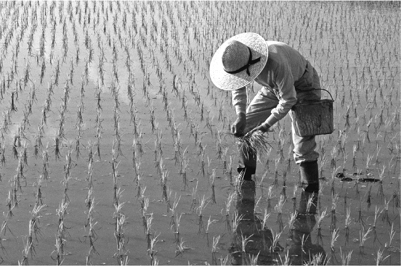
This Japanese farmer is transplanting young rice seedlings into a rice paddy. Rice has been cultivated in Japan since at least l000 B.C.E.
Origin
Rice belongs to the Poaceae or Gramineae family and genus Oryza. The genus Oryza includes 20 wild species and two cultivated species. The wild species are generally found in humid tropics and subtropics. Of the two cultivated species, African rice (Oryza glaberrima) is native and confined to west Africa, whereas Asian rice (Oryza sativa) is commercially grown in all continents. The reason for the parallel evolution of the above two cultigens in Africa and Asia is the origin of genus Oryza in Gondwanaland in the supercontinent Pangaea before it fractured and drifted apart. Oryza‘s origin in Gondwanaland is also confirmed by the presence of closely related wild species of rice in Australia, Central America, and South America. The wild rice species of North America is Zizania palustris. Traditionally, this species was self-propagated and harvested only by Native Americans in the Great Lakes area. Today, it is grown in Minnesota and northern California.
There are two major subspecies in Oryza sativa: the sticky, short-grained japonica (or sinica) variety, and the nonsticky, long-grained indica variety. Japonica is generally cultivated in dry fields in east Asia, whereas indica is mostly cultivated submerged under water in tropical Asia. Although the origin of domestication of Asian rice is still controversial, the scientific consensus concludes that Oryza sativa indica was domesticated in eastern India and japonica in southern China. A recent archaeological study suggests a single domestication of rice in the lowlands of China. The Yangtze was probably the site of the earliest rice cultivation.
China introduced japonica rice to Korea before 1030 B.C.E. Rice cultivation in Japan began in the late Jomon period in about 1000 B.C.E. From the Indian subcontinent and mainland southeast Asia, the indica rice spread to Sri Lanka before 543 B.C.E., to the Malay Archipelago, to the Indonesian islands between 2000 and 1400 B.C.E., and to central and coastal China.
...
- Food Challenges
- Animal Welfare
- Beyond Organic
- Cheap Food Policy
- Crop Genetic Diversity
- DDT
- Debt Crisis
- Disappearing Middle
- Export Dependency
- Famine
- Farm Crisis
- Fast Food
- Food Processing Industry
- Food Safety
- Food Security
- Genetically Modified Organisms
- Grain-Fed Beef
- High Fructose Corn Syrup
- Integrated Pest Management
- Irradiation
- Mad Cow Disease
- Malthusianism
- Mechanization
- Millennium Development Goals
- Modernization
- Nitrogen Fixation
- Organochlorines
- Origin Labeling
- Peasant
- Pesticide
- Productionism
- Proletarianization
- Recombinant Bovine Growth Hormone
- Roundup Ready Crops
- Salmonella
- Sewage Sludge
- Soil Erosion
- Sustainable Agriculture
- Swidden Agriculture
- Weed Management
- Food Economics and Trade
- Food Farm and Industry
- Agrarian Question
- Agrarianism
- Agribusiness
- Agricultural Commodity Programs
- Agricultural Extension
- Agrodiversity
- Agroecology
- Agrofood System (Agrifood)
- Aquaculture
- Biodynamic Agriculture
- Biological Control
- Bt
- Composting
- Confined Animal Feeding Operation
- Contract Farming
- Cooperative
- Corn
- Cover Cropping
- Crop Rotation
- Dairy
- Dioxins
- Factory Farm
- Family Farm
- Fertilizer
- Fruits
- Grazing
- Hunting
- Intercropping
- Irrigation
- Legume Crops
- Low-Input Agriculture
- Meats
- Nanotechnology and Food
- Organic Farming
- Plantation
- Rice
- Salmon
- Seed Industry
- Soil Nutrient Cycling
- Soybeans
- Substitutionism
- Sugarcane
- Urban Agriculture
- Vegetables
- Wheat
- Yeoman Farmer
- Food Laws, Agreements, and Organizations
- Archer Daniels Midland
- California Certified Organic Farmers
- Certified Humane
- Certified Organic
- Codex Alimentarius
- Commons ConAgra
- Department of Agriculture, U.S
- Diamond v. Chakrabarty
- Doha Round, World Trade Organization
- Fair Labor Association
- Fair Trade
- Farm Bill
- Federal Insecticide, Fungicide, and Rodenticide Act
- Food and Agriculture Organization
- Food and Drug Administration
- Food First
- Food Justice Movement
- Food Quality Protection Act
- Food Sovereignty
- Institute for Agriculture and Trade Policy
- International Coffee Agreement
- Land Grant University
- National Organic Program
- North American Free Trade Agreement
- Northeast Organic Farming Association
- Ogallala Aquifer
- Public Law 480, Food Aid
- Sustainable Fisheries Act
- United Farm Workers
- Wal-Mart
- Foods and Lifestyle
- Loading...
Get a 30 day FREE TRIAL
-
 Watch videos from a variety of sources bringing classroom topics to life
 -
Read modern, diverse business cases
-
Explore hundreds of books and reference titles

Read next

More like this
Sage Recommends
We found other relevant content for you on other Sage platforms.
Have you created a personal profile? Login or create a profile so that you can save clips, playlists and searches