
Entry
Reader's guide
Entries A-Z
Subject index
Retail Sector
The food system consists of broad sectors that include production, processing and manufacturing, distribution, and retail. The retail sector is the part of this system that is closest to the consumer. Although processors/manufacturers were once quite powerful, exerting tremendous influence over retailers and consumers, this dynamic is shifting toward greater retailer power. The leading retailers make up a large and increasing percentage of sales for the largest food processors. Wal-Mart, for example, sells more than 10 percent of the products made by Dean Foods, General Mills, Kellogg, Kraft, Campbell's, Tyson, and Pepsi. This gives Wal-Mart the leverage to demand low wholesale prices, as well as exacting packaging and delivery requirements, from its suppliers. Leading retailers are also more effectively encouraging consumers to behave in ways that enhance their profits, using means such as store design and shelf placement. Their increasingly sophisticated marketing strategies also include discounts for customers who use loyalty or rewards cards—these enable the collection of massive amounts of data and highly targeted advertising efforts.
A shopper in Maputo, Mozambique, selecting packaged meat at a supermarket butcher counter in 2002. The supermarket format has spread to much of the world, and Western companies are looking to developing countries for new audiences.
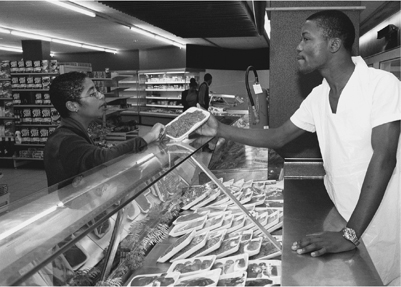
Food retailing was dominated by supermarkets from the 1950s to the 1990s. The supermarket format originated in the United States and is characterized by: (1) a reliance on customers to self-service and line up to check out; (2) a larger store size and higher number of food items (currently 15,000+) than most other formats; (3) low markups from wholesale prices; and (4) high sales volumes (currently $2 million or more annually). Many of these innovations were facilitated by the development of a national highway system and refrigerated trucking, which lessened dependence on railroads and encouraged more self-distribution by retailers. By shipping directly from manufacturers, supermarkets were able to negotiate price discounts based on volume. Until recently, more than 75 percent of food sales in the United States were made through supermarkets and grocery stores, and the average person was estimated to spend 2 percent of their life in these retail outlets.
Supermarkets and grocery stores are facing increasing competition from other retail formats including hypermarkets/supercenters (a combination supermarket and department store, pioneered by the French firm Carrefour in the 1960s), wholesale buying clubs, convenience stores, inexpensive department stores (e.g., dollar stores), and specialty retailers (e.g., natural/organic markets, ethnic markets). They are also affected by a trend of increasing expenditures for food consumed outside the home, particularly at fast food restaurants. The differentiation unfolding in the retail sector reflects a shift from mass production and consumption to a model more highly targeted to particular groups of consumers (based on age, socioeconomic status, ethnicity, or other differences), or even to individuals.
The entrance of Wal-Mart into food retailing has had a dramatic effect on the retail sector. Wal-Mart began selling groceries in a supercenter format in 1988, and in little more than a decade it became the leading food retailer in the United States. The corporation also operates a chain of wholesale buying clubs (Sam's Club) and introduced a chain of smaller-format grocery stores (Wal-Mart Neighborhood Market) in 1998. Wal-Mart's involvement in food retailing helped to trigger a wave of consolidation in the 1990s, particularly in North America and Europe, as other retailers merged or made acquisitions to remain competitive. It is estimated that the top 3 firms control 80 percent of grocery sales in Australia, the top 4 firms control 75 percent of sales in the United Kingdom, the top 5 firms control 50 percent of sales in the United States, and the top 30 firms control 33 percent of sales globally.
...
- Food Challenges
- Animal Welfare
- Beyond Organic
- Cheap Food Policy
- Crop Genetic Diversity
- DDT
- Debt Crisis
- Disappearing Middle
- Export Dependency
- Famine
- Farm Crisis
- Fast Food
- Food Processing Industry
- Food Safety
- Food Security
- Genetically Modified Organisms
- Grain-Fed Beef
- High Fructose Corn Syrup
- Integrated Pest Management
- Irradiation
- Mad Cow Disease
- Malthusianism
- Mechanization
- Millennium Development Goals
- Modernization
- Nitrogen Fixation
- Organochlorines
- Origin Labeling
- Peasant
- Pesticide
- Productionism
- Proletarianization
- Recombinant Bovine Growth Hormone
- Roundup Ready Crops
- Salmonella
- Sewage Sludge
- Soil Erosion
- Sustainable Agriculture
- Swidden Agriculture
- Weed Management
- Food Economics and Trade
- Food Farm and Industry
- Agrarian Question
- Agrarianism
- Agribusiness
- Agricultural Commodity Programs
- Agricultural Extension
- Agrodiversity
- Agroecology
- Agrofood System (Agrifood)
- Aquaculture
- Biodynamic Agriculture
- Biological Control
- Bt
- Composting
- Confined Animal Feeding Operation
- Contract Farming
- Cooperative
- Corn
- Cover Cropping
- Crop Rotation
- Dairy
- Dioxins
- Factory Farm
- Family Farm
- Fertilizer
- Fruits
- Grazing
- Hunting
- Intercropping
- Irrigation
- Legume Crops
- Low-Input Agriculture
- Meats
- Nanotechnology and Food
- Organic Farming
- Plantation
- Rice
- Salmon
- Seed Industry
- Soil Nutrient Cycling
- Soybeans
- Substitutionism
- Sugarcane
- Urban Agriculture
- Vegetables
- Wheat
- Yeoman Farmer
- Food Laws, Agreements, and Organizations
- Archer Daniels Midland
- California Certified Organic Farmers
- Certified Humane
- Certified Organic
- Codex Alimentarius
- Commons ConAgra
- Department of Agriculture, U.S
- Diamond v. Chakrabarty
- Doha Round, World Trade Organization
- Fair Labor Association
- Fair Trade
- Farm Bill
- Federal Insecticide, Fungicide, and Rodenticide Act
- Food and Agriculture Organization
- Food and Drug Administration
- Food First
- Food Justice Movement
- Food Quality Protection Act
- Food Sovereignty
- Institute for Agriculture and Trade Policy
- International Coffee Agreement
- Land Grant University
- National Organic Program
- North American Free Trade Agreement
- Northeast Organic Farming Association
- Ogallala Aquifer
- Public Law 480, Food Aid
- Sustainable Fisheries Act
- United Farm Workers
- Wal-Mart
- Foods and Lifestyle
- Loading...
Get a 30 day FREE TRIAL
-
 Watch videos from a variety of sources bringing classroom topics to life
 -
Read modern, diverse business cases
-
Explore hundreds of books and reference titles

Read next

More like this
Sage Recommends
We found other relevant content for you on other Sage platforms.
Have you created a personal profile? Login or create a profile so that you can save clips, playlists and searches