
Entry
Reader's guide
Entries A-Z
Subject index
Pesticide
A pesticide is a material used for the mitigation, control, or elimination of plants or animals detrimental to human health or economy. Specifically, a pesticide is a chemical—liquid, granule, or gas—used to kill or control pests such as insects, weeds, bacteria, fungi, rodents, and worms. Pesticides play significant roles in increasing food production and eliminating diseases. However, only a few environmental issues have aroused the concern of the public as much as pesticides because exposure to them can be harmful to humans. The ill effects experienced may result from short- or long-term exposure or low- or high-level exposure through dermal absorption, inhalation, and oral ingestion. Frequent application of pesticides has led to the development of resistance to them. Scientists thus face the challenge of developing new environmentally friendly pesticides that overcome the rapid development of resistance by pests. Pesticides can be classified according to chemical class (e.g., organochlorine, carbamate, organophosphorus, and chlorophenoxy compounds) or according to their intended use (e.g., insecticide, herbicide, rodenticide, fungicide, fumigant, and acaricide). Insecticides act by poisoning the nervous system of target harmful insects. They include organochlo-rines, organophosphates, carbamate esters, pyrethroids, and botanical insecticides. Herbicides target weeds and include chlorophenoxy compounds and bipyridyl derivatives. Rodenticides target rodents and include zinc phosphide, fluoroacetic acid and derivatives, Naphthyl Thiourea, and anticoagulants. Fungicides target fungi, and they include hexachlorobenzene, organomercurials, pentachlorophenol, phthalimides, and dithiocarbamates. Examples of fumigants are phosphine, ethylene dibromide, and dibromochloropropane. Acaricides target acarose (a mite).
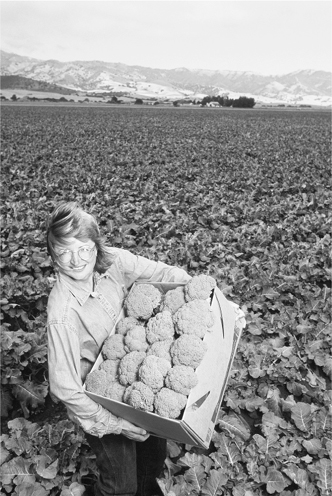
This agronomist is collecting broccoli samples from a test plot in Salinas, California, to test them for pesticide residue.
When a pesticide is introduced into the environment by application, disposal, or spill, it is influenced by many processes. These processes determine a pesticide's persistence, its movement, and its ultimate fate. The fate processes can have both positive and negative influences on a pesticide's effectiveness or its effect on the environment. The fate processes can be beneficial. They can move a pesticide to the target area or destroy its potentially harmful residues. Sometimes they can be detrimental, leading to reduced control of a target pest, injury of nontarget plants and animals, and environmental damage. Different soil and climatic factors and different handling practices can promote or prevent each process. An understanding of the fate processes ensures that applications are not only effective but also environmentally safe. Fate processes could be grouped into four major types: degradation, transfer, adsorption, and bio-accumulation/bio-magnification. These physical and chemical properties of pesticides influence their environmental risk.
Pesticide Degradation
Pesticide degradation refers to the breakdown of pesticides in the environment. The rate at which the degradation occurs is measured by the pesticide's half-life. A pesticide with a long half-life is described as persistent. Persistence is good for long-term pest control, but the pesticide can cause environmental damage over a long period of time. Pesticide degradation is usually beneficial, as pesticide-destroying reactions change most pesticide residues in the environment to nontoxic or harmless compounds. However, degradation is detrimental when a pesticide is destroyed before the target pest has been controlled. The rate of pesticide degradation is affected by many environmental factors including temperature, moisture, and pH. The three types of pesticide degradation are microbial, chemical, and photodegradation.
...
- Food Challenges
- Animal Welfare
- Beyond Organic
- Cheap Food Policy
- Crop Genetic Diversity
- DDT
- Debt Crisis
- Disappearing Middle
- Export Dependency
- Famine
- Farm Crisis
- Fast Food
- Food Processing Industry
- Food Safety
- Food Security
- Genetically Modified Organisms
- Grain-Fed Beef
- High Fructose Corn Syrup
- Integrated Pest Management
- Irradiation
- Mad Cow Disease
- Malthusianism
- Mechanization
- Millennium Development Goals
- Modernization
- Nitrogen Fixation
- Organochlorines
- Origin Labeling
- Peasant
- Pesticide
- Productionism
- Proletarianization
- Recombinant Bovine Growth Hormone
- Roundup Ready Crops
- Salmonella
- Sewage Sludge
- Soil Erosion
- Sustainable Agriculture
- Swidden Agriculture
- Weed Management
- Food Economics and Trade
- Food Farm and Industry
- Agrarian Question
- Agrarianism
- Agribusiness
- Agricultural Commodity Programs
- Agricultural Extension
- Agrodiversity
- Agroecology
- Agrofood System (Agrifood)
- Aquaculture
- Biodynamic Agriculture
- Biological Control
- Bt
- Composting
- Confined Animal Feeding Operation
- Contract Farming
- Cooperative
- Corn
- Cover Cropping
- Crop Rotation
- Dairy
- Dioxins
- Factory Farm
- Family Farm
- Fertilizer
- Fruits
- Grazing
- Hunting
- Intercropping
- Irrigation
- Legume Crops
- Low-Input Agriculture
- Meats
- Nanotechnology and Food
- Organic Farming
- Plantation
- Rice
- Salmon
- Seed Industry
- Soil Nutrient Cycling
- Soybeans
- Substitutionism
- Sugarcane
- Urban Agriculture
- Vegetables
- Wheat
- Yeoman Farmer
- Food Laws, Agreements, and Organizations
- Archer Daniels Midland
- California Certified Organic Farmers
- Certified Humane
- Certified Organic
- Codex Alimentarius
- Commons ConAgra
- Department of Agriculture, U.S
- Diamond v. Chakrabarty
- Doha Round, World Trade Organization
- Fair Labor Association
- Fair Trade
- Farm Bill
- Federal Insecticide, Fungicide, and Rodenticide Act
- Food and Agriculture Organization
- Food and Drug Administration
- Food First
- Food Justice Movement
- Food Quality Protection Act
- Food Sovereignty
- Institute for Agriculture and Trade Policy
- International Coffee Agreement
- Land Grant University
- National Organic Program
- North American Free Trade Agreement
- Northeast Organic Farming Association
- Ogallala Aquifer
- Public Law 480, Food Aid
- Sustainable Fisheries Act
- United Farm Workers
- Wal-Mart
- Foods and Lifestyle
- Loading...
Get a 30 day FREE TRIAL
-
 Watch videos from a variety of sources bringing classroom topics to life
 -
Read modern, diverse business cases
-
Explore hundreds of books and reference titles

Read next

More like this
Sage Recommends
We found other relevant content for you on other Sage platforms.
Have you created a personal profile? Login or create a profile so that you can save clips, playlists and searches