
Entry
Reader's guide
Entries A-Z
Subject index
Organic Farming
Organic farming is a form of sustainable agriculture committed to growing food naturally with respect for ecological systems. Its methods promote diversity and emphasize closed nutrient cycles and healthy soil. Though organic farming is an agricultural science with specific international and domestic regulations, it also encompasses social values and economics. Organic farming is defined in contrast to conventional or high input agriculture, which depends on synthetic, often fossil-fuel-intensive, fertilizers, pesticides, fungicides, and other agrichemicals. Conventional agriculture is generally highly specialized, and monocultures, or farms only growing one crop, are common. Regulations surrounding organic agriculture vary from state to state and country to country, but organic farming generally does not allow genetically modified organisms, irradiation, or, in animal operations, the use of antibiotics or hormones, such as recombinant bovine growth hormone. Organic foods are defined by the U.S. Department of Agriculture (USDA) as food products produced without using most conventional pesticides, fertilizers made with synthetic ingredients or sewage sludge, bioengineering (genetic modification), or ionizing radiation.
History of Organic Farming
The terms sustainable and organic are relatively new, but the practices are not. In fact, organic farming in many respects represents a return to older, unconsciously agroecological land stewardship practices as a response to the introduction of agrochemicals in the early 20th century.
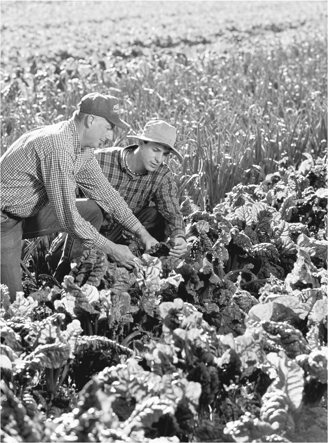
There are an estimated 30,000 organic farms in the United States. This organic farmer in San Juan Bautista, California, is consulting with a horticulturalist (right) about the condition of red chard planted among a variety of crops.
As plants began to be shipped around the world for cultivation and the global trade in food found its feet in the 19th century, diseases and foreign pests became serious problems for growers. Removed from their native habitats, natural checks and balances were dislodged, leaving plants more vulnerable to the ravages of nature's forces. Oranges, for example, are not native to California, and varietal importation has brought in many citrus diseases with no natural predators, such as the deadly cottony cushion scale. Chemical research from government agencies and university institutes offered a seemingly ideal solution to battling such pests: chemical warfare. With chemicals, diseases that lived in the soil could be eradicated, rather than forcing farmers to let the land lie fallow, or without crops, for years. At the same time, farmers, such as California's citrus growers and the cotton plantation owners of the south, began to focus on monoculture (single crop) production for the sake of efficiency. World competition was fierce, and a farmer could make more money by focusing on the tools, markets, and labor needed for only one crop. The result was more or less an ideal breeding ground for pests, with ample food sources and little, if any, predatory dangers. Farmers were more vulnerable than ever to diseases and pests and turned ever more readily to synthetic solutions. Today an estimated 5.6 billion pounds of pesticides are used every year worldwide. In turn, the large-scale use of pesticides, herbicides, and fungicides has created resistance to the chemicals, rendering them useless against certain genetic immunities. There has been a tenfold increase in pesticide use since 1945, and between 1946 and 1948, U.S. production of synthetic fertilizers grew from 800,000 tons to 17 million tons. However, during this same time, crop losses doubled. Internationally, over 250 varieties of plants were estimated to be herbicide-resistant in 2004, with the United States housing the majority of those plants.
...
- Food Challenges
- Animal Welfare
- Beyond Organic
- Cheap Food Policy
- Crop Genetic Diversity
- DDT
- Debt Crisis
- Disappearing Middle
- Export Dependency
- Famine
- Farm Crisis
- Fast Food
- Food Processing Industry
- Food Safety
- Food Security
- Genetically Modified Organisms
- Grain-Fed Beef
- High Fructose Corn Syrup
- Integrated Pest Management
- Irradiation
- Mad Cow Disease
- Malthusianism
- Mechanization
- Millennium Development Goals
- Modernization
- Nitrogen Fixation
- Organochlorines
- Origin Labeling
- Peasant
- Pesticide
- Productionism
- Proletarianization
- Recombinant Bovine Growth Hormone
- Roundup Ready Crops
- Salmonella
- Sewage Sludge
- Soil Erosion
- Sustainable Agriculture
- Swidden Agriculture
- Weed Management
- Food Economics and Trade
- Food Farm and Industry
- Agrarian Question
- Agrarianism
- Agribusiness
- Agricultural Commodity Programs
- Agricultural Extension
- Agrodiversity
- Agroecology
- Agrofood System (Agrifood)
- Aquaculture
- Biodynamic Agriculture
- Biological Control
- Bt
- Composting
- Confined Animal Feeding Operation
- Contract Farming
- Cooperative
- Corn
- Cover Cropping
- Crop Rotation
- Dairy
- Dioxins
- Factory Farm
- Family Farm
- Fertilizer
- Fruits
- Grazing
- Hunting
- Intercropping
- Irrigation
- Legume Crops
- Low-Input Agriculture
- Meats
- Nanotechnology and Food
- Organic Farming
- Plantation
- Rice
- Salmon
- Seed Industry
- Soil Nutrient Cycling
- Soybeans
- Substitutionism
- Sugarcane
- Urban Agriculture
- Vegetables
- Wheat
- Yeoman Farmer
- Food Laws, Agreements, and Organizations
- Archer Daniels Midland
- California Certified Organic Farmers
- Certified Humane
- Certified Organic
- Codex Alimentarius
- Commons ConAgra
- Department of Agriculture, U.S
- Diamond v. Chakrabarty
- Doha Round, World Trade Organization
- Fair Labor Association
- Fair Trade
- Farm Bill
- Federal Insecticide, Fungicide, and Rodenticide Act
- Food and Agriculture Organization
- Food and Drug Administration
- Food First
- Food Justice Movement
- Food Quality Protection Act
- Food Sovereignty
- Institute for Agriculture and Trade Policy
- International Coffee Agreement
- Land Grant University
- National Organic Program
- North American Free Trade Agreement
- Northeast Organic Farming Association
- Ogallala Aquifer
- Public Law 480, Food Aid
- Sustainable Fisheries Act
- United Farm Workers
- Wal-Mart
- Foods and Lifestyle
- Loading...
Get a 30 day FREE TRIAL
-
 Watch videos from a variety of sources bringing classroom topics to life
 -
Read modern, diverse business cases
-
Explore hundreds of books and reference titles

Read next

More like this
Sage Recommends
We found other relevant content for you on other Sage platforms.
Have you created a personal profile? Login or create a profile so that you can save clips, playlists and searches