
Entry
Reader's guide
Entries A-Z
Subject index
Nitrogen Fixation
The process of nitrogen fixation involves taking nitrogen in its molecular form (N2) and converting it into nitrogen compounds that help produce proteins. It was originally wholly a natural process, but chemicals are now used to engineer nitrogen fixation artificially. It is therefore the use of those chemicals on plants that differentiates between vegetables that are “green” and those that are not.
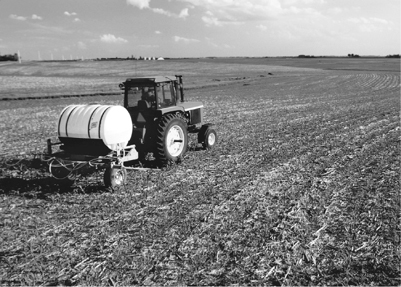
At this farm in Hardin County, Iowa, in 1999, nitrogen was applied to cornfields in small doses during the season, rather than in one large dose, to avoid having excesses that might contaminate water supplies.
This process was discovered by the French agricultural chemist Jean Baptiste Joseph Dieudonné Boussingault (1802–87), who was born in Paris but spent the period until 1832 serving in the South American wars of independence, and then remained in the region, where he became increasingly interested in science and agriculture. As professor of chemistry at Lyons and then professor of agriculture at the Conservatoire des Arts et Métiers in Paris from 1839 until his death, Boussingault was able to show that the growing of legumes was made easier by fixing the level of atmospheric nitrogen. This was a major advance in microbiology that led to his being able to demonstrate that green plants absorb carbon dioxide. However, it was his experiment on nitrogen that encouraged the growth of leaves and stems, which is especially important in vegetables that are grown for their leaves, such as lettuce, cabbage, and Brussels sprouts. It also was shown by experimentation that a lack of nitrogen caused the plants to have stunted growth. Later, Martinus Beijerinck (1851–1931), a Dutch microbiologist who established the Delft School of Microbiology, was able to add to Boussingault's discovery. The German chemist Justus von Liebig (1803–83) had already discovered that ammonium was beneficial to plants, and Beijerinck expanded this knowledge further by uncovering the fact that bacteria in the root nodules of certain leguminous plants perform nitrogen fixation naturally, which helps not only the growth of legumes but also the fertility of the soil over many years. His task, and that of later scientists, therefore, was the creation of artificial methods of increasing nitrogen fixation, which was expected to increase crop yields.
Obviously, as a natural process, nitrogen fixation in itself has been important in the growing of vegetables, but it was not long before chemical nitrogen fixation agents were used to help increase crop yields (and also occasionally in explosives through “fertilizer bombs”). This practice increased rapidly throughout the 20th century, and the largest source of fixed nitrogen in the Earth's ecosystem is now from the production of artificial fertilizers. This alone has major implications, because of the energy used to produce the chemicals, and for the entire ecosystems where it is used; this is why the debate dealing with “green food” is so important.
The making of artificial fertilizers to help with nitrogen fixation requires very high pressure, at about 200 atm, and also a temperature of at least 400 degrees C (752 degrees F) to establish what is known as the Haber Process (or the Haber-Bosch Process), which was invented by the German scientist and 1918 Nobel laureate Fritz Haber. The vast use of energy used in the manufacture of such fertilizers on such a wide scale has obvious implications for global warming, but the major concern is over the use of the fertilizer, especially its frequent overuse.
...
- Food Challenges
- Animal Welfare
- Beyond Organic
- Cheap Food Policy
- Crop Genetic Diversity
- DDT
- Debt Crisis
- Disappearing Middle
- Export Dependency
- Famine
- Farm Crisis
- Fast Food
- Food Processing Industry
- Food Safety
- Food Security
- Genetically Modified Organisms
- Grain-Fed Beef
- High Fructose Corn Syrup
- Integrated Pest Management
- Irradiation
- Mad Cow Disease
- Malthusianism
- Mechanization
- Millennium Development Goals
- Modernization
- Nitrogen Fixation
- Organochlorines
- Origin Labeling
- Peasant
- Pesticide
- Productionism
- Proletarianization
- Recombinant Bovine Growth Hormone
- Roundup Ready Crops
- Salmonella
- Sewage Sludge
- Soil Erosion
- Sustainable Agriculture
- Swidden Agriculture
- Weed Management
- Food Economics and Trade
- Food Farm and Industry
- Agrarian Question
- Agrarianism
- Agribusiness
- Agricultural Commodity Programs
- Agricultural Extension
- Agrodiversity
- Agroecology
- Agrofood System (Agrifood)
- Aquaculture
- Biodynamic Agriculture
- Biological Control
- Bt
- Composting
- Confined Animal Feeding Operation
- Contract Farming
- Cooperative
- Corn
- Cover Cropping
- Crop Rotation
- Dairy
- Dioxins
- Factory Farm
- Family Farm
- Fertilizer
- Fruits
- Grazing
- Hunting
- Intercropping
- Irrigation
- Legume Crops
- Low-Input Agriculture
- Meats
- Nanotechnology and Food
- Organic Farming
- Plantation
- Rice
- Salmon
- Seed Industry
- Soil Nutrient Cycling
- Soybeans
- Substitutionism
- Sugarcane
- Urban Agriculture
- Vegetables
- Wheat
- Yeoman Farmer
- Food Laws, Agreements, and Organizations
- Archer Daniels Midland
- California Certified Organic Farmers
- Certified Humane
- Certified Organic
- Codex Alimentarius
- Commons ConAgra
- Department of Agriculture, U.S
- Diamond v. Chakrabarty
- Doha Round, World Trade Organization
- Fair Labor Association
- Fair Trade
- Farm Bill
- Federal Insecticide, Fungicide, and Rodenticide Act
- Food and Agriculture Organization
- Food and Drug Administration
- Food First
- Food Justice Movement
- Food Quality Protection Act
- Food Sovereignty
- Institute for Agriculture and Trade Policy
- International Coffee Agreement
- Land Grant University
- National Organic Program
- North American Free Trade Agreement
- Northeast Organic Farming Association
- Ogallala Aquifer
- Public Law 480, Food Aid
- Sustainable Fisheries Act
- United Farm Workers
- Wal-Mart
- Foods and Lifestyle
- Loading...
Get a 30 day FREE TRIAL
-
 Watch videos from a variety of sources bringing classroom topics to life
 -
Read modern, diverse business cases
-
Explore hundreds of books and reference titles

Read next

More like this
Sage Recommends
We found other relevant content for you on other Sage platforms.
Have you created a personal profile? Login or create a profile so that you can save clips, playlists and searches