
Entry
Reader's guide
Entries A-Z
Subject index
Meats
Meat production has increased consistently in the last decades through organizational innovations and better technology, despite sporadic high-profile outbreaks of diseases such as bovine spongiform encephalopathy, avian flu, and foot and mouth disease. The growing purchasing power of consumers from developing regions has also boosted the demand for meat. Though the livestock industry is not of the largest economic sectors globally, its social, political, and economic significance cannot be underestimated. The livestock industry accounts for 40 percent of agricultural gross domestic product, creates livelihoods for 1 billion people worldwide, and provides one-third of our protein intake. The sector is touted as a remedy for global undernourishment and also is paradoxically blamed for the rise in obesity rates as well. These realities make the meat sector a rich terrain for analysis—one that a cross-disciplinary group of researchers, hailing from sociology, agricultural economic, and developmental studies, have long undertaken. The question of meats is often drawn into broader debates over culture, economy, society, health, and environmental safety, with politics playing a particularly important role. Pertinent issues in the discussion of meats include the following:
- the cultural and religious dimensions of meat consumption,
- the changing systems of production of meat,
- the politics of meat production and consumption,
- the environmental impacts of the production of meat, and
- nonconventional meat production.
The Cultural and Religious Dimensions of Meat Consumption
Cultural preferences and religious restrictions have always been important considerations in the consumption of meats. For example, the most systematic and codified of all food taboos are the Islamic halal and the Jewish kosher dietary laws. Of all the restrictions in their diets, the avoidance of pork is perhaps the most well-known. Hindus are also noted for their general avoidance of meat consumption and their specific avoidance of beef. The latter is directly related to their belief that the cow is a sacred animal. Much research has been attempted to explain the roots of such religious prohibition of meats.
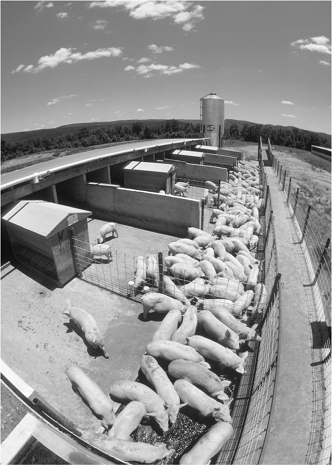
Pigs near the finishing stage on an Arkansas farm in 1983. Contract farming has meant that the percentage of pigs that are raised in a single location dropped to just over 20 percent in 2004.
Cultural or regional variations in the consumption of meats are also prevalent in many parts of the world. For example, in the American South, niche meat types like alligator are more commonly eaten than in other parts of the country. At the extreme, horse, whale, and dog meat (considered taboo by many cultures) are consumed as delicacies by groups of people around the world. The intense affinity toward certain types of animals has compelled many to launch protests and campaigns against the consumption of meats like dogs and cats by other cultures. Nonetheless, even at such aggregate societal levels, tastes and perception toward meat do change. For example, as noted earlier, India, a country that is historically averse to meat consumption, has seen steady growth in the demand for meat. Religious and cultural norms have also shaped the production of meat in very specific ways. The slaughtering of animals in Islamic and Jewish traditions has to adhere strictly to a prescribed set of rituals and regulations.
...
- Food Challenges
- Animal Welfare
- Beyond Organic
- Cheap Food Policy
- Crop Genetic Diversity
- DDT
- Debt Crisis
- Disappearing Middle
- Export Dependency
- Famine
- Farm Crisis
- Fast Food
- Food Processing Industry
- Food Safety
- Food Security
- Genetically Modified Organisms
- Grain-Fed Beef
- High Fructose Corn Syrup
- Integrated Pest Management
- Irradiation
- Mad Cow Disease
- Malthusianism
- Mechanization
- Millennium Development Goals
- Modernization
- Nitrogen Fixation
- Organochlorines
- Origin Labeling
- Peasant
- Pesticide
- Productionism
- Proletarianization
- Recombinant Bovine Growth Hormone
- Roundup Ready Crops
- Salmonella
- Sewage Sludge
- Soil Erosion
- Sustainable Agriculture
- Swidden Agriculture
- Weed Management
- Food Economics and Trade
- Food Farm and Industry
- Agrarian Question
- Agrarianism
- Agribusiness
- Agricultural Commodity Programs
- Agricultural Extension
- Agrodiversity
- Agroecology
- Agrofood System (Agrifood)
- Aquaculture
- Biodynamic Agriculture
- Biological Control
- Bt
- Composting
- Confined Animal Feeding Operation
- Contract Farming
- Cooperative
- Corn
- Cover Cropping
- Crop Rotation
- Dairy
- Dioxins
- Factory Farm
- Family Farm
- Fertilizer
- Fruits
- Grazing
- Hunting
- Intercropping
- Irrigation
- Legume Crops
- Low-Input Agriculture
- Meats
- Nanotechnology and Food
- Organic Farming
- Plantation
- Rice
- Salmon
- Seed Industry
- Soil Nutrient Cycling
- Soybeans
- Substitutionism
- Sugarcane
- Urban Agriculture
- Vegetables
- Wheat
- Yeoman Farmer
- Food Laws, Agreements, and Organizations
- Archer Daniels Midland
- California Certified Organic Farmers
- Certified Humane
- Certified Organic
- Codex Alimentarius
- Commons ConAgra
- Department of Agriculture, U.S
- Diamond v. Chakrabarty
- Doha Round, World Trade Organization
- Fair Labor Association
- Fair Trade
- Farm Bill
- Federal Insecticide, Fungicide, and Rodenticide Act
- Food and Agriculture Organization
- Food and Drug Administration
- Food First
- Food Justice Movement
- Food Quality Protection Act
- Food Sovereignty
- Institute for Agriculture and Trade Policy
- International Coffee Agreement
- Land Grant University
- National Organic Program
- North American Free Trade Agreement
- Northeast Organic Farming Association
- Ogallala Aquifer
- Public Law 480, Food Aid
- Sustainable Fisheries Act
- United Farm Workers
- Wal-Mart
- Foods and Lifestyle
- Loading...
Get a 30 day FREE TRIAL
-
 Watch videos from a variety of sources bringing classroom topics to life
 -
Read modern, diverse business cases
-
Explore hundreds of books and reference titles

Read next

More like this
Sage Recommends
We found other relevant content for you on other Sage platforms.
Have you created a personal profile? Login or create a profile so that you can save clips, playlists and searches